Enochian chess solo is the simplest way into a game that was built for four players. You take a single seat and command one element, and the computer runs the other three armies for you: your ally cooperates on your side, and the two enemy armies work together against you. Nobody needs to be free on a weeknight, and nothing has to be scheduled. You sit down, pick your strength, and play a full four-handed game by yourself, at your own pace.
What solo play means here
The historic game seats four people, one at each corner of the board, each holding one element. That is beautiful and almost impossible to arrange on short notice. Solo play keeps the full four-army game intact and simply hands the other three seats to the machine. You still play a real game with all its structure: two alliances of two, Water and Earth on the receptive side, Air and Fire on the active side, locked into teams that never change. The difference is that three of the four hands belong to the computer, and only one belongs to you.
You command one element, your ally helps
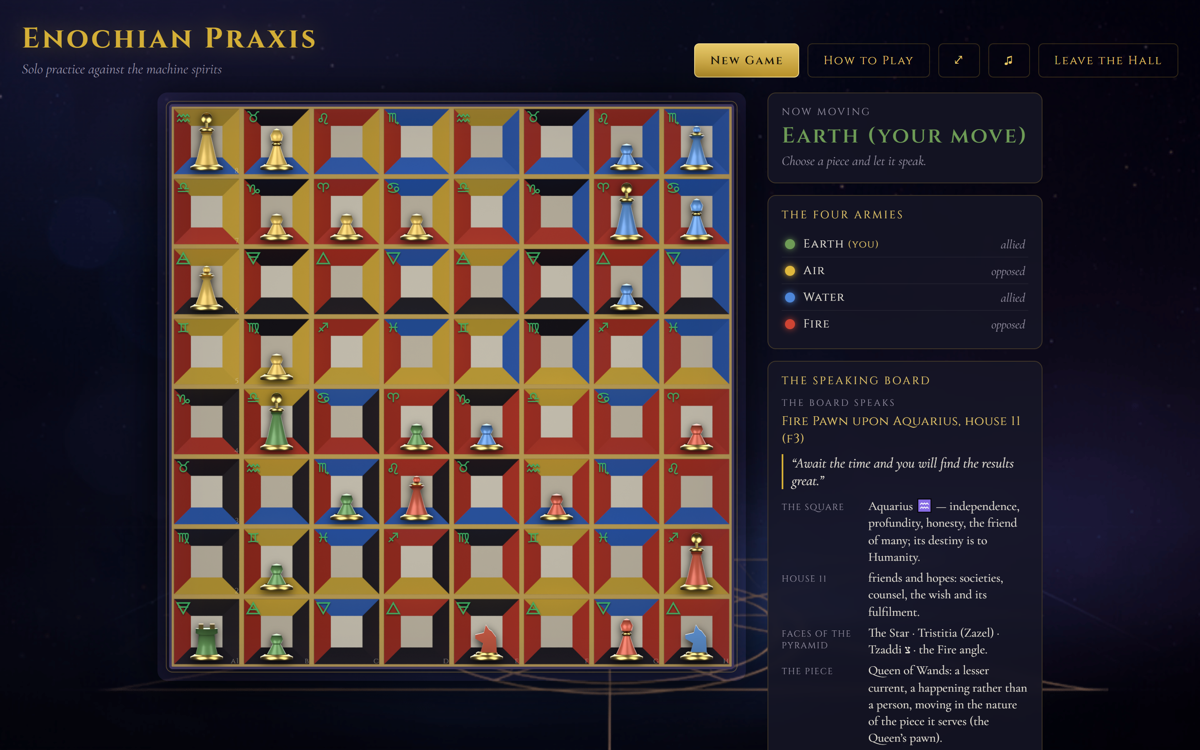
When you start a solo game you take one army and its element. The partner sitting on your side is played by the computer, and it is genuinely on your team. You cannot capture your ally, you win and lose together, and the machine will try to support your position rather than compete with it. Across the board sit the two opposing armies, also run by the computer, and they coordinate against your pair. So a solo game is never you against one flat opponent. It is your side of two against their side of two, with you steering half of your own alliance and the computer steering the rest.
Three levels of strength: Novice, Adept, Magus
Before the pieces move you choose how hard the other three hands will play. There are three settings.
Novice is where almost everyone should begin. The opposing armies play plainly, they take obvious captures and defend obvious threats, and they give you room to make mistakes and learn from them. This is the level for your first dozen games while the movements are still settling in.
Adept tightens things up. The enemy pair coordinates better, punishes loose pieces, and makes you earn your captures. Move here once Novice starts to feel comfortable and you want a real fight.
Magus is the deep end. The opposition plays sharply, looks further ahead, and pressures both of your Kings at once. Save it for when you know the board well and want to be genuinely tested.
How winning works, so you know what to aim for
Solo play uses the full rules, so it is worth knowing the shape of a win before you start. There is no checkmate in Enochian chess. You win by capturing the enemy Kings outright, and because two armies oppose you, your side wins only when both of their Kings have fallen. When a King is taken, that army does not vanish: it freezes in place, its pieces holding their squares as inert terrain that still blocks lines. A frozen army can even be roused again if a partner reaches its throne. Playing solo lets you feel this rhythm at your own speed, without a table of people waiting on your next move.
How to learn fastest on your own
Solo is the fastest teacher because you can slow everything down. A few habits help. Start on Novice and stay there until captures and defenses feel automatic. Pay early attention to the Queen, who leaps exactly two squares in any direction and jumps whatever stands between, since chess players almost always misread her at first. Watch what your computer ally does on its turn, because its choices quietly model good coordination for the receptive or active side you share. And when a game ends, replay the moment it turned. Because you set the pace, you can sit with a position as long as you like instead of rushing to keep three other people entertained.
Autosave means you can walk away
Solo games save themselves as you go. If you close the tab, lose your connection, or simply need to stop mid-game, the position is kept and waiting when you return. Nothing punishes you for stepping away in the middle of a long game against Magus. You can think about a hard position overnight and pick it up exactly where you left it, which is another reason solo suits learning: there is no clock and no pressure to finish in one sitting.
Why solo is the best on-ramp before online
Playing against the computer first makes online play far more enjoyable later. Against three live people, a shaky grasp of the Queen's leap or the frozen-army rule slows the whole table down. Solo lets you make those mistakes privately, as often as you need, with no one waiting. By the time you sit down for a live four-handed game you already know how alliances share a win, how King captures decide it, and how the board tends to flow. Solo builds the fluency; online play is where you spend it.
Take a seat right now
You have read how it works. The fastest way to understand it is to make a few moves. Start a free solo game, pick Novice, and command your first element.
Play NowKeep reading
Want the fuller picture before your first game? Learn the complete rules, meet the pieces including that leaping Queen, and see how the same board works as a divination.