Enochian chess for beginners is far less daunting than the name suggests. If you have ever moved a knight or castled a king, you already own most of the skills you need. The board is the familiar eight-by-eight grid, the pieces have the same names, and they mostly move the way you expect. What follows is a calm introduction to the handful of things that are genuinely new, plus a simple, low-pressure plan for playing your first solo game against the computer. Take it one idea at a time and it clicks quickly.
What to expect your first game
Nobody plays a perfect first game, and you are not supposed to. Your goal is not to win but to feel how the pieces move and to notice the moments where this game surprises you. Set the pressure aside. Move a piece, watch what happens, and let your hands learn the shapes. In Enochian Praxis you can start a solo game in seconds, so there is no setup to fuss over and no opponent waiting on you. Treat the first sitting as a friendly tour, not an exam.
You will see four small armies rather than the two you are used to, each dressed in the color of an element. That single fact reshapes almost everything else, so it is the natural place to begin.
Surprise one: four armies in two alliances
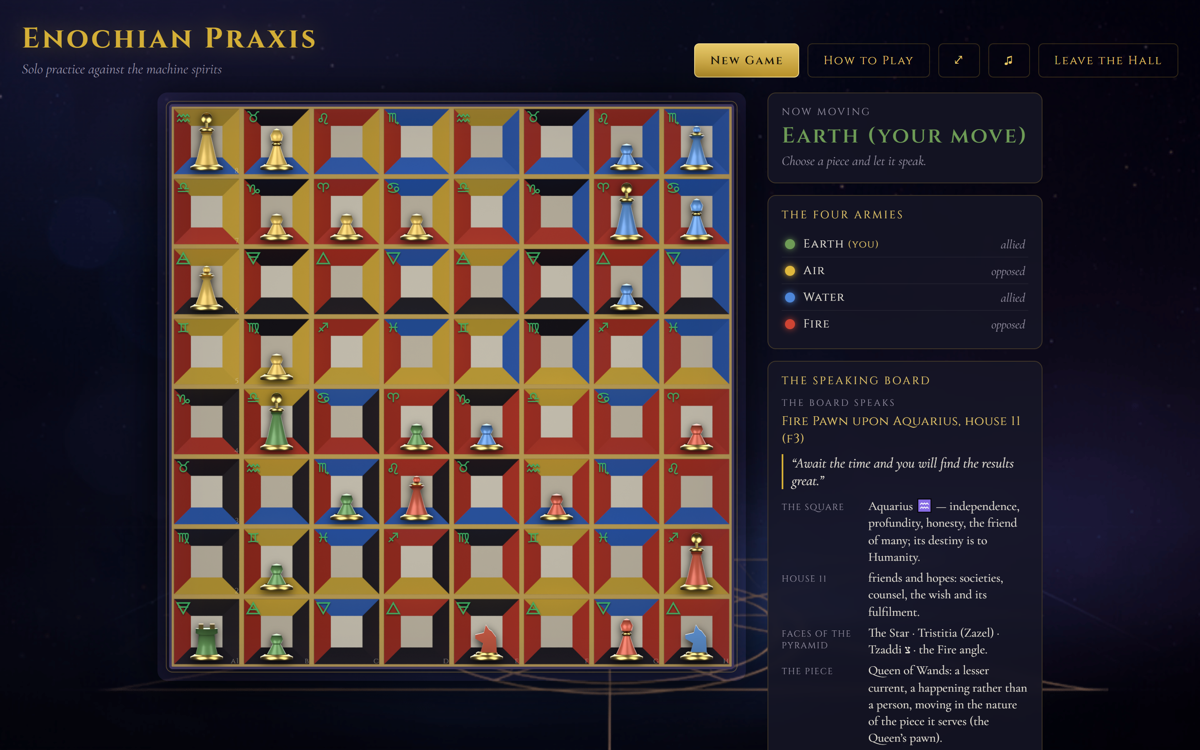
Ordinary chess is a duel between two sides. Enochian chess seats four armies at the four corners of one board: green Earth, gold Air, blue Water, and red Fire. They do not each fight alone. They are locked into two fixed teams that never shift during play. Water and Earth work together as one side, and Air and Fire work together as the other. You control one army, an ally sits beside you, and the two of you share a single victory or defeat.
For a beginner this is actually good news. You are never carrying the whole game by yourself, and you can lean on your partner's position when your own gets awkward. The one habit to build early is to stop thinking of the board as "my pieces versus everything else." Two of those armies are on your team, and helping them is often the strongest move you can make.
Surprise two: the Queen leaps
This is the move that trips up every chess player in their first game, so learning it now will save you a lot of confusion. In ordinary chess the queen is a long-range slider that sweeps across the whole board. The Enochian Queen does something completely different. She leaps exactly two squares in any of the eight directions, and she jumps clean over whatever sits between her and her landing square.
So she is short-range but very hard to block, because pieces in her path simply do not stop her. Beginners tend to either forget she can jump or expect her to slide like the old queen. Spend a moment in your first game moving the Queen back and forth to feel the two-square hop. Once it is in your fingers, she becomes one of your most reliable attacking pieces.
Surprise three: you win by capturing Kings, not by checkmate
There is no checkmate in Enochian chess, and this changes the whole feel of the endgame in a way beginners tend to enjoy. You do not hunt for a mating net. You win by capturing the enemy Kings outright. Because your alliance faces two rival armies, a full victory means both of the opposing Kings have been taken.
Here is the gentle part: when a King is captured, that army does not vanish and the game does not end. The losing army freezes. Its pieces stay exactly where they stood, still blocking lines and holding squares, but they can no longer move. So an early mistake rarely ends things on the spot. There is room to recover, room for your ally to press on, and even a chance for a frozen army to be revived later in the game. For a first-timer, that softer landing takes a lot of the fear out of every move.
Your first solo game, step by step
Here is a simple plan you can follow start to finish. It is not the strongest line of play, it is the easiest way to learn.
First, pick a board and start a solo game so the computer runs the other three armies. Do not overthink the choice; each board belongs to an element, and any of them is fine for a first sitting. Second, find your King and your Queen, then note the color of the army directly across from yours; that is one of your two opponents. Third, make three or four quiet developing moves: nudge your pawns, bring your smaller pieces off the back rank, and practice the Queen's two-square leap at least once so the jump stops feeling strange.
Fourth, keep half an eye on your ally. When you can defend one of their pieces or open a lane for them, do it, because shared wins reward teamwork. Fifth, when an undefended enemy piece is there for the taking, take it, and steer toward the enemy Kings rather than some grand combination. Finally, do not restart the moment you lose material. Let one game run all the way to a frozen army or two, so you can see how captures reshape the board instead of ending it. One finished game teaches more than ten abandoned openings.
The fastest way to learn is to play
You can read about the leaping Queen all day, but one game teaches it in a minute. Start a free solo game against the machine and try the plan above.
Play NowKeep reading
When you are ready for more, start with what Enochian chess is, walk through the full rules, and meet the pieces one at a time. When the game feels comfortable, the same board can be read as a divination, since every square carries a zodiac sign, a tarot trump, a Hebrew letter, and a geomantic figure.