Four player chess is not a single game but a small family of them, and Enochian chess is one of its stranger members. The idea of putting four armies on one board is old, and it has been reinvented more than once, so it helps to see the whole field before deciding where the elemental board belongs. The short version: the family shares a table shape, but the games play nothing alike, and Enochian chess is the only one that also works as an oracle.
Where four-player chess comes from
The oldest game usually named in this conversation is Chaturaji, a four-handed relative of the Indian ancestor of chess. It seated four small armies at the corners of an eight-by-eight board, and in some accounts it was played with dice that decided which piece a player could move on a given turn. Whether it was primarily a race for points or a straight battle is still debated by historians, and versions differed by region and century. What matters here is that the impulse to seat four players around one board is genuinely ancient, long before anyone thought of elements or divination.
Modern online four-player chess
The version most people meet today looks quite different. Modern four-player chess is a popular online variant played on a plus-shaped board: a central eight-by-eight square with a three-rank wing added to each side, giving each of the four players a home edge. It keeps the ordinary chess pieces and their ordinary moves, and it usually runs in two modes, a free-for-all where everyone plays for themselves and scores points for captures and checkmates, or a teams mode where two pairs face off. It is fast, chaotic, and easy to learn if you already play chess, which is a large part of why it caught on.
How Enochian chess fits the family
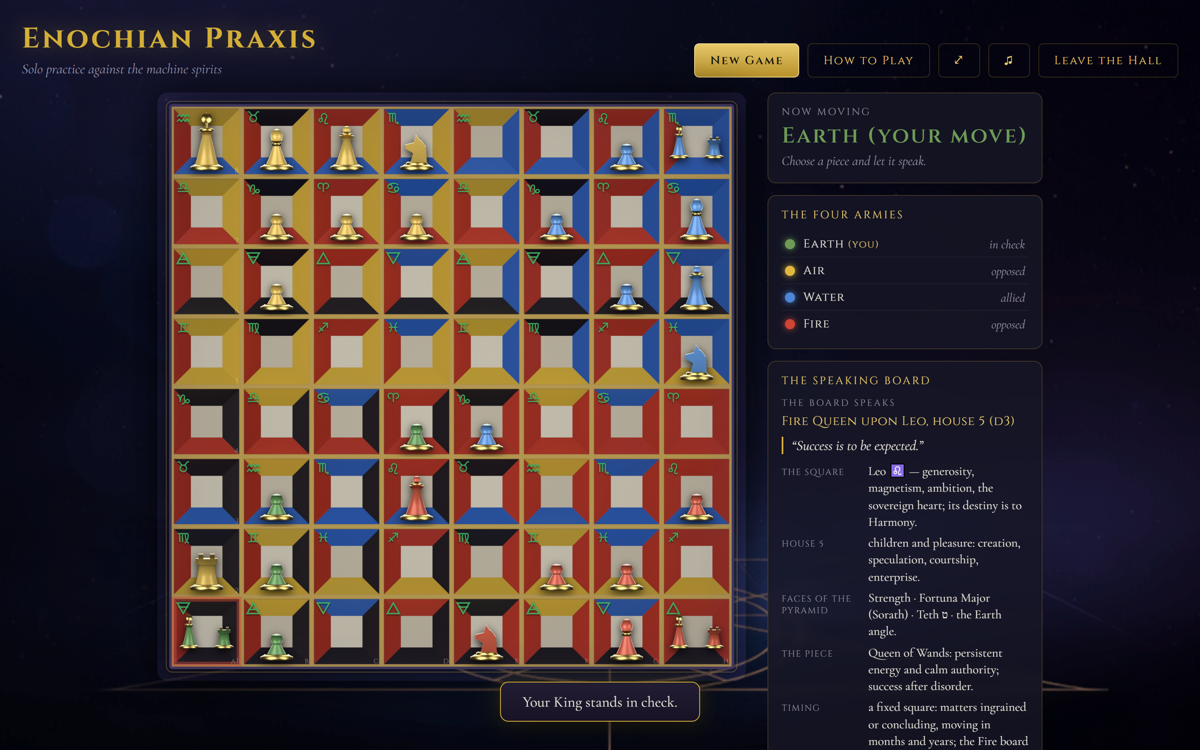
Enochian chess shares the founding idea and almost nothing else. It comes from the Hermetic Order of the Golden Dawn, the late nineteenth-century magical society, and it was built as a ritual and study tool rather than a pastime. Like Chaturaji it uses a standard eight-by-eight board, not the plus shape of the online game, and it seats four armies at the corners. Each army is an element: Fire, Water, Air, and Earth. From there it goes its own way, and the differences are the whole point.
Fixed alliances and elemental armies
In the modern online game you can play every man for himself. In Enochian chess you never can. The four armies are locked into two teams that never change: Water and Earth play together as the receptive side, and Air and Fire play together as the active side. You cannot capture your ally, you win and lose together, and strong play often means feeding your partner's attack instead of your own. The pairings are not arbitrary either. They follow the traditional friendships of the elements, so the alliance structure carries meaning as well as strategy. Because an alliance is the real unit of play, you do not even need four people: two players can share the board, one holding each side.
A leaping Queen and a different win
The moves are not quite the ordinary ones. The clearest example is the Queen. In every other chess game on this page she slides any distance in a straight line; in Enochian chess she leaps exactly two squares in any of the eight directions and jumps over whatever sits between. She is short-range but hard to block, and she catches out newcomers in their first few games. The goal is different too. There is no checkmate here. You win by capturing the enemy Kings outright, and an alliance wins only once both opposing Kings have fallen.
When a King falls, the army freezes
In the online free-for-all, a checkmated player's pieces typically stay on the board as dead wood that others can capture. Enochian chess does something related but distinct. When a King is taken, that army does not leave and does not simply die: it freezes. Its pieces hold their squares as inert terrain, still blocking lines and denying ground, but unable to move or be moved. A frozen army can even be roused again if an ally claims its empty throne. Captures reshape the board rather than knocking a player out of the game.
The feature no other version has
Here is the real dividing line. Chaturaji and the online variant are games and only games. The Enochian board is also a divination. Every square carries a sign of the zodiac, a tarot trump, a Hebrew letter, a geomantic figure, and an astrological house, so the pattern a game leaves behind can be read as an oracle. The armies and their moves map onto a full symbolic system, which is why the Golden Dawn treated the board as an instrument of study rather than a toy. A game of four-player online chess ends with a score. A game of Enochian chess ends with a reading.
So the honest summary is this. All three games seat four armies, and the instinct behind them is genuinely old. But there is no straight line of descent from Chaturaji through the modern online game to the elemental board; they are cousins that arrived at the same table shape for different reasons. Chaturaji is an ancient dice-touched game, the online variant is a fast modern sport on a plus-shaped board, and Enochian chess is a fixed-alliance elemental game on a standard board that doubles as a working oracle.
Try the elemental version
Descriptions only go so far. Sit down at the four-cornered board, feel the alliances, and watch the leaping Queen in motion. A free solo game is the fastest way in.
Play NowKeep reading
Want the full picture of the elemental game? Start with what Enochian chess is, walk through the complete rules, or read how the finished board becomes a divination.