Every game of Enochian chess is a meeting of the four classical elements. Fire, Water, Air, and Earth each command an army, each wear a color, and each sit at their own corner of the board. They are not decoration laid over ordinary chess; they set the sides, the tempo, and the meaning of the reading that a finished game leaves behind. Understand the elements and you understand the whole game.
The four armies and their colors
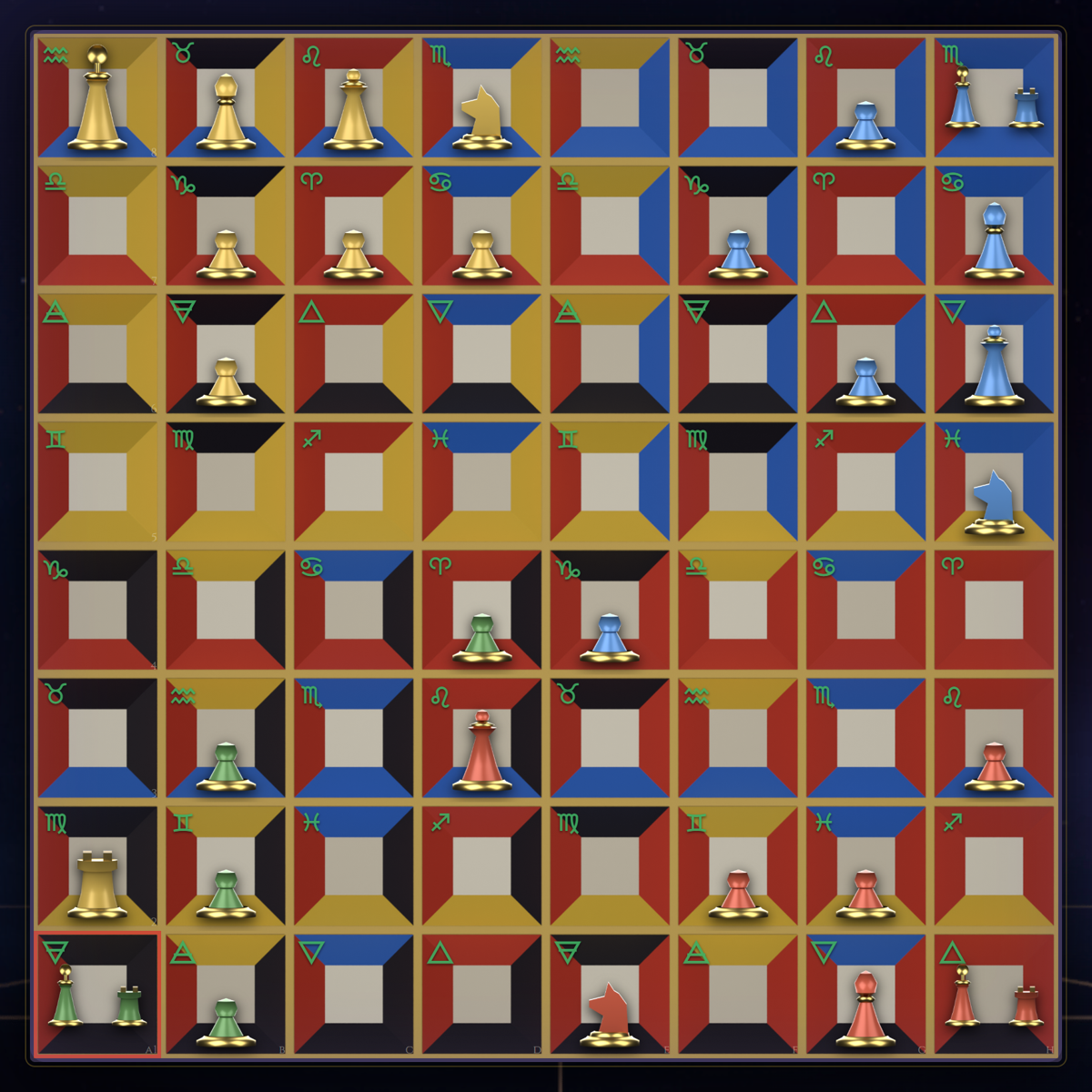
The board seats four armies at its four corners, one for each element. Earth plays in green, the color of soil and growing things. Air plays in gold or yellow, bright and mobile. Water plays in blue, deep and slow. Fire plays in red, quick and consuming. On the Enochian board these colors are not just team markers. They tell you which force each army carries, and the pyramid squares beneath the pieces are tinted with the same elemental palette, so the whole field is a map of the four powers at once.
Two alliances: receptive and active
The four elements do not fight as loners. They lock into two fixed teams that never change during play. Water and Earth stand together as the receptive, passive side. Air and Fire stand together as the active, kindling side. This split follows the old ordering of the elements: Earth and Water are the heavy elements that sink and hold, while Air and Fire are the light elements that rise and move. You cannot capture your ally, you win and lose as a pair, and the whole game is really two forces contending, each force wearing two elemental faces.
Because the alliance is fixed, your partner's element shapes your own plans. A Water player leans on Earth's patience; an Air player feeds Fire's speed. Good play often means covering for your ally rather than pressing your own attack, and the elemental pairing tells you where that support naturally falls.
The character of each element
Each element brings a temperament to the game, and it helps to play with that temperament in mind rather than against it.
Fire (red) is the aggressor. It wants to open lines fast, force exchanges, and reach the enemy Kings before the slower side has settled. In alliance with Air, it supplies the pressure.
Air (gold) is the connector. Mobile and flexible, it links positions together and keeps options open, the element that carries Fire's attack sideways when a frontal push stalls.
Water (blue) is the absorber. Deep and unhurried, it soaks up an attack and waits, holding the receptive side steady while the pressure spends itself.
Earth (green) is the anchor. Slow, dense, and hard to shift, it fixes squares and gives Water something solid to defend behind. Together they hold rather than chase.
How the board element sets the tempo
Before a single piece moves, you choose which element rules the board. That choice is not cosmetic. The board's element decides who moves first, and first mover flows to that element's alliance. Pick the Fire board and the active Air and Fire side opens the game with the initiative; pick the Water board and the receptive Water and Earth side takes the lead instead. The chosen element also colors the mood of the whole game, quick and kindling on a Fire or Air board, holding and enduring on a Water or Earth board. Choosing the board is a real strategic decision made in advance, and it tilts the balance between the two alliances from the very first move.
The elemental world of a reading
Enochian chess was never only a strategy game. Every square on the board carries a full set of correspondences: a sign of the zodiac, a tarot trump, a Hebrew letter, a geomantic figure, and an astrological house. The board's chosen element sets the world in which those symbols are read. A game played on the Fire board speaks in the language of will, drive, and spirit; a Water game speaks of feeling and the depths; an Air game of thought and exchange; an Earth game of body, work, and the material world. When you gather a finished position into a reading, the element you selected at the start is the ground the whole oracle stands on. In Enochian Praxis the panel reads each move as it lands, and the elemental world you chose colors every line of it.
Why the pairings make the game
Once you see the elements clearly, the four-player format stops feeling strange. It is really two forces, receptive and active, each divided into a heavier and a lighter element so that patience and pressure both have a voice on each side. Water gives Earth movement; Earth gives Water a wall. Fire gives Air a purpose; Air gives Fire reach. The win comes only when both enemy Kings have fallen, and a captured King freezes his army into inert terrain rather than ending the game, so the elemental balance keeps shifting until one alliance has cleared both opposing thrones. The elements are the reason the board plays the way it does, not a costume it wears.
Feel the elements in play
Reading about Fire's pressure and Water's patience is one thing. Watching them contend across the board is faster. Start a free solo game and choose your element.
Play NowKeep learning
Want to go deeper? See how the element you choose shapes each board, read the full rules, or learn how a finished game becomes a divination.