Is Enochian chess hard? Not really, and probably less than you fear. If you can play ordinary chess you already know most of it, because the pieces move in ways you will recognize almost at once. The parts that are genuinely new are few, and they are more fun than difficult: four players in fixed alliances, a Queen that leaps rather than sweeps, and a win by capturing Kings instead of by checkmate. This is an honest walk through where the ease is, where the real learning sits, and why you can start playing before you understand every last detail.
The moves are the easy part
Enochian chess uses the same eight-by-eight grid you already know and a familiar cast of pieces. Rooks run in straight lines, Bishops travel on diagonals, Knights hop in their crooked jump, and Kings step one square at a time. If you have ever played a single game of ordinary chess, the movement will feel like home within a few minutes. The Golden Dawn assigned the pieces to elements and gods, and writers such as Israel Regardie and Steve Nicholls recorded the system in detail, but none of that changes how the men slide across the squares. You do not have to memorize anything to make legal moves. You just move.
What actually takes getting used to
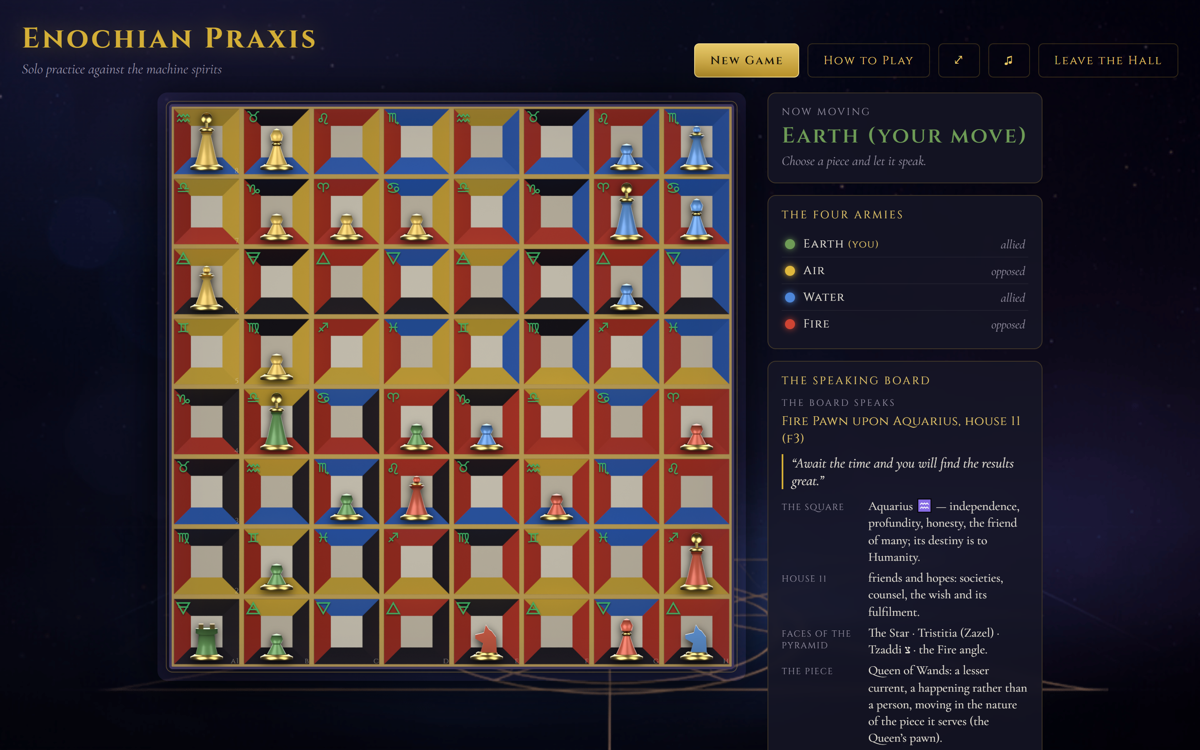
The real learning curve is not in the mechanics; it is in thinking with four armies instead of two. Enochian chess seats four elements at the corners of one board: Fire, Water, Air, and Earth. They are locked into two fixed alliances that never change. Water and Earth play as one side, Air and Fire play as the other. You always have a partner across the board, and you win and lose together. That single fact reshapes how you plan. Instead of hunting one opponent, you are reading three other players, protecting an ally, and watching two rivals who are cooperating against you. It takes a game or two before this stops feeling crowded and starts feeling natural, and that stretch is the honest heart of the difficulty.
Two rules that surprise chess players
Two differences catch newcomers most often, and both are quick to absorb once you meet them. The first is the Queen. In ordinary chess she is the long reach of the board, sliding any distance. The Enochian Queen does not sweep at all: she leaps exactly two squares in any of the eight directions and jumps over whatever sits between. She is short-range but very hard to block, and almost everyone misjudges her in their first few games. The second is how you win. There is no checkmate here. You win by capturing the enemy Kings outright, and because two armies stand against you, your alliance wins only when both of the opposing Kings have fallen. These two rules do most of the work of making the game feel new, and neither takes more than a game to learn by feel.
A captured King does not end the game
Here is a piece that surprises people in a good way. When a King is taken, that army does not vanish and the game does not stop. The losing side freezes. Its pieces stay exactly where they stand, still blocking lines and holding squares, but unable to move until the game resolves. So an early loss is not the end of your evening; play carries on around the frozen army, and the shape of the board keeps shifting. This is gentler on beginners than ordinary chess, where a single decisive mistake can close the whole game. In Enochian chess there is more room to recover, watch, and learn while a hand plays out.
The divinatory layer is as deep as you want it
You may have heard that every square carries a sign of the zodiac, a tarot trump, a Hebrew letter, and a geomantic figure, and that the finished position can be read as an oracle. That is true, and it is one of the loveliest things about the game. It is also entirely optional. You can play a clean, satisfying strategy game and never touch the symbolism, or you can lean in and let the board double as a divination. The depth is a dial you set yourself. A newcomer who wants only the game will never be slowed down by the oracle, and a newcomer who wants the oracle can grow into it one attribution at a time.
What your first hour looks like
Expect the first few minutes to feel familiar and the first full game to feel a little busy, in the best way. You will make legal moves right away. You will probably forget the Queen only leaps, forget which of your neighbors is your ally, and misjudge how the frozen-army rule changes the endgame. All of that is normal, and all of it settles fast. By the end of one game the four-corner geometry clicks, and by the second or third the alliance thinking starts to feel obvious. The software carries the memory work for you, so you are free to learn the way people actually learn games, which is by playing them.
Let the software carry the hard part
The old barrier to Enochian chess was never the moves; it was the memory work. Setting up four elemental armies with the correct god-forms and attributions, by hand, from a book, is genuinely fiddly, and that is what gave the game its intimidating name. Playing on Enochian Praxis removes that step. The board sets itself up correctly, the legal moves are shown to you, and the symbolic attributions are handled in the background, so nothing stands between you and a real game. What is left is just a good four-handed strategy game that happens to be beautiful.
The best way to find out is to play
Reading about the leap and the alliances only goes so far. One free solo game will teach you more in ten minutes than any explanation. The board sets itself up, so you can start straight away.
Play NowWhere to go next
Want the full picture before you sit down? Begin with what Enochian chess is, walk through the complete rules, and meet the leaping Queen and her companions on the pieces page.