Good Enochian chess strategy starts with a simple admission: this is not a duel, and the habits that win at ordinary chess will only take you part of the way. Four armies share one board in two fixed alliances, Water and Earth against Air and Fire, and you win by capturing both enemy Kings rather than by checkmate. The pieces move a little differently too, most notably a Queen that leaps two squares instead of sliding. What follows is a set of sound first principles rather than a book of memorized lines. Learn the ideas and you will find good moves in positions no opening chart could have predicted.
Play for tempo, and remember the board has an element
Every Enochian game is played on one of the four elemental boards, and the board you sit on colors the tempo of the whole game. On a Fire or Air board the play tends to kindle quickly, with early threats and open lines rewarding the side that develops first. On a Water or Earth board the game holds and endures, and patient buildup often beats a rushed attack. Read the board before you commit to a plan. A tempo you spend well early, bringing a piece toward the center where it touches more of the field, is worth more than a tempo spent shuffling a piece you will only have to move again.
Develop the leaping Queen and the Knight early
Your two most mobile attackers are the Queen and the Knight, and both reward early, thoughtful development. The Enochian Queen does not sweep down a file the way a chess queen does. She leaps exactly two squares in any of the eight directions and jumps clean over whatever stands between, which makes her short-range but very hard to block. That leap is easy to misjudge in your first games, so practice tracing where she can actually land before you rely on her. Bring her toward active squares where two or three of her leaps threaten something, rather than parking her in a corner where her jumps land on empty air. The Knight keeps its familiar hop, and the two pieces together cover a mix of squares that no single slider can screen. Coordinate them so a defender that stops the Knight walks into the Queen's leap.
Guard your King: a lost King costs more than in chess
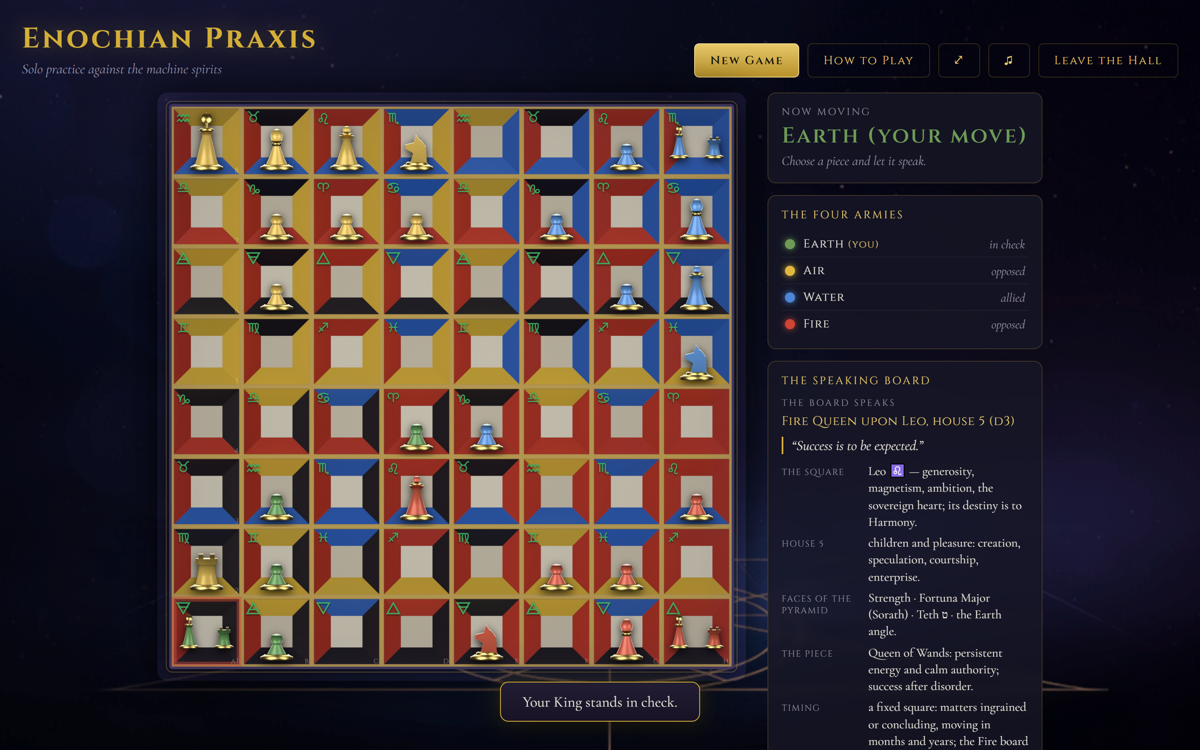
King safety matters more here than in any two-player game, because the consequence is heavier. When your King falls, your army does not simply lose the game. It freezes. Your pieces stay on the board as inert terrain, still blocking lines and holding squares, but unable to move or be captured or do anything to help. In effect a single capture removes half of your alliance's fighting force in one stroke and leaves your ally to face two live armies alone. That is why an exposed King is a much larger liability than an exposed king in chess. Keep him screened behind his own pieces, avoid marching him into the open to chase a small gain, and think twice before opening the lines around him even when the attack looks like it is going your way.
Coordinate with your ally, do not freelance
You are never fighting alone. Your ally sits with you against the opposing pair, you share the win and the loss, and you cannot capture each other. The strongest plans usually come from two armies aiming at the same target rather than two armies pursuing separate ambitions. If your partner is building pressure against one enemy King, it is often better to add your weight to that attack than to open a second front of your own. Watch what your ally is threatening and set up so that your Queen's leap or your Knight's hop lands where their pieces already bear down. Two attackers converging on one King are far more dangerous than the sum of two lone attacks, and because a captured King freezes an army, breaking through on one side can swing the whole board.
Track three opponents, not one
In chess you watch a single opponent. Here you have to keep three other armies in view at once, two of them allied against you and one of them your own partner. Turn order runs around the board, so between your moves three other players act, and a threat you ignore can be reinforced by a second enemy before it comes back to you. Before you commit, scan all four corners: what does each live army threaten on its next turn, which of your pieces are loose, and is your King safe from every angle rather than just the nearest one. A move that looks strong against one opponent can hang a piece to another sitting quietly across the board. The players who win consistently are the ones who account for the whole table, not just the army in front of them.
Know when to threaten a King and when to hold
Because you win by capturing Kings, a real King threat is the sharpest thing on the board, but it is not always right to spend it at once. A threat that forces a defender to freeze in place, guarding its King instead of joining the fight, can be worth more held in reserve than cashed in early for a small return. Ask what the capture actually buys: if taking a King now freezes a dangerous army and shifts the balance toward your side, take it. If the threat instead ties down an enemy while your ally builds a decisive attack elsewhere, sustaining the pressure may win more than grabbing the King today. The same logic applies in reverse when your own King is the target, so read whether a threat against you is a genuine danger or a bluff you can afford to answer calmly. Timing the King hunt, rather than merely starting it, is where much of the real skill lives.
Put the principles to work
Strategy sticks faster when you play it. Start a free solo game, try developing the Queen toward the center, and watch how the four armies and the frozen-King rule change every calculation.
Play NowKeep reading
Want the ground under these ideas? Read the full rules, get to know each piece and how it moves, and see how the four elemental boards shape the pace of a game.