A chess is elemental when the elements are not decoration but structure. Three things have to be true: the armies must be the four elements themselves rather than colors or nations, the sides must be fixed by which elements befriend which, and the board must carry elemental meaning square by square. Change the piece art on an ordinary set and you have a themed chess, not an elemental one. Enochian chess is the case where all three conditions hold, which is why it is the game the phrase points to.
Four armies, one element each
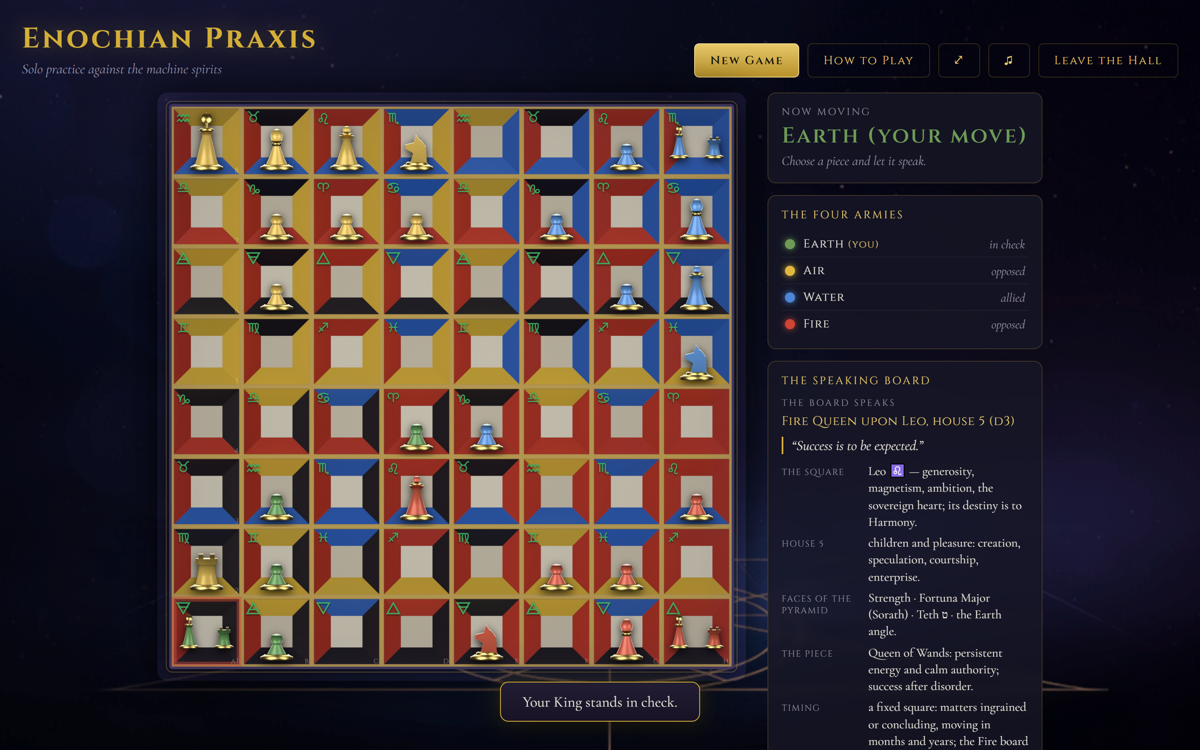
The first mark is the simplest to see. Instead of two players and two colors, an elemental chess seats four armies, and each army is an element. In Enochian chess those armies are Fire, Water, Air, and Earth, set at the four corners of a single eight by eight board: Earth at one corner, Air at the next, then Water, then Fire. Every army carries the full set of a King, four major pieces, and four pawns, so the elements are not mascots painted onto one force. Each is a complete fighting body with its own throne, its own direction of march, and its own promotion edge. If you want the full breakdown of the four and what each one stands for, the four elements of Enochian chess covers it, and the boards page shows the corner arrangement.
Alliances set by elemental friendship
The second mark is where a real elemental chess separates from a mere four-player game. The four armies do not fight as loose rivals. They lock into two alliances, and the pairing follows the old logic of which elements agree. Earth and Water form the receptive, passive side. Air and Fire form the active side. These alliances never change during a game. Allies cannot capture one another and cannot give check to one another, and an alliance wins and loses as a unit. The friendship is spatial as well as thematic: your ally sits at the corner diagonally opposite you, never beside you, so the two active armies and the two receptive armies each face each other across the board. Turn order then rotates around the corners so the two sides alternate move by move.
That single rule reshapes everything above it. Because the elements are bound by friendship rather than by seat, a game is a duel between two elemental temperaments, not a free-for-all among four. It is also why the game scales cleanly to different numbers of people: one player can run all four armies, two can each hold an alliance, and four can each take a single element. If you are coming from the standard game, the piece-by-piece contrast in Enochian chess versus regular chess makes the shift concrete.
A board that carries meaning square by square
The third mark is the one people miss, and it is the deepest. In a fully elemental chess the board itself is not neutral ground. Every square carries its own attribution: a sign of the zodiac, a tarot trump, a Hebrew letter, a geomantic figure, an astrological house. Each square is drawn as a small pyramid seen from above, its four faces bearing those layers of meaning, so a piece never simply sits on a color. It sits on a specific parcel of elemental symbolism. This is what lets the finished position of a game be read back as an oracle rather than just scored as a win. If you want to see how that layer works and follow a worked reading, the divination page walks through it, and the Enochian chess board explained gives the fuller tour.
Enochian chess has four board designs for exactly this reason: one for each element, Fire, Water, Air, and Earth. A game is played on one of them, and the board's own element opens the play. The design is not a skin. It sets which attributions live where and colors the whole game with a single element's character while the four armies contest it. That is the difference between a chessboard that has been decorated and a board that means something in every cell.
Why the label fits some games and not others
Many chess variants borrow one of these marks. Some four-player games seat four sides but pair them by convenience rather than by any elemental logic, and their boards stay blank. Themed sets swap kings and queens for gods or planets but leave the two-color, two-player skeleton intact underneath. None of that makes a chess elemental in the strict sense. The word earns its place only when the armies are the elements, the alliances follow elemental friendship, and the ground under the pieces is charged with attribution. Enochian chess is the reference case because it satisfies all three without borrowing, which is why occult and esoteric writers reach for it whenever the phrase comes up.
The game reached the public through the published Golden Dawn papers, most of it by way of Israel Regardie, who put the order's material into print. The Golden Dawn built the four elemental boards on the symbolism of the elemental tablets from John Dee's system, which is where the name Enochian enters. What matters for the label is the design that resulted: a chess in which the elements are the players, the rules, and the field all at once.
See an elemental board in motion
Set up a game and watch the four elements take the corners, lock into their alliances, and contest a board that carries meaning in every square. Play free in your browser, solo or online, no download.
Play NowKeep reading
Once the three marks make sense, the next step is the alliances themselves. See how the pairs form and why they never change in the four elements of Enochian chess, then pick a board and play a full game to feel the pattern move.