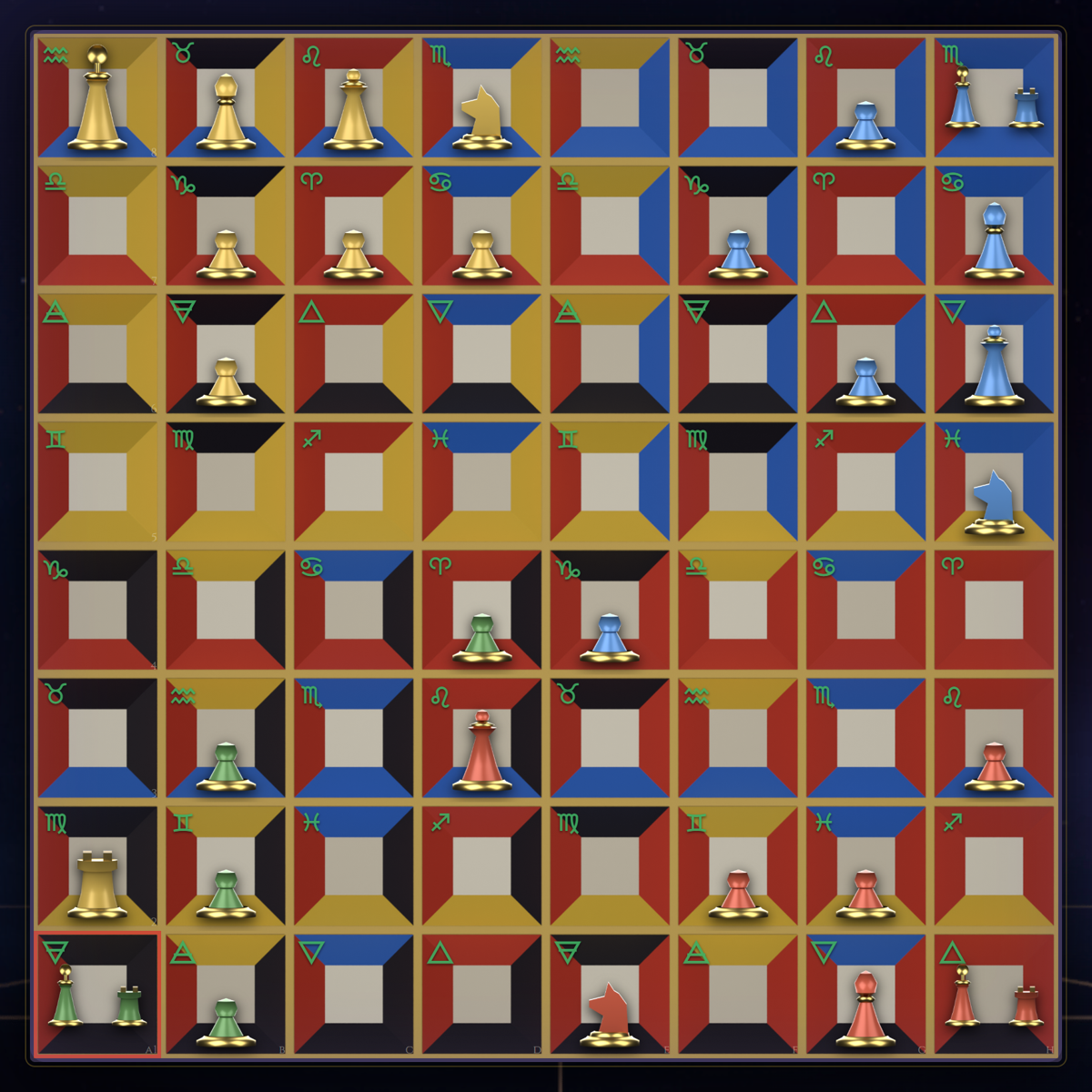
The Enochian chess board looks familiar and strange at the same time: an eight-by-eight grid you already recognize, painted in four elemental colors, with a small four-faced pyramid drawn onto each of its sixty-four squares. That pyramid is the whole point. It is what turns a checkered surface into a map of elements, signs, and forces, and it is what lets the same board carry a game and a divination at once. This page looks only at the board itself, the grid and the colors and the pyramid squares, and sets aside the four separate boards and their alliances, which live on the boards page.
The grid: sixty-four squares you already know
Start with what carries over. The Enochian board is eight squares by eight, the same sixty-four cells as an ordinary chessboard, and the pieces travel across it in ways a chess player will find mostly legible. The armies begin in the four corners rather than along two facing edges, because four elemental forces sit at the board rather than two, but the underlying lattice is the chessboard you have always used. If all you did was learn the movement rules, you could play a full game on this grid and never look closer. The reason to look closer is that every one of those sixty-four squares has been given a character it would never have in ordinary chess.
Four colors, four elements
The first thing that character shows in is color. The board is not black and white. It is painted in the four elemental colors of the Golden Dawn system: red for Fire, blue for Water, gold (a warm yellow) for Air, and green for Earth. These are not decoration and they are not team markers in the way chess uses light and dark. Each color states the elemental nature of the ground under a piece, and the pattern of colors across the whole board is itself part of the design. When you look at a set-up board you are looking at a distribution of Fire, Water, Air, and Earth spread over sixty-four positions, arranged so that the elements meet, mix, and contrast in a deliberate order rather than a random checker.
Every square is a small pyramid
Here is where the Enochian board leaves ordinary chess entirely. Each square is not painted as a flat block of one color. It is drawn as a small pyramid seen from above, a square split by two diagonals into four triangular faces that meet at a point in the center. So a single cell is not one thing but four, four faces angled toward a shared apex, and each face can carry its own color and its own marking. This is why the board can hold so much meaning in so little space. A flat square can say one word. A four-faced pyramid can say four, and it can say them in relation to one another.
The image of the pyramid is not arbitrary. It comes from the way the Golden Dawn built its elemental symbolism, where a force is understood as a blend of contributions rather than a single pure ingredient. Drawing each square as a little pyramid gives that idea a shape: four faces leaning in toward one point, four influences resolving into the single force that governs the square.
What the four faces carry
The four faces of a pyramid square are not decorative repetition. Each face carries a specific piece of information, and read together they locate the square exactly within the system. In broad terms the four faces record: the element of the board the square belongs to; a letter drawn from the column the square stands in; the lesser angle or quarter of that column's tablet; and a letter drawn from the rank the square stands in. You can think of the column face and the rank face as coordinates, a horizontal reference and a vertical one, while the board-element face and the angle face fix which region of the larger elemental scheme you are standing in.
Because the faces come from crossing a column reference with a rank reference inside a chosen board and quarter, no two squares carry quite the same combination. That is the machinery that lets each square resolve to a distinct meaning. The point of the four faces is not to be admired individually but to be read as a set, four values that, taken at once, single out one square from the other sixty-three.
How the faces resolve to a sign or force
Put those four values together and the square resolves. Some squares resolve to a sign of the zodiac; others resolve to a purer elemental force, one of the sub-elements formed when an element is colored by another (Fire of Water, Air of Earth, and so on). The combination of board element, column, angle, and rank is what decides which. This is the same resolution that makes the whole board readable as an oracle: a square is never just red or blue, it is a named influence, and a piece resting on it is resting on that influence.
This is worth keeping firmly in view, and it is also the natural place to stop, because filling in the specific per-square attributions is a longer study than one page can carry. The important thing here is the system: color states the element, the pyramid splits each square into four faces, and those four faces (board element, column, angle, rank) combine to fix the square's sign or force. That structure is what every Enochian board shares, whichever of the four elemental boards you sit down at.
Why the board is built this way
The design earns its complexity by doing two jobs with one surface. As a playing field, the pyramid squares give the board texture a chess player can feel, elemental ground that flavors where pieces stand. As a symbolic map, the same squares carry the zodiacal and elemental attributions that let a finished position be read. Nothing is bolted on: the colors, the pyramids, and the four faces are the same set of marks serving strategy and divination together. Once you see a square as a small pyramid with four faces rather than a flat colored block, the rest of the board opens up, and the oracle hidden inside the game stops being mysterious and starts being legible.
See the pyramid squares in motion
A diagram can only say so much. Sit down at a live board, watch the colors light under your pieces, and read the squares as they fill. Start a free solo game.
Play NowKeep reading
Want to go further? See how the grid splits into the four elemental boards and their alliances, meet the pieces that travel the pyramid squares, or learn how a finished position is read as an oracle on the divination page.