The Enochian chess tarot connection is not a metaphor bolted on after the fact; it is the design. The Golden Dawn built the game on the same elemental scaffolding as its tarot, so the four armies answer to the four suits, the pieces answer to the court cards, and the squares carry the trumps. Once you see the correspondences, a game stops being only a contest and starts reading like a spread that you build move by move.
The four suits are the four armies
Everything begins with the elements. Enochian chess seats four armies, one for each element, and the tarot's four suits are simply those same elements in card form. Fire is Wands, Water is Cups, Air is Swords, and Earth is Pentacles (often called Disks in Golden Dawn material). So the red Fire army is the suit of Wands walking the board, the blue Water army is Cups, the gold Air army is Swords, and the green Earth army is Pentacles. When two armies ally, you are watching two suits cooperate: Water and Earth (Cups and Pentacles) hold the receptive side, while Air and Fire (Swords and Wands) drive the active side.
The pieces are the court cards
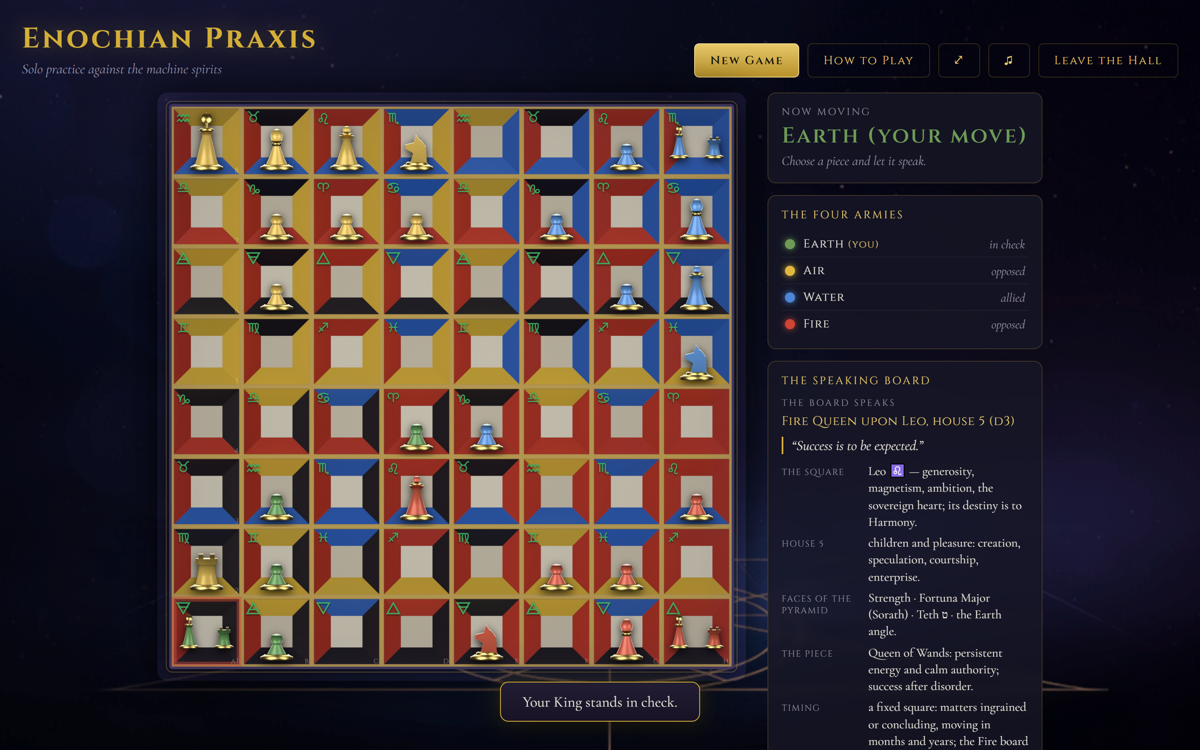
Inside each army the five kinds of piece answer to specific court ranks, and this is the part newcomers most often get backwards, so it is worth stating plainly. In a given suit the mapping runs: the King is the Ace, the Queen is the Queen, the Bishop is the Prince, the Knight is the Knight, and the Rook is the Princess. The Golden Dawn court is a family of four (Knight, Queen, Prince, Princess), and the Ace stands as the root of the suit, so the chess King, the head of the army, takes the Ace rather than a court figure.
Read across a single army it lines up cleanly. The Fire King is the Ace of Wands, the Fire Queen is the Queen of Wands, the Fire Bishop is the Prince of Wands, the Fire Knight is the Knight of Wands, and the Fire Rook is the Princess of Wands. Swap in Cups, Swords, or Pentacles and the same five slots fill for Water, Air, and Earth. Sixteen court cards, sixteen major pieces, one to one.
Every square carries a trump
The court cards live in the pieces, and the Major Arcana live in the board itself. Each square is assigned a sign of the zodiac, and because the Golden Dawn tied the trumps to the signs and the planets, that sign brings a Major Arcana card onto the square with it. A square governed by Aries carries the trump for Aries, a square governed by the Moon carries its trump, and so on across the grid. The squares are not blank terrain the way they are in ordinary chess; each one is a small piece of the tarot, waiting for a piece to stand on it and give it a voice.
How a move becomes a reading
Put the two layers together and a move gains a second meaning. A piece is a court card. The square it lands on is a trump. So when your Fire Bishop settles on a particular square, you are placing the Prince of Wands on, say, the trump for that square's sign, and the pairing reads the way a two-card draw would: the court figure describes an actor or a force, and the trump underneath describes the situation it steps into. Nothing extra has to be laid out. The reading is generated by play.
This is why the win condition matters to the divination as much as to the game. You take enemy Kings rather than deliver checkmate, and a captured King's army freezes in place instead of leaving the board. Those frozen pieces stay as fixed cards on their squares, so the final position is a full field of court-and-trump pairings, some active and some locked, that can be gathered into one closing reading. The shape of the game is the shape of the spread.
Why the tarot layer holds together
The correspondences feel neat because they are not decoration; they come from a single system. The Golden Dawn assigned the same elements, signs, and planets to the tarot, to the chessmen, and to the squares, so the three sets are just different faces of one table of meanings. That is also why you should resist the urge to invent extra links. The clean set is the reliable one: suits to elements, pieces to court ranks, squares to trumps. Writers in the tradition, from S. L. MacGregor Mathers through later teachers such as Steve Nichols, work from those same anchors, and the game reads best when you stay with them.
Watch the cards fall as you play
The fastest way to feel the tarot layer is to make a move and see the pairing it creates. Start a free solo game and let the board show you which card each piece is carrying.
Play NowKeep reading
Want to go deeper? See how the board works as a full oracle in divination, meet the ranks behind the court cards on the pieces page, or learn how each element shapes its own board in the four boards.