Enochian chess divination is the quiet second life of the game. You play a real strategy match, four armies in two alliances fighting to capture Kings, and the whole time the board is recording something else underneath the contest. Each of the sixty-four squares carries a bundle of meaning, so where your pieces travel and where they finally come to rest can be read as an oracle. This guide is a practical how-to: what a square holds, how a live reading is built move by move, how the end of a game becomes one statement, and how to frame a question so the answer means something.
What every square carries
The reading works because the board is not blank underneath the pieces. In the Golden Dawn system that Enochian Praxis follows, each square is tied to a small stack of correspondences drawn from the same table that runs through tarot and astrology. A single square can carry a sign of the zodiac, a tarot trump, a Hebrew letter, a geomantic figure, and one of the astrological houses. So when a Knight lands on a given square, it is not just occupying a coordinate. It has arrived at a specific letter and figure and sign, and that is the material a reading is made from. You do not have to memorize all sixty-four cells to start. The point is that no move is symbolically neutral, and the ones that matter for your question tend to stand out on their own.
The four elements color the whole reading
Before any of that detail comes into play, the elements set the tone. The four armies are Fire, Water, Air, and Earth, and they fight as two alliances: Water and Earth on the receptive side, Air and Fire on the active side. Whichever element leads the action tilts the mood of the reading. A game driven by Fire and Air tends to speak to things that are quick, kindling, and outward: conflict, ambition, ideas catching. A game held by Water and Earth speaks to things that endure and settle: feeling, resources, patience, the slow forms. You also choose an elemental board before play begins, and that choice sets the key the whole game is read in, the way a piece of music is colored by its key signature.
How the Speaking Board reads moves live
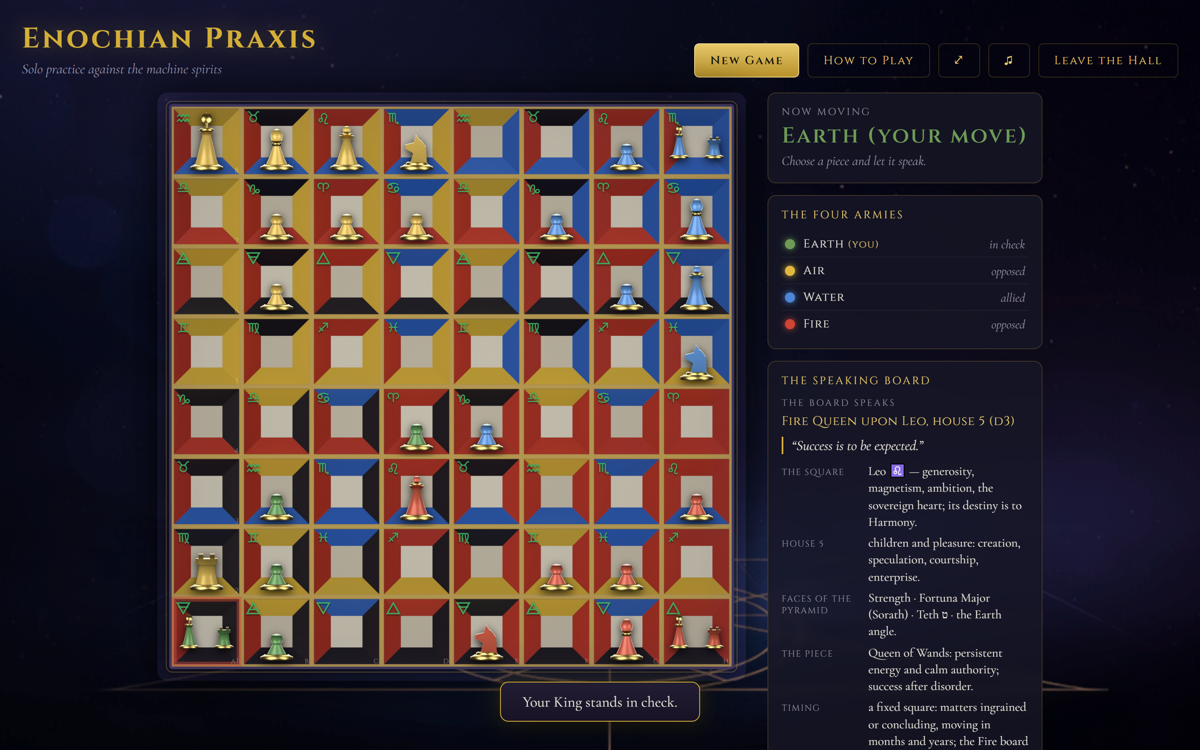
You do not have to wait for the game to finish to hear it speak. As you play, a running panel (the Speaking Board) reads each move the moment it lands and names what that square holds. Make a capture on a square governed by a particular trump and letter, and the panel says so, right then, in plain language. This is the part most people find surprising the first time: the oracle is not bolted on afterward, it is happening continuously while you scheme about Kings and defend your ally. A few kinds of move tend to carry the most weight and are worth watching for as they happen: captures, since taking a piece marks that square with force; a piece reaching the far side of the board; and any move onto a square whose symbol clearly answers the question you brought. Let the panel narrate, and keep a loose mental note of the two or three landings that felt pointed.
Why the ending carries the most weight
The live reading gives you texture, but the strongest single statement comes at the close. In Enochian chess you do not win by checkmate. You win by capturing both enemy Kings, and when a King is taken his whole army freezes: its pieces stay on the board as inert terrain, still holding squares, but unable to move. That freezing is why the ending is so readable. The final position is not a scattered mess of live pieces still in motion. It is a settled landscape, with whole armies fixed in place and the winning alliance's pieces resting where the game left them. The end-of-game reading is built from that settled picture: which element prevailed, which squares the surviving pieces occupy, and which trumps, letters, and figures those squares carry. Those correspondences, gathered together, become one reading rather than a running commentary.
How to build the end-of-game reading
When the game closes, work from the whole down to the detail. Start with the outcome: which alliance won, and therefore which pair of elements carried the day. That is the headline, the overall answer to the mood of your question. Next, look at where the winning side's key pieces came to rest, especially the surviving Kings and Queens, and read the symbols on those squares. Remember that the Queen leaps two squares rather than sliding, so where she finishes is often a deliberate, telling spot rather than the end of a long glide. Then take the two or three landings the Speaking Board flagged as pointed during play and set them beside the final picture. You are looking for a small cluster of correspondences that agree, a sign and a trump and a figure that all lean the same way. That cluster, not any single square, is the reading. Trust the pattern that repeats over the lone dramatic square.
How to frame a question first
None of this works well without a question you set before the first move. The clearest questions are open and situational rather than yes-or-no: not "will this happen," but "what is at work in this situation," or "what should I be paying attention to." Fix the question in your mind, or better, write it down, then choose your elemental board with the question in view. If the matter is fiery and urgent, a Fire or Air board suits it; if it is slow and material, a Water or Earth board fits better. Play the game honestly, as a real contest, without steering pieces toward symbols you want. The reading is truer when the game is played to win rather than played to flatter the question. When it ends, read the settled board back against what you asked, and let the elements and the symbols answer in their own terms.
Play a game and read it back
The fastest way to understand this is to bring a question, play a full solo game, and watch the Speaking Board name each move as it lands. Then read the ending.
Play NowKeep reading
For the wider picture of the oracle, see the divination overview. To sharpen the play itself, meet the pieces and choose among the four boards before your next reading.