The concourse rule is the strangest capture in Enochian chess. Five small blocks of squares are marked on the board, and if a Queen's move brings all four Queens together on one of those blocks, the moving Queen captures both enemy Queens at once and takes her ally's Queen under her guidance. Three Queens change hands on a single move. Nothing else in the game works like this, and very little in any chess variant does. Here is what the published Golden Dawn papers require, why you can play for years without seeing it happen, and why the Queen's two square leap is the reason it can be engineered at all.
Five marked blocks, one exact condition
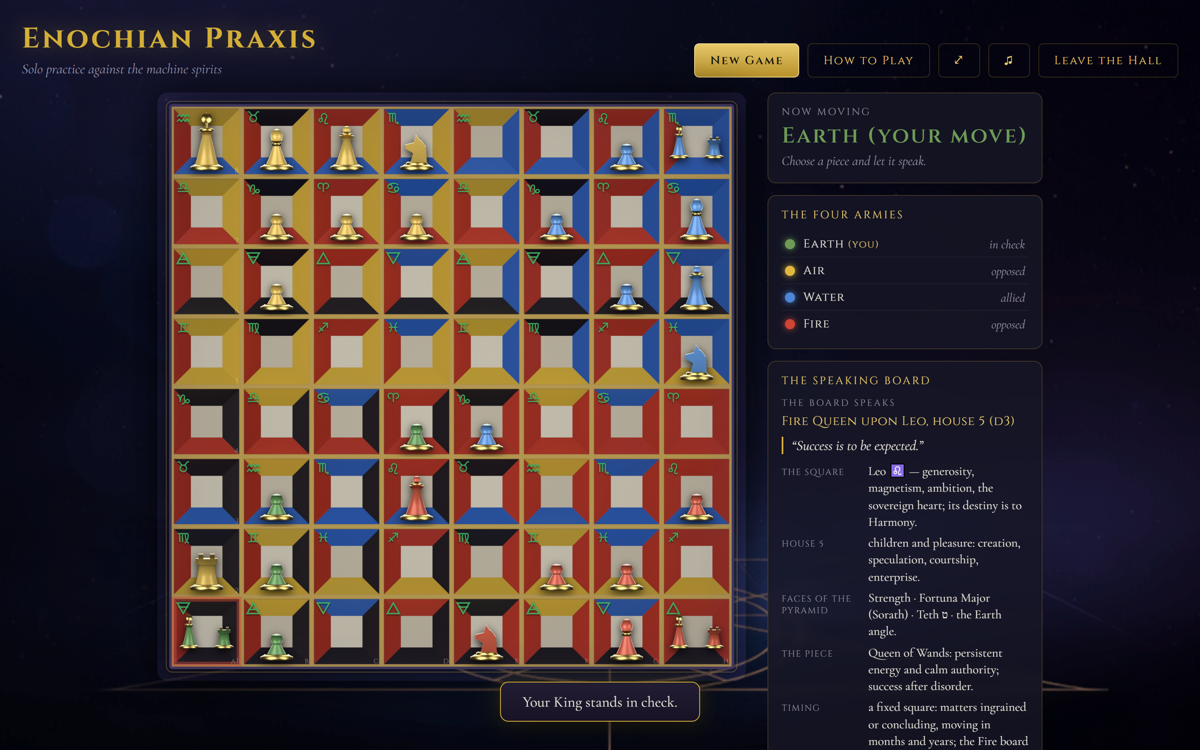
Every Enochian board singles out five 2x2 blocks of squares for this rule. One sits at the dead center: d4, e4, d5, and e5. The other four sit near the corners where the armies begin: b2, c2, b3, and c3 by Earth's home corner; b6, c6, b7, and c7 by Air's; f6, g6, f7, and g7 by Water's; and f2, g2, f3, and g3 by Fire's. Twenty squares in all, out of sixty four.
The rule fires in one situation only. A Queen moves. When her move is complete, the four Queens, one from each of the four armies, stand alone on the four squares of a single marked block, one Queen to a square. None of the four may belong to a frozen army, an army whose King has fallen to an enemy (the full rules cover freezing). If every condition holds, the moving Queen captures both enemy Queens and takes her allied Queen under her guidance. Two enemy pieces leave the board and the friendly Queen passes into the mover's care, all on one move.
The papers grant the same power to the four Bishops. Bring all four onto one marked block with a Bishop move, none frozen, each alone on its square, and the moving Bishop claims both enemy Bishops the same way. The rule speaks of the four Queens or the four Bishops, never a mixture. Two Queens and two Bishops sharing a block is just a crowd.
Why you may never see one
Count what must be true at the same moment. All four Queens must still be alive, in a game where Queens are natural targets. None may belong to a frozen army, so no army among the four can have lost its King to an enemy. The Queens must occupy four exact squares out of the twenty that are marked. And the meeting must be completed by a Queen's own move, since no Queen already inside a block can travel within it: every square of a 2x2 block is one step from every other, and this Queen cannot move one step.
That last condition is the killer. Turn order rotates around the board, so between any two of your moves each of the other three armies moves once. An opponent who sees three Queens assembling on a marked block simply leaps away, and one two square leap is usually enough to break the pattern.
In practice the concourse punishes inattention. It lands when an opponent stops counting the marked squares, or when checks and threats elsewhere consume the enemy's turns while the meeting quietly completes. Against alert opponents it borders on impossible, and that is part of its charm. The rule is less a weapon you rely on than a trap the board holds open from the first move to the last.
Why it is worth watching for
Because nothing else in the game captures two pieces at once. A concourse removes both enemy Queens in a single stroke and gathers your ally's Queen besides. Allied armies win and lose together, so stripping the opposing alliance of both its Queens in one move is a swing no ordinary capture can match.
The threat carries value even when the capture never comes. The position worth hunting is the one where your ally's Queen and both enemy Queens already stand on three squares of a marked block while yours can leap onto the fourth: complete the meeting and both enemy Queens come off the board on your move. The reverse position is the one to fear. Park both of your alliance's Queens on a block and you have set the trap against yourself, because an enemy Queen who steps onto the third square risks nothing from the rule, while her partner then stands one legal leap from completing the meeting and taking your pair. The strategy guide has more on trading small threats for time.
The watching cuts both ways. The fourth Queen to arrive is the one who profits, so the danger is never in completing a meeting: it is in standing among the first three when an enemy can complete it. Before you let your Queen rest on a marked square, count the Queens already on the block and check whether the enemy's remaining Queen can legally leap onto the last open square. The player who forgets the marked squares exist is exactly the player this rule catches, still standing at the gathering when the fourth guest arrives.
The leap that makes it possible
None of this would work if the Queen moved like her modern namesake. The Enochian Queen leaps exactly two squares in any of the eight directions, jumping over whatever stands between, and she can never move a single square. She is short ranged but unblockable, the only leaper on the board besides the Knight. The piece guide covers her move in full.
Two consequences matter here. First, her arrival cannot be prevented by putting a body in her path. A Rook or Bishop sliding toward a marked block can be stopped by anything that stands in the way; a Queen two squares out simply lands. However crowded the middle of the board becomes, the Queens pass over the crowd. That is what makes engineering a concourse possible at all: you can plan her landing square several turns ahead, and no wall of pawns will take it off the map.
Second, her leap never changes the color of her square. Two squares straight and two squares diagonal both land on the color she left, so each Queen keeps to one color for as long as she lives. Every 2x2 block holds two light squares and two dark ones, which means a concourse always seats two Queens on each color. Check your board before you spend moves chasing the meeting: if three of the living Queens are bound to the same color, no block can hold all four, and no concourse of the Queens can happen while those four Queens live.
The Bishop concourse is rarer still. The Enochian Bishop is an ordinary diagonal slider, blocked by anything in his path, including the frozen pieces of a fallen army, and he too is bound to one color from the first move. Herding four blockable sliders onto one small block, against opponents who each move between your turns, is a genuine feat. If you ever complete one, record the game.
A rule, not the motto
One caution about the name. The Golden Dawn used the phrase concourse of the forces for something much larger than this capture: the interplay of the elemental forces that runs through the whole system, the four boards included. The rule on this page borrows the word concourse for one literal meeting of pieces on marked squares. If you have met the phrase in the papers Israel Regardie published and want the wider idea, read our companion article on the concourse of the forces. The two share a name and a spirit, not a definition. This page is the letter of the rule; that one is the current it swims in.
Set the board and watch the blocks
The fastest way to learn the concourse is to hunt one. Start a free game against the computer, keep your Queens near the marked squares, and see who blinks first.
Play NowKeep reading
Meet the two square leaper properly in the Enochian chess Queen, explained, step back to what Enochian chess is, or compare the four elemental boards the blocks are marked on.