The Concourse of the Forces is the Golden Dawn's name for the way the four elemental powers gather, meet, and act upon one another rather than standing apart. Fire, Water, Air, and Earth are never truly isolated in this system; they flow into and against each other, and the shape of any working depends on how they are arranged. Enochian chess takes that abstract idea and gives it a body: four elemental armies sharing one board, moving among each other move by move. To sit at the board is to watch a concourse of forces in miniature.
What the Golden Dawn meant by the concourse
In the teachings preserved in the Golden Dawn papers, the elements are treated less like four boxes and more like four currents. Each has its own nature, but each also carries a share of the others: there is a moist warmth to some workings and a dry heat to others, and these mixtures matter. The concourse is the general term for that mingling, the meeting-ground where the forces come together and their proportions decide the character of the whole. It is a broad principle rather than a single diagram, and the Golden Dawn returned to it whenever it wanted to describe how elemental powers combine in a real situation instead of in the abstract.
Why the board has four elements
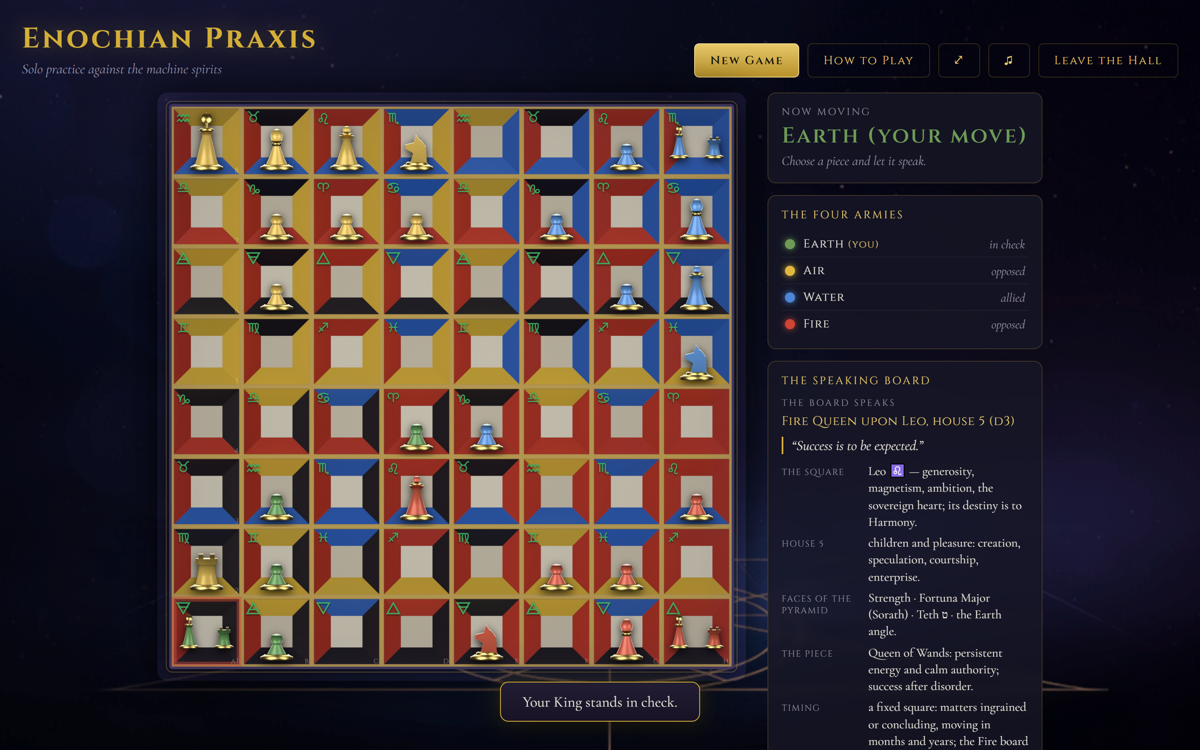
Once you see the concourse as a meeting of currents, the design of the Enochian board follows naturally. A duel between two sides could only ever show one opposition at a time. Four armies, one to each element, let all four forces be present at once and let their interactions play out together. Fire pushes, Water yields, Air darts, Earth holds, and the position at any moment is the sum of all four acting on one another. That is the concourse made visible: not a lecture about the elements, but the elements themselves crowded onto a single field, jostling for room.
Two alliances, one meeting-ground
The four armies do not scatter at random. They fall into two fixed teams that mirror the elemental cross of the Golden Dawn. Water and Earth play together as the receptive pair; Air and Fire play together as the active pair. This is why the concourse has structure rather than chaos: the forces meet, but they meet along lines the tradition already draws between them. The active side kindles and moves, the receptive side gathers and holds, and the game becomes a contest between those two temperaments. Every move you make is a small statement about which current is gaining ground.
How the game reads the concourse
Enochian Praxis treats the concourse as more than a background idea. In the app it is a formation the engine watches for and tracks, a weighty pattern in the position that the reading takes seriously. When the four forces gather in a way the system recognizes as a concourse, that arrangement is noted and carried into the divination rather than passing unremarked. The point is not a precise rule you memorize but a sensibility the game shares with its Golden Dawn roots: some meetings of the elements carry more charge than others, and the board is built to notice them. The exact weighting stays deliberately in the background, the way the tradition itself keeps the concourse a living principle rather than a fixed formula.
The concourse and the divination
None of this stays purely strategic. Every square of an Enochian board already carries a sign of the zodiac, a tarot trump, a Hebrew letter, and a geomantic figure, so any position is also a spread of symbols. When the forces come together in concourse, they do so across that lettered ground, and the pattern they leave can be read as an oracle. A game does not only decide who captured whom; it records where the elements met and how they were mingled at the end. That record is what the panel gathers into a reading, so the concourse you played through becomes the concourse you interpret.
Playing with the concourse in mind
You do not need to hold the whole doctrine in your head to feel it at the board. Watch which element is crowding the center, notice when the active pair is kindling faster than the receptive pair can hold, and pay attention to the squares where all four armies press close together. Those crowded squares are the concourse at its most intense, and they tend to decide both the game and the reading. Play them with care and you are practicing the old idea in a very concrete form: the forces are meeting in front of you, and your moves are part of how they resolve.
Watch the forces meet
The concourse is easier to feel than to describe. Start a free solo game and see how four elements crowd one board and shape the reading they leave behind.
Play NowKeep learning
Want to go deeper into the system behind the board? Read about the four elemental boards, see how a finished position becomes a reading in the divination guide, or check the glossary for the terms the tradition uses.