If you already play chess, three of the five Enochian piece types will feel familiar at once. The Knight makes the same L-shaped jump, the Bishop slides along diagonals, and the Rook slides along ranks and files, just as they do on an ordinary board. That familiarity is real, and it is also a little misleading. These three keep their old moves but lead very different lives: they share the board with four armies, any of them can begin the game stacked on a King's throne, each owns a pawn that will one day become it, and each carries a tarot court identity that matters when the finished game is read as an oracle.
The moves you already know
The Knight leaps in the usual L: two squares one way, one square at a right angle, over anything standing between. The Bishop runs any distance along a diagonal until another piece blocks the way. The Rook runs any distance along a rank or file under the same condition. None of this will surprise a chess player.
What changes their character is the company they keep. The Enochian Queen is not a long-range slider here; she leaps exactly two squares in any direction and can never move just one, a strange and wonderful piece we cover in the Queen, explained. The King steps one square. Pawns take a single step forward with no double first move. That makes the Bishop and the Rook the only pieces on the board that can cross it in one move. With four armies and thirty-six units at the start (the full roster is on the pieces page), open lines are scarce early and precious late, and the two sliders are the pieces that collect on them.
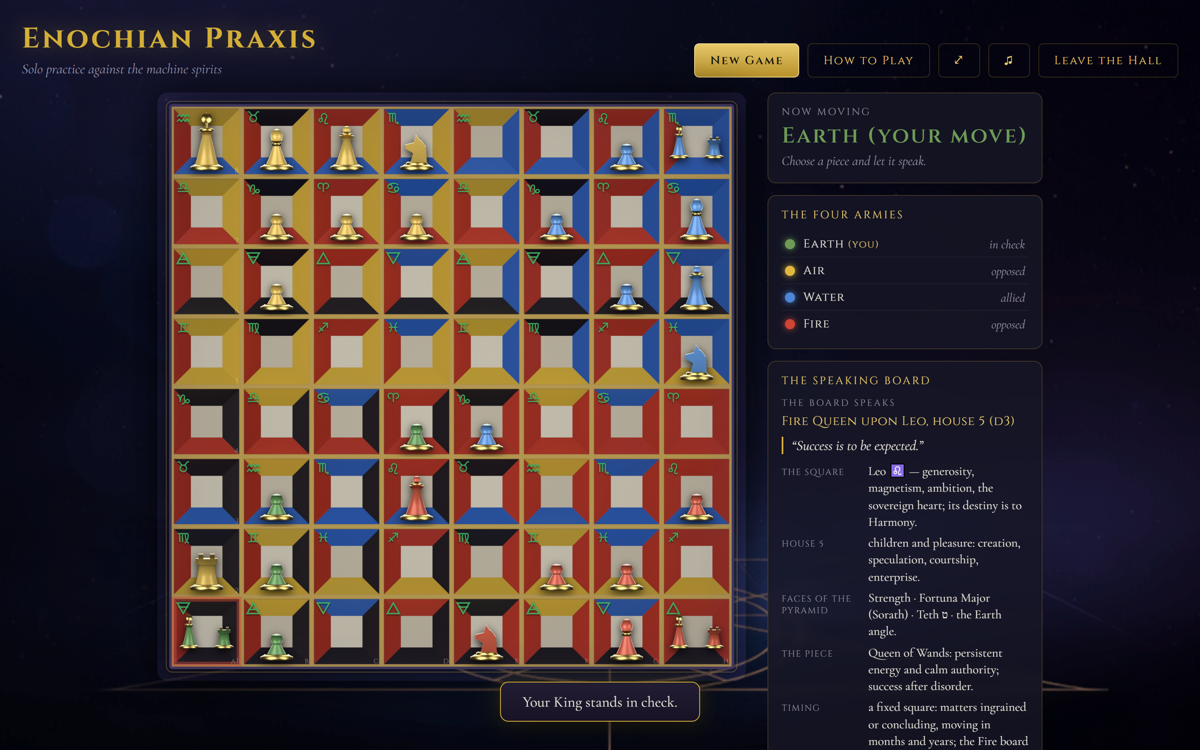
Frozen armies turn lines into walls
Enochian chess has no checkmate. Kings are captured outright like any other piece, and when an enemy takes a King, that King's whole army freezes where it stands (the full sequence is in how to play). Frozen pieces cannot move and cannot be captured. They give no check and threaten nothing. They simply sit on their squares as terrain.
For the Knight this barely matters. It jumps over frozen pieces the way it jumps over everything else; the only restriction is that nobody may land on a frozen square, because frozen pieces cannot be taken. For the Bishop and the Rook, freezing rewrites the late game. A diagonal that used to open with one capture can now dead-end into a frozen pawn no one can remove. A Rook's file can be walled off by an army that is no longer even playing. So before you trade down late, picture the board as it will look if an army freezes across your best lines. And remember the walls are not always permanent: a frozen army wakes again if its ally's King reaches its corner throne and takes command.
Thrones, settings, and the pawns that become them
Each army begins with its King doubled on the corner throne, sharing that single square with one major piece, the throne partner. Which piece that is depends on the setting, the opening array chosen for the game. There are eight settings, four used on the Fire and Earth boards and four on the Air and Water boards, and depending on the one in play, the throne partner may be the Knight, the Bishop, the Rook, or the Queen. Any of the three pieces in this article can start the game pressed against its King.
Ownership runs down to the pawns. Each of an army's four pawns stands in front of one major piece and belongs to it: the Rook's pawn, the Bishop's pawn, the Knight's pawn, the Queen's pawn. The pawn in front of the throne belongs to the throne partner, never to the King. When a pawn reaches its promotion edge, it becomes the piece it belongs to, so the Knight's pawn rises as a second Knight, the Rook's pawn as a second Rook. Promotion is delayed, though: no pawn may promote until its army has lost at least one pawn, and a pawn that arrives early stands waiting on the edge until that happens. Two wrinkles complete the picture. A pawn that promotes on a corner square becomes whatever piece shared the King's throne in that game's setting. And an army cut down to its King and one last pawn (alone, or with only a Queen or only a Bishop left besides) holds a privileged pawn, free to choose its promotion piece. The whole system is laid out in pawns and promotion.
The Bishops hold a concourse
The Bishop shares one more rule with the Queen: the concourse. Five two-by-two blocks of squares are marked on the board, one at the center (d4, d5, e4, e5) and four set in toward the corners. If a Bishop move leaves all four Bishops, one from each army and none of them frozen, standing alone on the four squares of one marked block, the moving Bishop captures both enemy Bishops at once and takes the allied Bishop under its guidance. The four Queens have the same rule among themselves. It happens rarely, but learn the marked blocks by sight, because a Bishop parked on one of them can be swept up the moment an enemy Bishop completes the four. Every marked block, and the fine print, is in the concourse rule.
Court cards and god-forms
Every Enochian piece is also a tarot card. An army's pieces are the court cards of its element's suit: Wands for Fire, Cups for Water, Swords for Air, Pentacles for Earth. Within the court, the Knight plays as the Knight of the suit, the Bishop as the Prince, and the Rook as the Princess. So the Fire Knight is the Knight of Wands, the Water Bishop is the Prince of Cups, and the Earth Rook is the Princess of Pentacles, and so on around the board. The full mapping is in Enochian chess and tarot.
The published Golden Dawn papers go further and set an Egyptian god-form on every piece. Earth's Knight carries Horus, the falcon-headed god. Earth's Rook carries Nephthys, sister of Isis. Fire's Knight carries Ra, the sun god himself. These attributions are not decoration: together with the zodiac and tarot correspondences assigned to the squares themselves, they are what let a finished game be read as a divination. When your Knight lands on a square, a court card meets a sign, and the position starts to say something.
Meet them on the board
The fastest way to learn how a Knight, Bishop, and Rook behave among four armies is to move them. Start a free game in your browser, solo against the computer or online with friends.
Play NowKeep reading
For all five piece types in one place, start with the piece guide. Then see how the Queen's two-square leap changes everything around her, or follow the pawns that grow up to become these pieces.