The King in Enochian chess moves one square in any direction, the same modest step he takes in the ordinary game. What changes is what he is worth. There is no checkmate here. Kings are captured outright, like any other piece, and an alliance wins the moment both enemy Kings are taken off the board. The published Golden Dawn papers build the whole endgame around that fact, and around three ideas ordinary chess never imagined: the frozen army, the rescue capture, and the seized throne.
One square, and a shared throne
Nothing about the King's step will surprise you. He walks a single square in any of the eight directions and captures the same way he moves. He is slow, short of reach, and easy to read, which is exactly why the rules around him carry so much weight.
His starting position is the strange part. Each army sets up in its own corner, and the corner square itself is the King's throne. He does not begin beside his pieces; he begins doubled on that one square with one of his four major pieces, the throne partner named by the game's setting, the opening array chosen for the board. Two units stand on a single square until one of them steps off. Which piece shares the throne matters all game long, because a pawn that promotes on a throne square becomes that same partner piece. Even the pawn standing in front of the throne belongs to the partner, never to the King. The King owns no pawn; he owns the game. You can see how every piece moves on the pieces page, and how the settings arrange each army in the full rules.
The check ladder
Check still exists, but it works as a ladder of duties rather than a hunt for mate. The published Golden Dawn papers give it four rungs. First: if a checked King has a safe square, he must move to safety. That is an obligation, not advice; a King who can save himself is required to. Second: if he can move but no square is safe, he may step anyway, into check if need be, or another piece may deal with the threat. Third: if he cannot move at all, another piece must resolve the check if any piece can. Fourth: if nothing can help, any move is legal, and the King may simply fall.
Outside of check the usual discipline holds: you may never move into check or expose your own King to it. Two quieter facts sit underneath the ladder. Allies never give check to each other. And frozen pieces give no check at all, so a fallen army's Queen staring at your King means nothing.
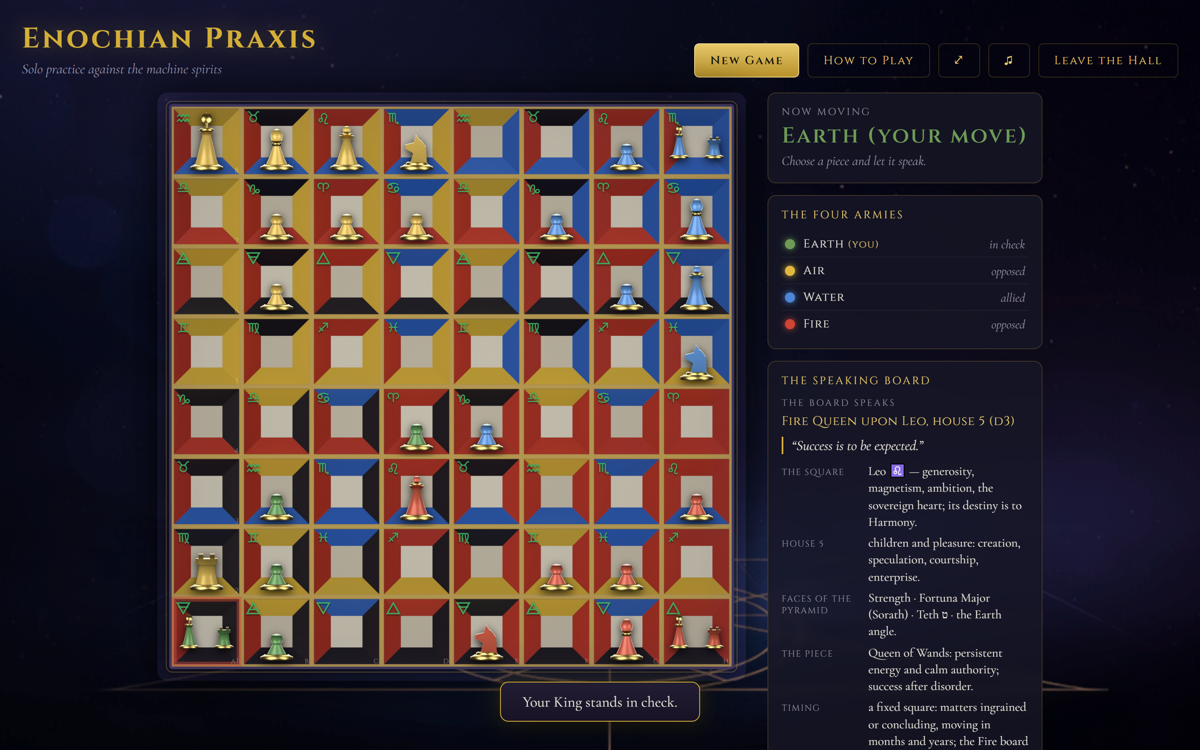
The fall and the freeze
When an enemy captures a King, the game does not end. Instead his entire army freezes where it stands. Frozen pieces become terrain: they cannot move, they cannot be captured, they block the lines of Rooks and Bishops, and they threaten nothing. A whole army turns to statuary in a single capture, and open lines you were counting on may close for the rest of the game. The freeze reshapes the board so thoroughly that it has its own article, Frozen Armies: When a King Falls. For the King himself the lesson is blunt. His life is not one goal among several. He is the army.
The rescue capture
Allies never capture one another, with one exception carved out for a King in danger. The moment check falls on a King, his partner gains the right to take him off the board himself, a move the game calls the rescue capture, and it is a kindness rather than a betrayal. For the rescued King the loss is closer to sanctuary than to death. He waits out the war in his ally's keeping, not in enemy hands, and since no enemy claimed him the freeze never arrives. His soldiers keep their posts, keep every move they had, and answer from then on to the partner King, who leads the rescued army alongside his own.
Why would you ever take your own partner? Because sometimes the ladder runs out. If the allied King is checked and no rung can save him, the enemy will take him next turn and freeze everything he leaves behind. Your capture freezes nothing. You trade his presence on the board for his army's continued life, and an army in motion can still fight for the win in a way no field of statues ever will.
Thrones, command, and waking the frozen
The throne squares never stop mattering. If your King reaches the throne of his ally, the corner diagonally opposite his own, he takes command of that whole army, and its pieces move under him from that point on. If the allied army had been frozen by the loss of its own King, seizing the throne wakes it: the statues stir and march again under the commanding King. A long walk across a hostile board, one square at a time, can bring a dead army back into the war. It is the largest single swing the game allows, and it gives even a battered position a live plan.
Command is not permanent. When a commanding King is himself captured, any army he led reverts: back to its own King's command if that King still lives, or back into the freeze if he does not. Command follows a living King and never outlasts him.
The Ace of his suit
In the tarot mapping from the published Golden Dawn papers, the King does not correspond to the tarot King at all. He is the Ace of his suit: the Fire King is the Ace of Wands, the Water King the Ace of Cups, the Air King the Ace of Swords, and the Earth King the Ace of Pentacles. The fit is easy to feel. The Ace stands for the element itself gathered into one card, and the King is the piece whose life the whole element depends on. Take him and the element stops; seat him on a throne and it moves again. The squares he walks carry their own attributions, which is how a finished game becomes a reading. See the divination page for how a position is read, and the four boards for the elemental fields he crosses.
Walk a King yourself
Rescue captures and throne seizures make far more sense on a live board than on a page. Start a free game against the computer and see how long you can keep both of your alliance's Kings standing.
Play NowKeep reading
Start with what Enochian chess is, get the complete rules of play, or read how a game is actually won.