There is no checkmate in Enochian chess. A King in trouble is not cornered and declared beaten; he is captured outright, taken from the board like any other piece. And the moment an enemy takes him, something happens that no ordinary chess game prepares you for. His entire army freezes where it stands. Every surviving piece stays on its square as inert terrain: it cannot move, it cannot be captured, it blocks the lines it stands on, and it threatens nothing. The game continues around the wall. This is the signature mechanic of the four-handed board, and playing well means understanding it from both sides.
A King falls like any other piece
The published Golden Dawn papers protect the King with a strict ladder rather than a mate rule. A King in check must move to a safe square if he has one. If he can move but no square is safe, he may step into danger anyway, or another piece may answer the check. If he cannot move at all, another piece must resolve the check if it can. And if nothing can help, any move is lawful and the King may simply fall. The whole sequence is covered in the full rules, and the King has a page of his own. What matters here is the bottom rung of that ladder: Kings really do get taken, and the freeze is what taking one does to the board.
What a frozen piece can and cannot do
The freeze lands on the whole army at once, the instant an enemy captures its King. From that move on, every piece of the fallen army is fixed to its square. It cannot move, not one square, not ever, unless the army is later woken. It cannot be captured, which means the enemy cannot clear it out of the way at any price. It gives no check and makes no threats; a frozen Rook staring down your King is scenery, nothing more. And it blocks lines exactly the way a living piece does: the Rook and Bishop cannot slide through a frozen piece, while the Knight and the leaping Queen pass over frozen squares the way they pass over everything else. No one, friend or enemy, can land on a square a frozen piece occupies.
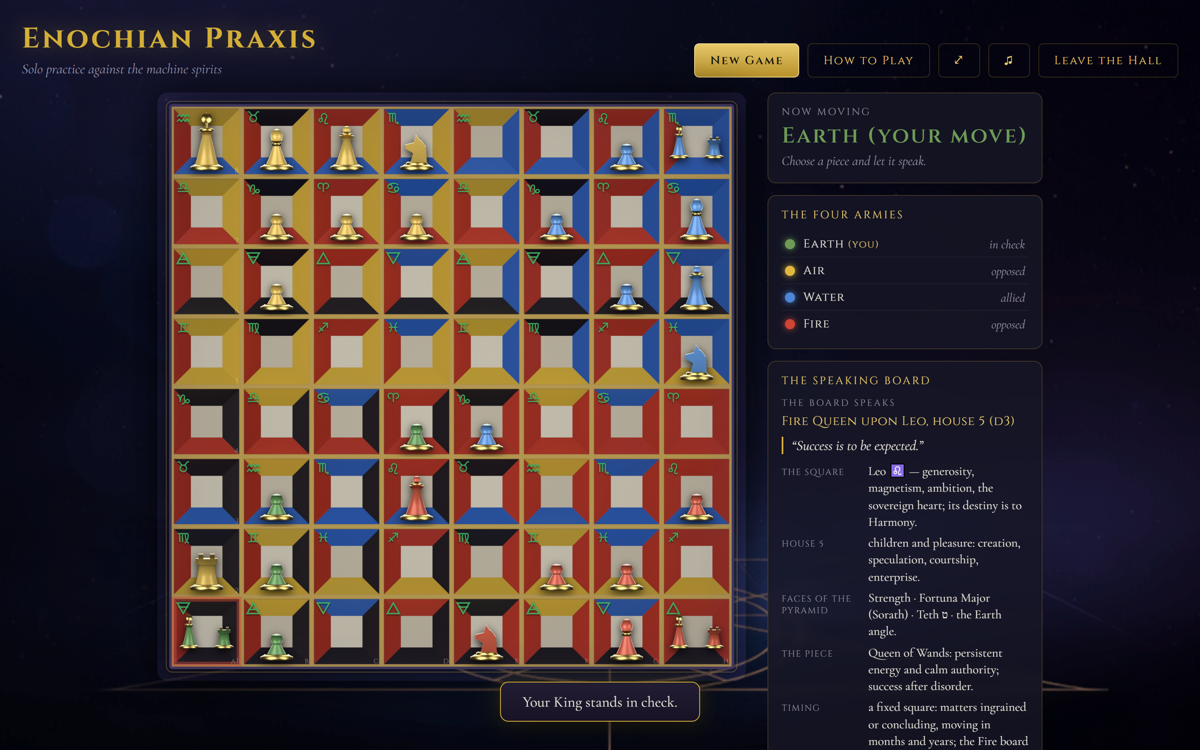
How a frozen wall reshapes the position
Think of a freeze as the board suddenly growing walls. Files and diagonals that were open a move ago now end at pieces that will never move and can never be removed. Ground is denied: every frozen square is off limits to every army, so pawn paths close, Kings lose flight squares, and attackers lose landing squares in the most contested part of the board. A freeze that catches an army mid-advance leaves its pieces scattered like boulders across the center. A freeze that catches it at home leaves a ring of stone around its corner. Either way the geometry of the game changes in a single capture, and plans laid two turns earlier can stop making sense.
Waking the frozen: the march to the throne
A frozen army is not dead. It is waiting for a commander. Each army has a throne, the corner square where its King began the game, and a King who reaches his ally's throne takes command of that army. If the allied army was frozen, reaching its throne reactivates it: the whole force wakes and moves again under the commanding King. This hands the surviving allied King one of the strongest long plans in the game. A slow march across a hostile board, ending on one corner square, can bring an entire army back from stone.
Rescue capture: refusing the freeze
The papers also give an alliance a way to dodge the freeze before it happens. When a King stands in check, his own ally may capture him instead of leaving him to the enemy. A King taken by his ally is held in trust. His army does not freeze; it fights on under the ally's command. Capturing your own partner sounds like betrayal, but it is the opposite. It turns a coming catastrophe into a merger. Where the enemy would have gained a wall of dead material, the alliance instead has two armies answering to one King, all of them still moving.
Reversion: when the commanding King falls
Command lasts only as long as the King who holds it. When a commanding King is himself captured, any army he commanded reverts to its own command if its King still lives, or freezes again if not. An army woken at the throne can turn back to stone the moment its commander is taken. The freeze is never truly settled until the game ends.
The strategy of the freeze
Freezing an enemy army is nearly winning half the game. An alliance wins the moment both enemy Kings are taken, and capturing the first one removes an entire army from play, cuts the enemy's active material roughly in half, and leaves a single King to hunt. Most winning plans in Enochian chess run through a freeze.
But the wall cuts both ways. Frozen pieces cannot be captured and they close lines, so the surviving enemy King can shelter behind his partner's stone formation, where Rooks and Bishops cannot reach him and attackers find no squares to land on. The very wall you built by taking the first King can become the fortress that protects the second. And the survivor has a plan of his own: reach the frozen army's throne and wake it. Many endgames become a race, your hunt against his march. Take the second King before he sits the frozen throne, and the field is yours.
See a freeze for yourself
Reading about walls is one thing; watching a quarter of the board turn to stone is another. Start a free game against the computer and play until a King falls.
Play NowKeep reading
Start from what Enochian chess is, plan around the wall with a full look at strategy, or study the four elemental boards the game is played on.