You win at Enochian chess by capturing both enemy Kings. That is the entire condition. There is no checkmate: a cornered King is not the end of anything, because Kings in this game are taken off the board like any other piece. The four armies fight in two fixed alliances, Air and Fire against Water and Earth, with each ally seated at the corner diagonally opposite its partner. An alliance wins and loses together, and it holds the field the moment the second enemy King falls. Everything else in the game bends toward or away from that moment.
No checkmate, only capture
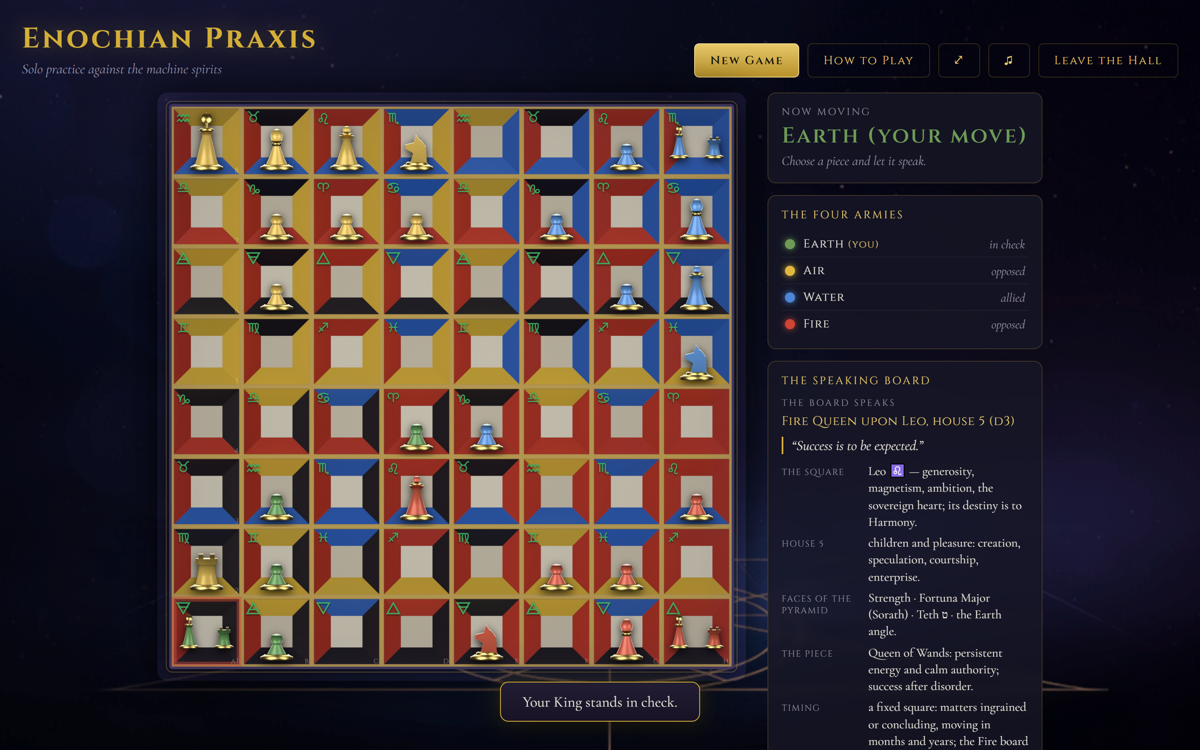
Ordinary chess ends one move early. The King is never actually taken; the game stops the instant his capture becomes unavoidable. Enochian chess refuses to stop. The published Golden Dawn papers treat the King as mortal, and the game plays straight through the moment that other chess politely skips. If your King stands in check and nothing can save him, he can simply be captured, and play continues around a board that has just changed shape.
That difference carries a larger one inside it. Losing a King does not lose the game. Your ally fights on, and your own army may even return to the fight later, as you will see below. The game ends only when one alliance has taken both Kings on the other side. If you want the complete rules in order, the how to play page walks through a full game from setup to the last capture.
The check ladder
Check still exists, and it is taken seriously. When a King comes under attack, the published Golden Dawn papers prescribe a strict ladder of responses. First, if the King has a safe square to move to, he must move to it. Not a piece interposing, not a counterthreat elsewhere: the King himself flees. Second, if the King can move but no destination is safe, he may step into check anyway, and that move is lawful, or another piece may resolve the check instead. Third, if the King cannot move at all, another piece must answer the check if any piece can. Fourth, if nothing can help, any move is allowed, and the King may simply fall.
Outside of check the familiar rule holds: you may never move into check or expose your own King to attack. Two details narrow the danger. Frozen pieces give no check, and allies give no check, so only the living pieces of the enemy alliance can threaten a King.
Freezing: when a King falls
When an enemy captures a King, that King's entire army freezes. The pieces stay exactly where they stand and become inert terrain. They cannot move. They cannot be captured. They attack nothing and they give no check. They do still block the lines of sliding pieces like the Bishop and Rook, so a frozen army reshapes the board into a field of obstacles that neither side can clear away.
A frozen army is not gone, though. It waits, and the rules give it two lifelines: one that prevents the freeze before it happens, and one that undoes it afterward.
The rescue capture
The first lifeline is prevention. When a King stands in check, his own ally may capture him. It sounds like treachery and works like mercy: a King taken by his ally is held in trust, not defeated, and his army does not freeze. It fights on under the ally's command as part of one force. Handing your King to your partner is a real sacrifice, but it keeps the whole army on the board and moving instead of letting the enemy turn it to stone.
Thrones, seizure, and reactivation
The second lifeline runs through the thrones. Each army begins at its own corner square, its throne, where the King starts the game sharing the square with one companion piece. Thrones matter to the win condition because of one rule: a King who reaches his ally's throne takes command of the allied army. If that army was frozen, the seizure wakes it. The pieces stir and move again under the visiting King's orders. A game that looked settled can turn around entirely when a patient King walks across the board and sits down on his partner's corner.
Command is mortal too. When a commanding King is himself captured, every army he commanded reverts: back to its own King's command if that King still lives, or back to frozen stillness if he does not.
The four draws
Not every game produces a winner. Enochian chess recognizes four drawn endings. The hundred-move rule ends the game when one hundred consecutive moves pass with no capture and no pawn advance. Bare Kings draws the game when only the four Kings remain on the board; with nothing else standing, nothing more can be decided. The bare alliance draw applies when one alliance is reduced to its two Kings alone, with no other pieces left; rather than force a hopeless chase, the game calls it even. And the locked board ends the game when no army can move at all.
Taken together, these rules refuse to reward endless shuffling. If you cannot bring down both enemy Kings, you have not won, and the game will eventually say so.
One more thing the ending gives you
Whatever the result, the final position is more than a score. Every square of the four elemental boards carries divinatory attributions, and a finished game can be read as an oracle. The divination page explains how a reading works, and the boards page introduces the four elemental fields a game can be fought on.
Quick answers
How do you win at Enochian chess?
You win by capturing both enemy Kings. The four armies fight in two fixed alliances, and an alliance holds the field the moment the second enemy King is taken. There is no checkmate to deliver; the Kings themselves must fall.
Is there checkmate in Enochian chess?
No. Kings are captured outright, like any other piece. A checked King must flee to a safe square if one exists, but when nothing can save him he simply falls, and play continues until both Kings of one alliance are gone.
What happens when a King is captured in Enochian chess?
If an enemy takes a King, that King's whole army freezes: its pieces stay on their squares but cannot move, cannot be captured, and threaten nothing. If the King's own ally captures him instead, he is held in trust and his army does not freeze; it fights on under the ally's command. A frozen army can also be reawakened when the allied King reaches its throne.
Can Enochian chess end in a draw?
Yes, in four ways: one hundred consecutive moves with no capture and no pawn advance, only the four Kings left on the board, one alliance reduced to its two bare Kings, or a board so locked that no army can move at all.
Hunt both Kings yourself
The fastest way to understand the win condition is to play for it. Start a free game against the computer, no account needed, and watch how the board changes when the first King falls.
Play NowKeep reading
New to the game? Start with what Enochian chess is, walk through the full rules, or sharpen your two-King hunt with our strategy guide.