Every piece in Enochian chess carries the name of an Egyptian god. The published Golden Dawn papers assign a god-form to the King and each of the four major pieces in all four elemental armies, and four more names to the pawns. Osiris rules the Earth army, Ra rides as the Knight of Fire, Isis stands as the Queen of Earth. Some of the other names are far stranger, and part of the pleasure of the table is meeting them. This article gives the complete list, explains what a god-form was in the order's practice, and shows where the names sit inside the game's larger web of correspondences.
The full table, element by element
Here is the assignment exactly as the papers give it. Each army fields nine units: a King, four major pieces, and four pawns. The King and the majors take five named gods per element, twenty in all.
| Army | King | Knight | Queen | Bishop | Rook |
|---|---|---|---|---|---|
| Earth | Osiris | Horus | Isis | Aroueris | Nephthys |
| Air | Socharis | Seb | Knousou Pekht | Shu Zoan | Tharpeshest |
| Water | Ptah | Sebek | Thoueris | Hapimon | Shooen |
| Fire | Chnupis Kneph | Ra | Sati-Ashtoreth | Toum | Anouke |
The pawns take their names differently. Every pawn in this game belongs to the major piece it stands in front of: it is the Rook's pawn, the Bishop's pawn, the Queen's pawn, or the Knight's pawn, and in the normal case it promotes to the very piece it belongs to. The pawn god-forms follow that ownership rather than the element, so the same four names serve all four armies. No pawn belongs to the King; the pawn in front of the throne belongs to the piece that shares it.
| Pawn | God-form |
|---|---|
| Knight's pawn | Kabexnuv |
| Queen's pawn | Tmoumthph |
| Bishop's pawn | Ahephi |
| Rook's pawn | Ameshet |
Sixteen pawns, four names. Add the twenty named Kings and majors and every one of the thirty-six units on the board answers to a god.
What a god-form was
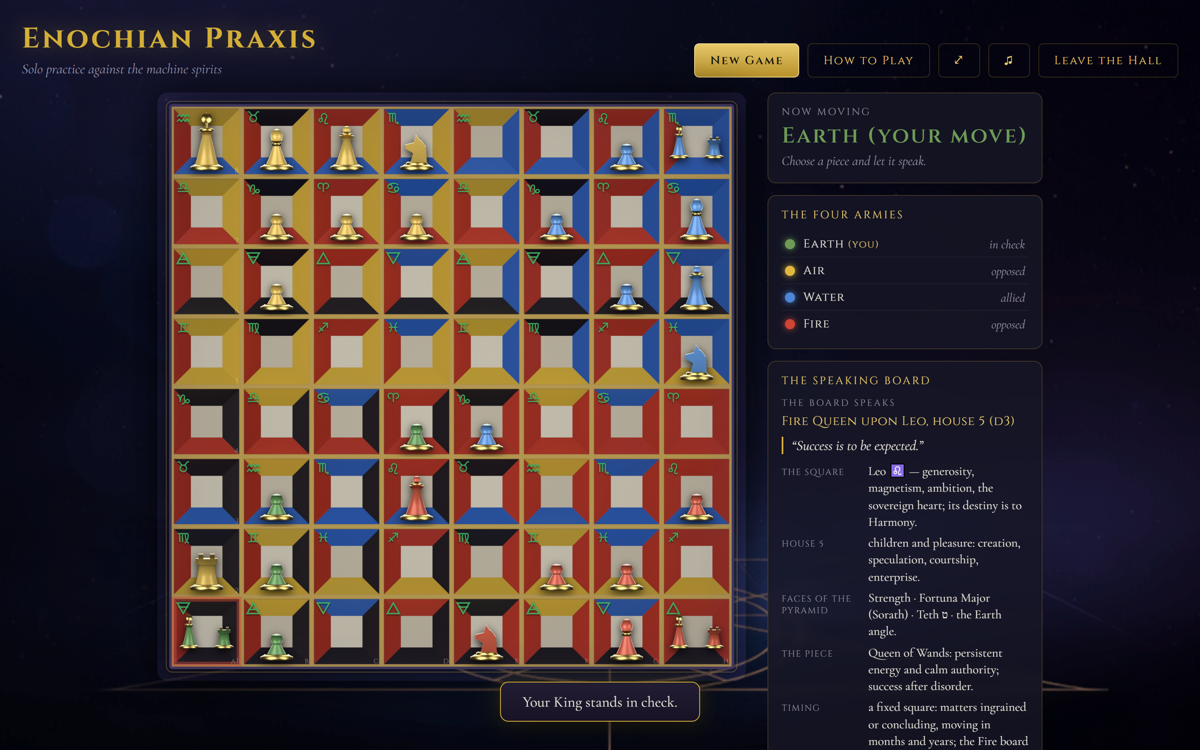
A god-form, in Golden Dawn practice, was a visualized divine image: a picture of the god built and held in the imagination, which the practitioner identified with. Applied to the chessboard, it means the pieces were never meant to be neutral tokens. The player was to see the Earth King not as a bit of painted wood but as Osiris, and to move the piece with that image in mind. The papers treat the game as a study and divination instrument for advanced members of the order, and the god-forms are part of what made it one: they kept the living symbolism of the elements in front of the player on every single move. Beyond that broad picture the published papers are the authority, and this article will not embroider them.
The famous names
Five of the names need no introduction. Osiris, King of Earth, is the god of the dead who is slain and restored, the great judge of the underworld. Isis, Queen of Earth, is the great mother goddess and his wife. Horus, the Knight of Earth, is their falcon-headed son. So the Earth army keeps the most famous family in Egyptian myth together at one corner, with Nephthys, the sister of Isis, standing as its Rook. Away from Earth, Ra, the Knight of Fire, is the sun god who crosses the sky by day, a fitting rider for the most active element. And Ptah, King of Water, is the creator god of Memphis, the patron of craftsmen.
The obscure names
The rest of the table is stranger, and it is fair to say so plainly. Names like Aroueris, Socharis, Knousou Pekht, Shu Zoan, Tharpeshest, Hapimon, Shooen, Chnupis Kneph, Sati-Ashtoreth, Toum, and Anouke are given here exactly as the papers render them, and some are obscure renderings of Egyptian names. The order worked from the Egyptology available in the late nineteenth century, and its spellings do not always match what a modern museum label would print. The pawn names, Kabexnuv, Tmoumthph, Ahephi, and Ameshet, are of the same kind. The sensible course is to take them as the papers give them: working labels in a symbolic system, not entries in a dictionary of Egyptian religion. A little strangeness clings to every table in this game, and it does no harm to let it.
Where the god-forms sit in the larger system
The divine names are one layer of several. Every piece also carries a tarot court card: the King reads as the Ace of its element's suit, the Queen as the Queen, the Bishop as the Prince, the Knight as the Knight, and the Rook as the Princess, with Fire speaking through Wands, Water through Cups, Air through Swords, and Earth through Pentacles. Put the two layers together and the Queen of Earth is Isis and the Queen of Pentacles at once. The pieces page walks through that full mapping. Underneath the pieces, every square of the four elemental boards carries attributions of its own, signs of the zodiac and tarot trumps among them, which is what lets a finished game be read as an oracle. The boards page covers the squares, and the divination page covers the reading. The god-forms crown the whole stack: they are the moving figures of the drama for which the squares set the scene.
Do you need the names to play?
No. The moves are identical whether you think of the Fire Knight as Ra or simply as a horse, and if you are here for the game you should start with the rules and let the names arrive in their own time. But the papers did not attach them idly. The game reached the public through Israel Regardie's publication of the order's papers, and those papers present the board as an instrument of study first and contest second. A gentle way in: learn one or two god-forms per game, starting with the army you like to command, and the board slowly gains a cast of characters. The history page tells the longer story of where the game and its symbols came from.
Put the pantheon in motion
Start a free game against the computer, no account and no download, and move Osiris, Isis, and Ra yourself. The names mean more once the pieces are yours.
Play NowKeep reading
For the mechanics behind the names, read about the pieces, see how a finished game becomes a reading, or trace where the game came from.