A pawn in Enochian chess moves one square straight forward and captures one square diagonally forward. That is the whole move: no double first step, no en passant. The interesting part is everything wrapped around it. Four armies march in four different directions. Every pawn belongs to one particular piece and normally promotes only into that piece. Promotion itself can be made to wait, corner squares change what a pawn becomes, and an army near ruin earns its last pawn a rare freedom. Here is how all of it works.
One square at a time
Pawns walk. Each move carries a pawn one square straight forward, and it captures one square diagonally forward to either side. The published Golden Dawn papers give pawns no double first step, and since en passant exists in modern chess only to answer the double step, there is no en passant here either. A pawn that wants the far edge earns it one square at a time, across a board where three other armies are moving.
That pace matters. With no opening sprint, pawn play develops slowly and deliberately, and a pawn that has crossed most of the board represents real invested effort. Losing one late in its march costs far more than losing one at home.
Four armies, four directions of march
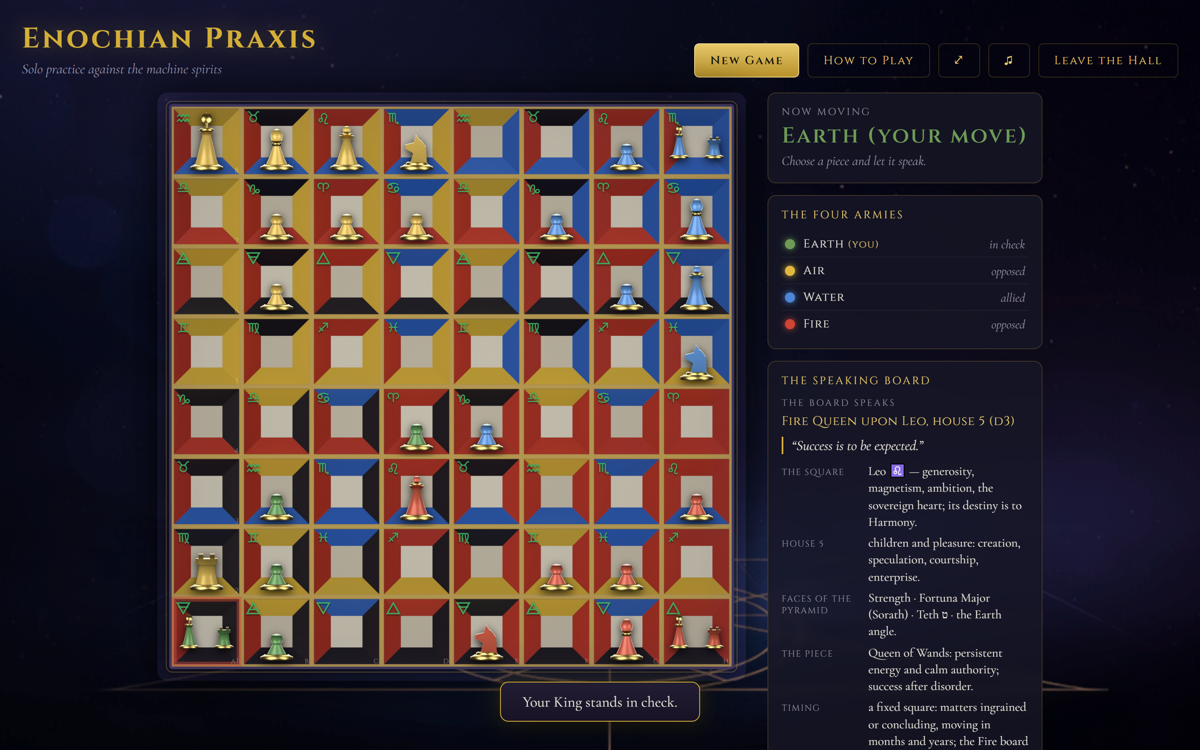
Forward points a different way at each corner. The four armies begin at the corners of one shared board: Earth at a1, Air at a8, Water at h8, Fire at h1. Earth's pawns march across the board toward file h. Water's pawns march the opposite way, toward file a. Fire's pawns climb toward rank 8, and Air's pawns descend toward rank 1. The far edge in an army's marching direction is that army's promotion edge.
Two things follow. A square that one army's pawns can never attack may sit directly in another army's path, because pawn threats arrive from four directions instead of two. And the promotion square is not one fixed rank: Earth promotes on the h file, Water on the a file, Fire on rank 8, and Air on rank 1. The board guide lays out this geometry in full, and the four elemental boards give the same layout four different faces.
Every pawn belongs to a piece
At the start of the game, each of an army's four pawns stands directly in front of one major piece, and it belongs to that piece for the rest of the game. There is a Rook's pawn, a Bishop's pawn, a Queen's pawn, and a Knight's pawn. One major piece begins the game doubled with the King on the throne, the army's corner square, and the pawn in front of that shared throne belongs to the throne partner, never to the King. Which piece that is depends on the setting, the opening array chosen for the game.
The papers treat this ownership as identity, not bookkeeping. Each pawn type carries its own Egyptian god-form: Ameshet for the Rook's pawn, Ahephi for the Bishop's, Tmoumthph for the Queen's, and Kabexnuv for the Knight's. A pawn here is not an anonymous foot soldier. It is the servant of one particular piece, and its future is fixed by that service. The pieces guide introduces the majors themselves, along with the tarot court each one answers to.
Promotion is decided in advance
When a pawn reaches its promotion edge, it normally becomes the piece it belongs to and nothing else. The Queen's pawn becomes a Queen. The Rook's pawn becomes a Rook. The Bishop's and Knight's pawns become a Bishop and a Knight. There is no menu.
That one rule reshapes pawn strategy from the first moves. In modern chess every pawn is a possible future queen, so pawns are nearly interchangeable. Here, in the normal course of play, only the Queen's pawn can become a Queen. You know exactly what each pawn is worth at the far edge, and so does everyone else at the table. Which pawns you trade away and which you shepherd forward becomes a genuine decision, made pawn by pawn.
Delayed promotion: the pawn that waits
Reaching the edge is not always enough. Promotion waits until the army has lost at least one pawn. A pawn that arrives at the promotion edge while all four of its army's pawns still survive stays a pawn: it stands on the edge and waits. The moment its army loses any pawn, the waiting pawn promotes automatically.
This produces a sight modern chess never shows: a pawn standing on the last square of its march, still a pawn, sometimes for many turns. It also produces strange incentives. An opponent may refuse an easy capture of one of your pawns because that capture would instantly wake the piece waiting at the edge. In a four-army game those small refusals matter; every player at the table can count your pawns, and everyone knows what your waiting pawn will become.
Throne promotion: what corners make
Corner squares are thrones, and every promotion edge ends in two of them. A pawn that promotes on a corner square becomes the piece that shared the King's throne in that game's setting, whatever piece the pawn itself belongs to. If the setting seats the Queen beside the King, a corner promotion produces a Queen, whichever pawn earned it.
This gives edge pawns a second possible destiny, and it ties promotion back to the setting chosen before the first move. You can read the full rules, from setup to the end of the game, on the how to play page.
The privileged pawn
The papers reserve one last grace for an army that has almost been destroyed. When an army is reduced to its King and a single pawn, either alone, or with only a Queen besides, or with only a Bishop besides, that last pawn becomes privileged. On promotion it may choose its piece freely: Rook, Knight, Bishop, or Queen.
The rule carries a sharp edge. If the privileged pawn chooses a piece its army already has on the board, the living twin is demoted back to a pawn. Promote to a second Queen while your Queen still stands, and the old Queen becomes a pawn again. In material the army ends where it began: King, Queen, and pawn. But the Queen is new, standing on the promotion edge, and the pawn is the old Queen, starting over. The choice is genuinely free, and never free of consequence.
Pawns look like the smallest part of Enochian chess. They set its tempo. Promotions, and the pawn losses that release them, carry a game out of its careful opening and into its middle fights, and the pawn you protected across the whole board can decide the end. Learn what each pawn carries and you will read all four armies better.
March one across yourself
Play Enochian chess free in your browser, solo against the computer or live online with friends. The game handles every promotion rule for you, waiting pawns and all.
Play NowKeep reading
Meet the rest of the army in the pieces guide, read how the Queen's two-square leap works, or start from the beginning with what Enochian chess is.