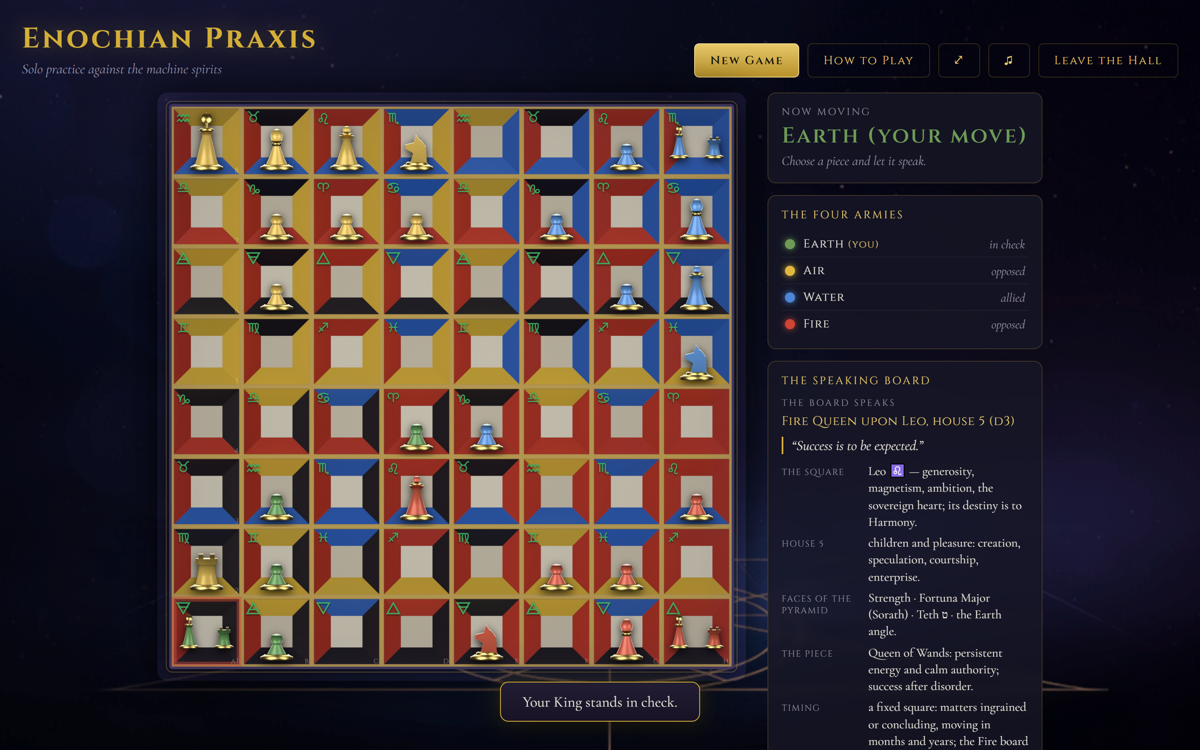
Enochian chess has no opening book. The published Golden Dawn papers set out rules and symbolism, not move lists, and no tradition of named lines ever grew up around the game. What the game has instead is a distinct opening problem. Four armies begin packed into four corners, each crowded behind its own pawn wall, each King sharing a single square with another piece. Your first moves are not about grabbing the center or launching an attack. They are about getting your own pieces out of each other's way, a little faster than the two enemy armies doing the same thing against you.
The corner you start in
Each army begins with nine units in its corner: a King, four major pieces, and four pawns. The King starts doubled on his throne, the corner square itself, sharing it with one major piece. Which piece that is depends on the setting, the opening array chosen for the game; there are eight of them, four used on the Fire and Earth boards and four used on the Air and Water boards. The remaining majors fill out the corner in an order the same setting decides, and one pawn stands in front of each major piece. Every pawn belongs to the piece behind it: the Rook's pawn, the Bishop's pawn, the Queen's pawn, the Knight's pawn. Even the pawn in front of the throne belongs to the throne partner, never to the King.
The result is a wall. Your Rook and Bishop stare into the backs of their own pawns. Your King has a piece standing on his square. Nothing in the position is loose or ready, and the same is true in the other three corners. Whoever untangles first makes the first real threats.
Send the Queen out first
The Queen is the piece built for cramped corners. She leaps exactly two squares in any of the eight directions, and she jumps whatever stands between, friend or enemy. Nothing blocks her, which means her own pawn wall is no wall at all: she can leave the corner on her very first move, sailing over the pawn in front of her. She cannot move one square, ever, so think of her squares in twos. From any square she has at most eight landing spots, and the useful opening habit is to pick the leap that carries her toward where the fighting will be, not merely the one that gets her out. Her odd gait is covered in full on the pieces page.
One caution while the Queens come out. Five two-by-two blocks of squares are marked for the concourse: one at the center of the board and four near the corners. If a Queen move ever leaves all four Queens standing alone on the four squares of one block, the moving Queen captures both enemy Queens outright. It is a rare event, but the near-corner blocks sit exactly where early Queens like to land, so learn where they are before you leap.
Knights jump the wall
The Knight is your other day-one piece. He moves exactly as he does in ordinary chess, the same L-shaped jump, and a jump does not care about walls. A Knight can clear the pawns immediately, the way a knight on b1 reaches c3 before a single pawn has moved. Between the Queen's leap and the Knight's jump, every army has two pieces that can act before any pawn steps forward, and most sound openings use both.
Sliders need a road
The Rook and Bishop move as they do in ordinary chess, straight lines and diagonals, and like ordinary sliders they stop at the first thing in their path. In the corner, the first thing in their path is their own pawn. Neither piece can do anything until a pawn steps aside, so pawn moves are how you open roads.
Pawns here are slower than the pawns you know. A pawn moves one square straight forward and captures one square diagonally forward, and that is all: no double first step, no en passant. Opening a diagonal for the Bishop or a line for the Rook costs real turns, so choose. Decide early which slider you want in the game first and spend your pawn moves on that one road, rather than nudging every pawn once and freeing nothing. The full movement rules live on the how to play page.
Which way the pawns march
Forward is not where you think it is. Each army's pawns march toward the far edge of the board in that army's own direction: Earth's pawns, starting from the a1 corner, walk across the board toward file h. Water's walk the other way, toward file a. Fire's climb toward rank 8, and Air's descend toward rank 1. If you sit where an ordinary White player sits, two of those armies push their pawns sideways and one pushes them straight down. That far edge is each army's promotion edge, and because all four directions run through the middle of the board, the four pawn chains cross there. The center gets congested in a way ordinary chess never prepares you for, and the crossing point is where early pawns start meeting each other. The geometry is the same on all four elemental boards; what changes between them is the symbolism.
Time your moves with your ally
You do not open alone. Your ally holds the corner diagonally opposite yours, and turn order rotates around the board, so the two alliances alternate: an enemy moves, then your ally, then the other enemy, then you again. Your ally acts once between every pair of your moves. In the default sunwise rotation the order runs Earth, Air, Water, Fire, and the board's own element moves first, so on the Fire board it is Fire that opens the game.
For the opening this means two things. First, plan in pairs. Any idea that needs two of your moves hands every other army a move in between, so prefer developing moves that stay useful even after the position shifts. Second, treat development as an alliance project. With two players you command both allied armies yourself and can unpack them toward the same region of the board. With four, you cannot move your ally's pieces, but you can choose which enemy to lean on, so the two of you are not both shoving at the same corner while the fourth army develops in peace.
Good habits, not book lines
There is no catalogue of named openings to memorize, and this article will not invent one. What holds up instead is a short list of habits. Leap the Queen out early. Jump at least one Knight over the wall. Spend your pawn moves in one place, on the road your chosen slider needs. Keep the King quiet on or near his throne; he moves one square at a time and the opening has nothing for him to do. And respect the rotation: your next move is always three armies away, so a threat you leave standing will be collected before you can answer it. If you are brand new to the game, start with what Enochian chess is and the rest of this will click faster.
Try your first opening
The fastest way to learn the untangle is to play it. Start a free game against the computer, no account needed, and watch how each army gets its pieces out.
Play NowKeep reading
Learn the complete rules of play, see how a finished game becomes an oracle in divination, or step back for the wider strategy guide.