The short answer is yes, and it is one of the most common ways the game is actually played. Enochian chess seats four elemental armies, so people assume it needs four players the way modern four-player chess does. It does not. The four armies are bound into two alliances, and an alliance is the real unit of play, not the single army. Once you see that, two players sharing the board stops feeling like a compromise and starts feeling like the natural shape of the game.
Two alliances, not four sides
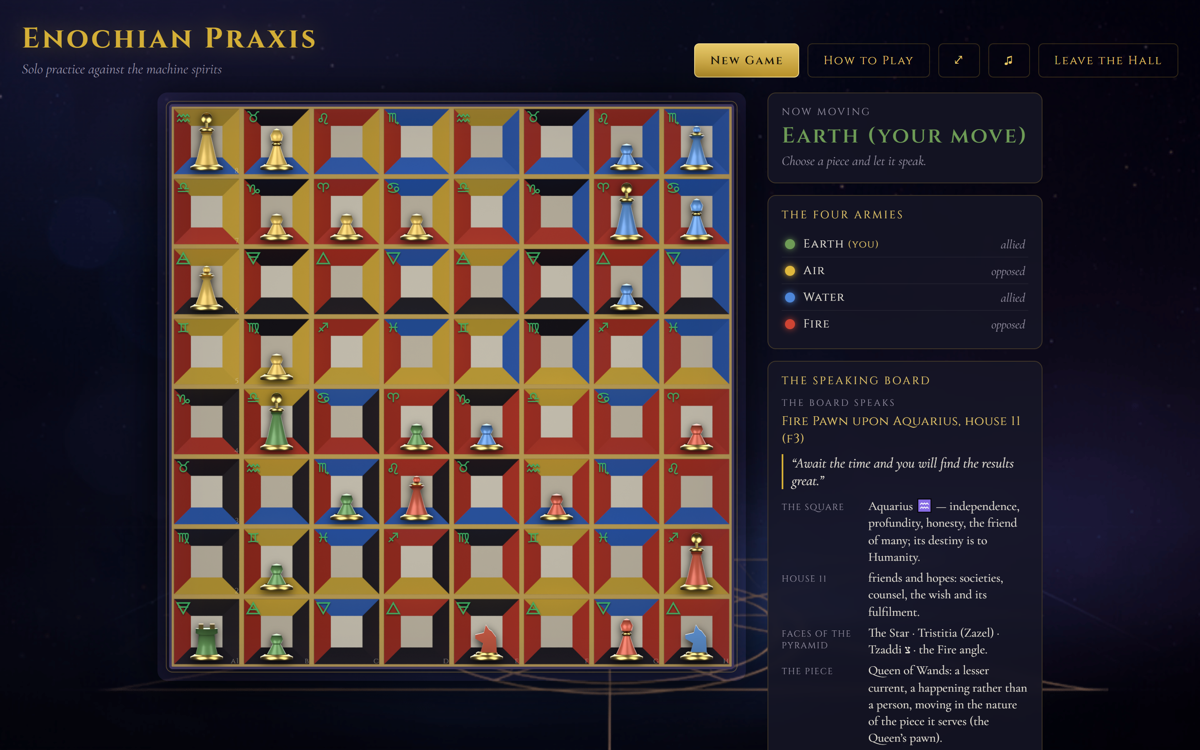
Every Enochian game is a contest between two teams that never change. Air and Fire play together as the active side. Water and Earth play together as the receptive side. You cannot capture your own ally, you win and lose together, and the two armies of an alliance sit at corners that face each other across the diagonal rather than side by side. Because those allied corners are diagonally opposite, the ordinary rotation around the board alternates the two sides on every turn, so the sides stay balanced no matter how many people are holding the pieces.
How two players share the board
With two people, each player takes an entire alliance. One holds Air and Fire, the other holds Water and Earth. Play still rotates through all four armies in the fixed order, so on your turn you move one of your two armies, then your opponent moves one of theirs, then you move your second army, then they move their second. You are effectively running two coordinated attacks at once, from opposite corners, against an opponent doing the same. It rewards a particular kind of thinking. You are not just pushing one force forward; you are timing two of them so they arrive together.
This is why players who come from ordinary chess often find the two-player game harder than they expect, even though the piece count per person is the same. You have to hold two positions in your head and keep them cooperating, and your two armies move on different turns rather than together. The reward is that the game opens up. A threat you cannot answer with one army can sometimes be answered by the other reaching across the board.
One, three, or four players work too
The same board flexes to any count from one to four. A single player can run all four armies alone, moving each in turn, which is the classic way the game was used for study and the fastest way to learn the flow of a full game. Three players split unevenly: one person holds an allied pair while the other two each take a single element, which keeps both sides at full strength. Four players is the full table, each commanding one element and answering only for it, leaning on a partner they cannot control but must not abandon. None of these change the rules. They only change how many hands are on the same four armies.
Playing two-player online
Sitting across a physical board is lovely, but you do not need one. The online game lets two people claim thrones from anywhere, and it handles the alliance bookkeeping for you: it seats each player, keeps the rotation honest, and speaks the same board state to both screens so nobody has to trust the other's memory of whose turn it is. Two, three, and four seat games all run on the same board, and empty thrones can be held by the computer so a game is never short a side. When you want a partner, invite one; when you want to think in quiet, play all four yourself.
Bring a second player
Try the two-player game the way it is meant to be felt: two alliances, two minds, one speaking board. Start a free game and claim a throne, or run all four armies solo to learn the rotation first.
Play NowKeep reading
New to the whole thing? Begin with what Enochian chess is, learn the full rules, or see how the elements pair into their two alliances.