Chaturaji is the ancient four-handed relative of chess, played on a standard eight-by-eight board with a small army in each corner and, in many accounts, dice that told a player which piece to move. Enochian chess also seats four armies at the four corners of an eight-by-eight board, which is why the two get set beside each other. Look past the shape, though, and they part ways fast. Chaturaji is a lean old contest of points and captures, decided partly by the throw of the dice. Enochian chess is a fixed-alliance elemental game with no dice at all, and it is the only one of the two that a player can read afterward as an oracle.
The shape they have in common
Start with what genuinely lines up. Neither game widens the board. Chaturaji uses the ordinary square grid, and so does Enochian chess: one standard eight-by-eight board, four armies tucked into the corners, no plus-shaped wings on the sides. That corner-seating is the family resemblance, and it is old. The urge to seat four players around a single board predates elements, alliances, and divination. If you have read about the wider field of four-player chess games, you already know Chaturaji is usually the first name mentioned, and Enochian chess borrows that same footprint rather than the modern online layout.
How Chaturaji actually plays
Chaturaji, in the versions historians describe, was a compact game. Each of the four corners held a small force, and a die or pair of dice decided which piece a player was allowed to move on a given turn. Points came from captures, and in some accounts the aim was to accumulate value rather than to hunt down a single enemy. Whether it was primarily a race for points or a straight fight is still argued over, and the rules shifted by region and by century, so there is no one canonical Chaturaji. The constant is that chance had a seat at the table. You did not always get to make the move you wanted; you moved what the dice permitted, and skill lived in making the best of the throw.
That single feature marks the deepest split between the two games. Enochian chess has no dice and no randomness of any kind. Every move is a free choice within the rules, and the whole burden of a position rests on the player. Where Chaturaji asks you to adapt to luck, the elemental board asks you to plan without any luck to blame or thank. Two games can seat four armies in four corners and still ask for completely different kinds of attention.
Four armies, but bound differently
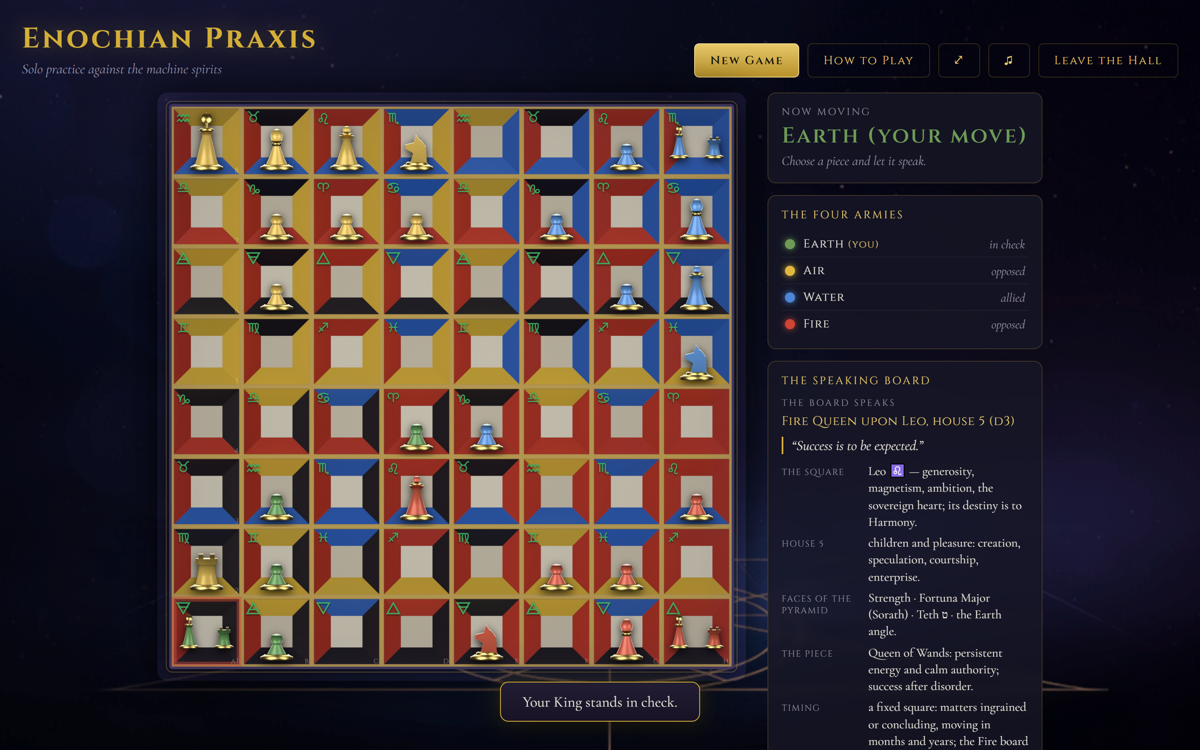
Chaturaji seated four players who could, depending on the version, each fight for themselves. Enochian chess never lets you. Its four armies are locked into two teams that never change: Water and Earth play together as the receptive side, and Air and Fire play together as the active side. You cannot capture your ally, you win and lose together, and your partner sits at the corner diagonally opposite you, not beside you. That diagonal pairing is a real structural difference. It means the ordinary rotation around the board alternates the two sides turn by turn, so an ally and an enemy always sit between you and your partner. Sound tactics often mean feeding your ally's attack rather than your own, and because an alliance is the true unit of play, you do not even need four bodies at the board. Each army is also an element, and if you want the reasoning behind the pairings, the four elements explain why Water befriends Earth and Air befriends Fire.
The pieces move on their own terms
Chaturaji carried its own set of pieces from the old Indian game, moving in ways close to the ancestor of modern chess. Enochian chess keeps recognizable names but changes what some of them do, and the clearest case is the Queen. She does not slide across the board. She leaps exactly two squares in any of the eight directions and jumps clean over whatever stands between, which makes her short in range but very hard to block. New players almost always misjudge her at first, so it is worth reading how the Enochian Queen really moves before your first game. The King steps one square as you would expect, the Knight keeps its familiar jump, and the sliders behave normally, but the leaping Queen alone is enough to make the elemental board feel unlike the older game.
Winning, and what happens to a fallen army
Chaturaji, by most readings, ended when the points were counted or when a side had nothing left to fight with. Enochian chess ends another way entirely. There is no checkmate. You capture the enemy Kings outright, like any other piece, and an alliance wins only once both opposing Kings have been taken. What happens to a beaten army is stranger still. When an enemy captures a King, that army does not clear off the board and does not simply die: it freezes. Its pieces hold their squares as inert terrain, still blocking sliding lines and denying ground, yet unable to move, unable to be captured, and threatening nothing. A frozen army can even be roused again if an ally reaches its empty throne. A capture in Chaturaji removed a piece and scored a point; a King capture here reshapes the whole geography of the board without removing anything at all.
The layer Chaturaji never had
Here is the line that separates the two games most sharply. Chaturaji was a game and only a game, a way to pass an afternoon with dice and a board among four people. The Enochian board is also a working oracle. Every square carries a set of divinatory attributions: a sign of the zodiac, a tarot trump, a Hebrew letter, a geomantic figure, an astrological house. Each square is even drawn as a small pyramid seen from above, its four faces bearing those meanings. Because of that, the pattern a finished game leaves behind can be read as a message rather than just scored. This came out of the Hermetic Order of the Golden Dawn, the late nineteenth-century magical society, which treated the board as a study and divination instrument rather than a pastime. Most of what reached the public came through the published Golden Dawn papers, later put into print by Israel Regardie. If the reading side draws you, the divination guide walks through how a completed board is interpreted. A game of Chaturaji ended with a tally. A game of Enochian chess ends with a reading.
So the honest summary is short. Chaturaji and Enochian chess are cousins by shape and nothing more. They arrived at the same four-cornered board for different reasons and centuries apart, with no straight thread of descent from one to the other. Chaturaji is an ancient dice-touched game of points and captures. Enochian chess is a fixed-alliance elemental game with a leaping Queen, freezing armies, and a board that doubles as an instrument of divination.
Feel the difference for yourself
Reading about a leaping Queen and freezing armies only goes so far. Sit down at the four-cornered elemental board and watch it move. A free solo game is the fastest way in.
Play NowKeep reading
Want to see how the elemental board stacks up against the game most people already know? Compare Enochian chess and regular chess, then start with what Enochian chess is before your first game.