Chaturanga is the game most historians point to as the root of chess. It grew in India well over a thousand years ago, spread west through Persia and the Arab world, and slowly hardened into the two-player game played today. Enochian chess sits far out on a later branch of that same tree. It is not descended from modern chess so much as it reaches back past it, borrowing the shape of the older four-army idea and rebuilding it as a tool for study and divination. To see what Enochian chess is, it helps to see what it kept from the root and what it chose to grow anew.
What chaturanga was
The name chaturanga names an army. It points to the four divisions of an old Indian force: foot soldiers, cavalry, elephants, and chariots. Those four became the pieces we still recognize, the ancestors of the pawn, the knight, the bishop, and the rook, gathered around a king and an advisor. The board was the familiar grid of sixty-four squares. From this single arrangement everything later followed. Persian players renamed the pieces and carried the game into a new tongue, Arab players spread it across a wide world, and European players sped up the queen and the bishop until the game we call chess emerged. The bones stayed the same the whole way down: one king per side, ranks of pawns, and a small set of officers with fixed ways of moving. Every board you have ever seen is a leaf on that one branch.
There is a second, older thread worth naming. Some accounts describe a four-handed dice game on the same board, with four small armies at the corners, one to each player. Whether that four-cornered form came before or after the two-sided one is still argued, but it matters here because the four-army table is exactly the shape Enochian chess adopts. If you want the closer cousin, look at the four-player line rather than the two-player one, which we treat separately in Enochian chess versus chaturaji.
What Enochian chess keeps
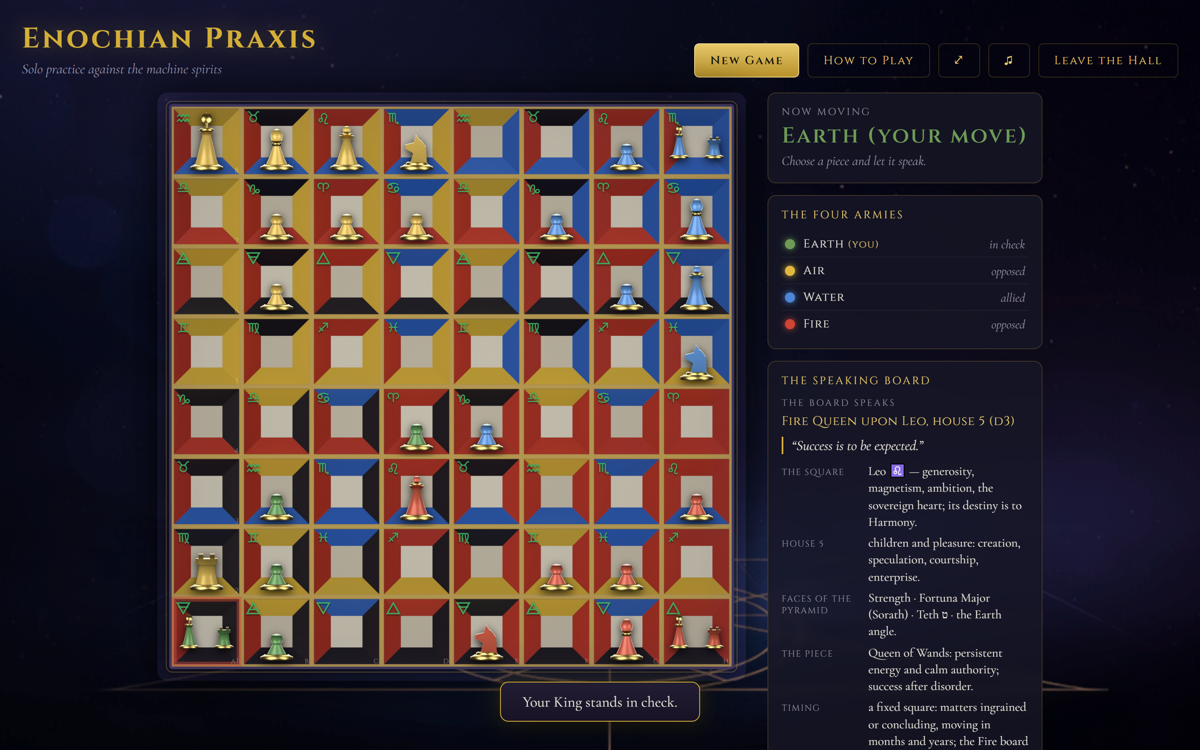
The inheritance is easy to spot. The board is the same eight-by-eight grid of sixty-four squares. The pieces carry the same names and, for the most part, the same jobs. The knight makes its bent jump exactly as it does in ordinary chess. The bishop slides on the diagonal and the rook slides straight, each blocked by whatever stands in the way. Pawns push one square forward and take one square diagonally. A player still guards a king and still tries to bring down the enemy king. Anyone who knows chess will read most of an Enochian position at a glance, because most of it is the shared skeleton that runs all the way back to the Indian root. For a fuller side-by-side of the shared parts, see Enochian chess versus regular chess.
What Enochian chess reinvents
The changes are where the branch turns into its own tree. Four armies stand at the four corners, not two along opposite edges. They belong to Fire, Water, Air, and Earth, and they lock into two fixed alliances: Air with Fire, Water with Earth. Your partner sits at the corner diagonally across from you, never beside you, and the two of you win and lose together. Turn order rotates around the board rather than passing back and forth, so on any given move only one of the four armies acts and the sides trade blows in a steady circle. That single decision, four seats instead of two, reshapes the whole feel of a game. You are never fighting one opponent across a line; you are watching threats build from more than one direction at once. You can read the elements and their pairings in the four elements of Enochian chess.
The queen is the sharpest break with the root. In modern chess she is the long sweeping ruler of the board. In Enochian chess she does the opposite: she leaps exactly two squares in any of the eight directions, jumping clean over whatever lies between, and she cannot move a single square at all. She is short, sudden, and impossible to block. Nothing in chaturanga or its descendants moves quite like her. Her strangeness gets its own walkthrough in the Enochian chess queen explained.
Then there is the ending. Ordinary chess ends in checkmate, a king trapped but never taken. Enochian chess has no checkmate. A king is captured outright like any other piece, and when an enemy takes him, his whole army freezes into inert terrain that blocks lines but can neither move nor be captured. An ally can rescue a checked king by taking him himself, keeping the army in the fight. A win comes only when both enemy kings have fallen. On top of all this sits a layer the old games never carried: every square holds a set of symbolic attributions, so a finished game can be read as an oracle. The Golden Dawn built the whole thing as a study and divination instrument, and that purpose is what the reinvention serves.
Play the modern branch
You already know the root if you know chess. Sit down at the four-cornered board and feel how far the branch has grown, free and with no download.
Play NowKeep reading
If you are meeting the game for the first time, start with what Enochian chess is, then walk through the rules and see how the same board grew into something the old Indian players would half recognize.