Enochian chess uses the same six pieces as ordinary chess: king, queen, knight, bishop, rook, and pawn. Four of them move exactly as you expect. The knight makes its L-jump, the bishop slides diagonally, the rook slides in straight lines, and the king steps one square. Two of them are different, and those two are what give the game its flavor. The queen leaps rather than glides, and the pawn is more restricted than its chess cousin. Learn those two changes and you can read every move on the board.
The king: one square, any direction
The king moves one square in any of the eight directions, the same step it takes in chess. Nothing about its motion is new. What is new is that there is no castling, so the king never makes a paired move with a rook. It also starts in an unusual place. Each king begins doubled on its throne in the corner, sharing that square with one partner piece set by the opening array. That is a starting position, not a special move, and once play begins the king walks one square at a time like any other. Because there is no checkmate in this game and kings are captured outright, keeping the king a step ahead of danger matters far more than it does in chess. For the fuller picture of how a king lives and falls, see the king in Enochian chess.
The queen: a leap of exactly two
This is the piece that surprises everyone. The Enochian queen does not sweep across the board. She leaps exactly two squares in any of the eight directions, orthogonal or diagonal, and she jumps clean over whatever sits between her and her landing square. She cannot move a single square, and she cannot slide three or more. Two is her only distance. Because she always jumps by two, she never changes the color of her square, so a queen that starts on a light square stays on light squares for the entire game. She is never blocked by a piece in the way, which makes her a nimble raider, but her short range means she is much weaker than the queen you know from chess. Do not expect her to dominate. Expect her to dart. The leaping queen has her own strategy, and the Enochian chess queen explained goes deeper into how to use her.
The knight: the ordinary L-jump
The knight moves exactly as it does in chess. It jumps in an L: two squares along one line and one square across, in any of its eight patterns, hopping over any piece in between. Nothing is added and nothing is taken away. On a crowded four-army board its ability to jump makes it one of the handiest pieces you own, since it can reach into tangles that a slider cannot enter. The knight, bishop, and rook are covered together in the knight, bishop, and rook.
The bishop: the diagonal slider
The bishop slides any distance along a diagonal, just as in chess. It stops at the first piece it meets and can go no further, whether that piece is friend or foe. One detail is worth naming: a frozen army also blocks a bishop's line. When an enemy king is captured its whole army freezes into inert terrain that cannot move or be taken, and those frozen pieces still sit on their squares and still stop a sliding line. Like a bishop everywhere, this one is bound to a single color for the whole game, so each army's bishop only ever touches half the board.
The rook: the straight slider
The rook slides any distance along ranks and files, the ordinary orthogonal slide. It too stops at the first occupant of its line and is blocked by the same things a bishop is, including frozen pieces. Rooks and bishops share the longest reach on the board, which makes them the pieces that project force across open lines. When files and diagonals open up, these are the pieces that decide who controls the center and who is pinned back in a corner.
The pawn: forward one, capture diagonally, and nothing extra
The pawn keeps the core of the chess pawn and drops the rest. It steps one square straight forward toward its own promotion edge, and it captures one square diagonally forward, exactly like a chess pawn. What it does not have is the two-square opening step, and it has no en passant. Every pawn advances one square at a time, from its first move to its last. Each army's four pawns march toward a different edge, because each army faces inward from its own corner. Promotion is its own subject with several twists, and pawns and promotion in Enochian chess lays those out. For the movement rules alone, the summary is simple: one step forward, capture on the diagonal, no jumps.
Reading the whole board at once
Once you hold those six movements in your head, the four-cornered board becomes legible. Every square is under threat from something specific: a rook down a file, a bishop across a diagonal, a queen two squares away in eight directions, a knight from its L, a pawn on the near diagonal, a king one step off. The only pieces that will trip you if you come from chess are the queen and the pawn, and both trip you by being smaller than you expect rather than stranger. The published Golden Dawn papers, brought to a wide audience by Israel Regardie, set these moves down plainly, and the online game enforces every one of them for you. If you want a side-by-side with the game you already know, Enochian chess vs regular chess lines the two up move by move.
Common questions about how the pieces move
How does the queen move in Enochian chess?
The queen leaps exactly two squares in any of the eight directions and jumps over whatever stands between. She cannot move one square and she cannot slide, so she is a short-range leaper that is never blocked and stays on one color for the whole game.
Is there castling in Enochian chess?
No. There is no castling. The king moves one square in any direction and never makes a paired move with the rook. The king does begin doubled on its throne with a partner piece, but that is a starting position, not a move.
Do pawns move like normal chess pawns?
Almost. A pawn steps one square straight forward and captures one square diagonally forward, like an ordinary pawn. But there is no two-square first step and no en passant, so a pawn always advances one square at a time.
What is the strongest piece in Enochian chess?
The rook and bishop have the longest reach, since they slide across the whole board. The queen is far weaker than her chess cousin because she only leaps two squares. Reach and safety matter more than any fixed ranking, since kings are captured outright with no checkmate.
See the moves on a live board
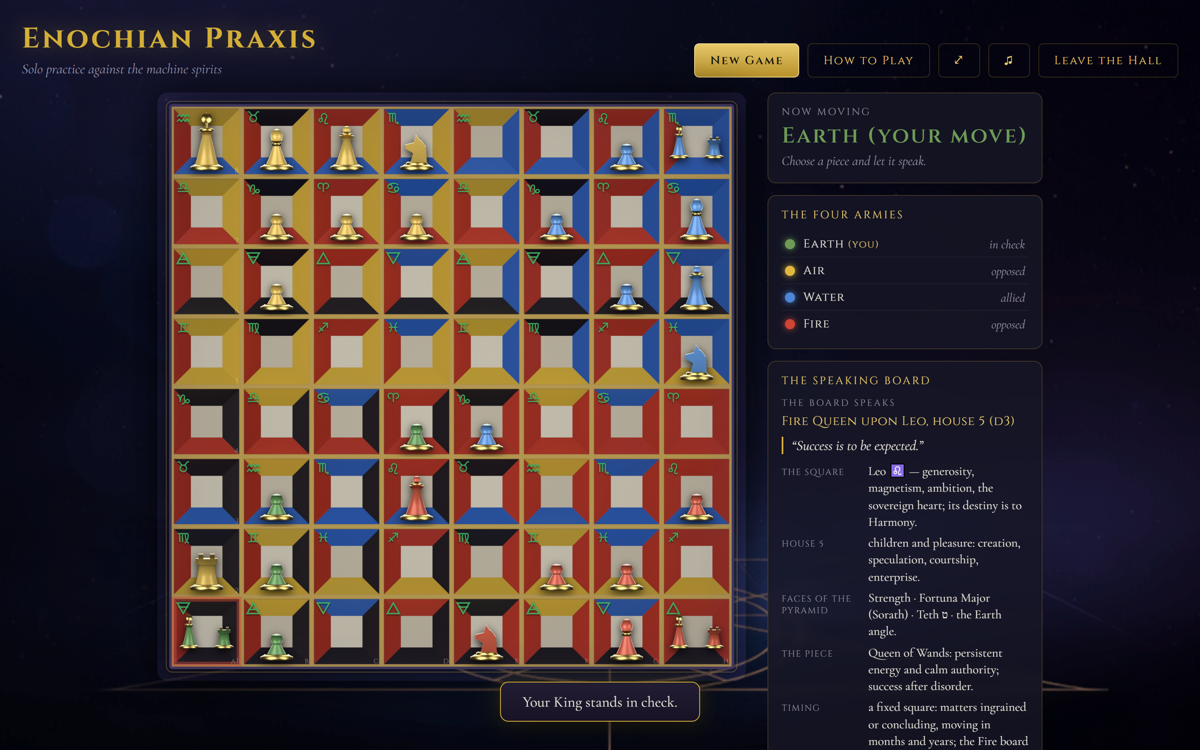
Reading the rules is one thing; watching a queen leap two and a pawn crawl one is another. Start a free solo game against the computer and try every piece for yourself.
Play NowKeep reading
Once the moves feel natural, put them to work. Learn the full order of play in how to play, meet each unit in depth on the pieces, or study the leaper more closely in the queen guide below.