Rosicrucian chess and Enochian chess are the same game. Same boards, same four elemental armies, same two alliances, same rules out of the published Golden Dawn papers. The two names come from two different threads in the order's own symbolism, and both are still in use, so you can meet the game under one name in a book and under the other on a website and reasonably wonder whether there are two games to learn. There are not. This article explains where each name came from, why both fit, and what the game behind them actually looks like.
Is Rosicrucian chess the same as Enochian chess?
The game was created inside the Hermetic Order of the Golden Dawn, the magical society founded at the end of the nineteenth century. Within the order it was never a parlor amusement. It was a study instrument and a divination tool, taught to advanced members as a working part of the curriculum. The order's papers reached the general public largely through Israel Regardie, who published them, and once the material was in print, writers called the game whatever their own emphasis suggested. Some reached for the Enochian name, because of what the boards are made of. Others reached for the Rosicrucian name, because of who made them. Both choices are defensible, both appear in the literature, and neither marks a different game. If you can play one, you can play the other, because they are one. Today the split survives mainly as a search problem: someone looking up one name can miss half of what has been written under the other, which is exactly why this page exists.
Why is it called Enochian chess?
The Enochian name points at the boards themselves. In the 1580s the English mathematician John Dee, an adviser to Elizabeth I, worked with the seer Edward Kelley through a long series of angelic operations. Those sessions produced the Enochian language and a set of elemental tablets, often called the Watchtowers, organized around the four classical elements. Three centuries later the Golden Dawn absorbed Dee and Kelley's material into its own system, and when the order built its four chessboards, one each for Fire, Water, Air, and Earth, it built them on the symbolism of those tablets. Every square carries attributions drawn from that scheme, which is what lets a finished game be read as an oracle rather than simply scored and put away.
So the name is not decoration. The game is Enochian in its bones: strip out the tablet symbolism and you would still have a clever four-handed variant, but you would not have this game. You can see all four boards and their elemental character on the boards page, and the longer story of Dee, Kelley, and the tablets in John Dee, Enochian Magic, and the Chessboard.
Why is it called Rosicrucian chess?
The Rosicrucian name points at the school rather than the boards. The Golden Dawn drew deliberately on Rosicrucian tradition, and it framed its inner order, the circle of advanced members, in Rosicrucian terms. The chess game belonged to that advanced work, so the label traveled with the game when members and later writers described it. Calling it Rosicrucian chess tells you where the game lived. Calling it Enochian chess tells you what the boards are built from. Both statements are true at the same time, neither name ever pushed the other out, and the literature simply kept both.
The game behind both names
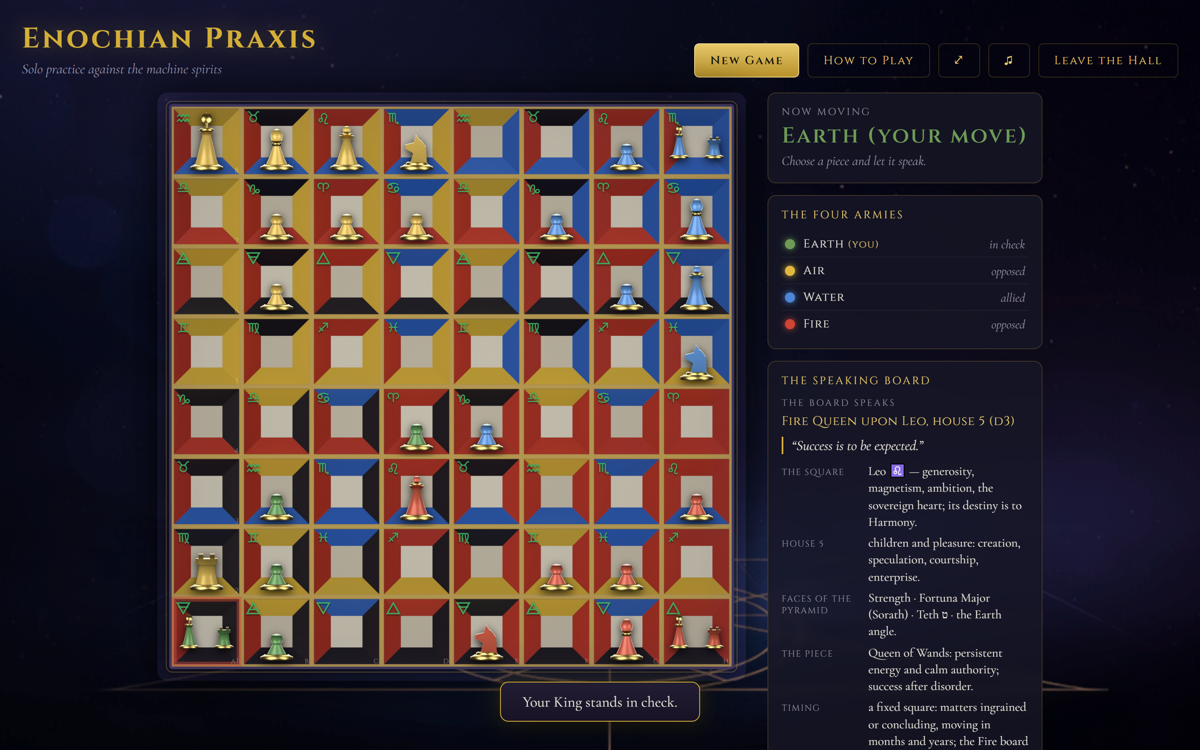
Under either name, here is the game. It is played on a standard eight by eight board, chosen from a set of four, one for each element. The board you pick colors the symbolism of the game, and its own element moves first: on the Fire board, Fire opens. Four armies sit at the four corners, Earth, Air, Water, and Fire, bound into two fixed alliances. Air and Fire fight together as the active side, Water and Earth as the receptive side, and your ally holds the corner diagonally opposite your own, never the one beside you. Allies cannot capture each other, cannot give each other check, and win or lose as one. Beneath the armies, every square carries attributions used in divination, signs of the zodiac and tarot trumps among them.
Each army fields a King, four major pieces, and four pawns, and the King begins doubled on his corner throne, sharing that square with one major piece. Some moves will feel familiar and some will not. The Rook, Bishop, and Knight move as in ordinary chess, and the pawn takes single steps with no double first move. The Queen is the strangest of the set: a short-range leaper who springs to a square exactly two away in any of the eight directions, sailing over anything on the square she crosses, and never moving just one. There is no checkmate either. A King is taken like any other piece, the army that loses its King to an enemy stands frozen where its pieces sit, and victory belongs to the alliance that captures both opposing Kings. The rules page walks through all of it step by step, the pieces page covers each piece with its tarot and god-form attributions, and the divination page explains how a finished position is read as an oracle.
Which name should you use?
Whichever one your reader will recognize. Enochian chess is the more common name today, and it is the one this site uses throughout, but Rosicrucian chess is not wrong, not a regional spelling, and not a variant with different rules. If you found this page while checking whether a Rosicrucian chess reference in an older text matches the Enochian chess you have seen online, it does, square for square. When other terms in the older material give you trouble, the glossary keeps the game's vocabulary straight, both names included.
One game, whichever name brought you here
Play it free in your browser: solo against the computer at three strengths, or online with two, three, or four players. Every finished game ends with a divination reading of the final position.
Play NowKeep reading
New to the game entirely? Start with what Enochian chess is, learn the full rules, or follow the longer arc from Dee's tablets to the Golden Dawn on the history page.