John Dee never played Enochian chess. He never saw the board, never wrote a rule for it, and died centuries before anyone thought of it. The game that carries the name of his angelic system is a creation of the Hermetic Order of the Golden Dawn, the late 19th-century magical society, and nothing like it appears anywhere in Dee's records. That leaves an honest question sitting in plain view: why is a Victorian four-handed chess game called Enochian at all? The answer runs through an angelic language, four tables of letters, and a group of magicians who read a Renaissance system with Victorian eyes.
The scholar and the seer
John Dee was one of the most learned men of Elizabethan England, a mathematician and an adviser to Elizabeth I. In the 1580s he and Edward Kelley recorded a long series of angelic workings, sessions Dee documented with a scholar's care. Two products of those workings matter for this story. The first is the Enochian language, an angelic tongue with its own script, the thing that gives the whole system its name. The second is a set of elemental tablets called the Watchtowers, squared tables of letters tied to the four elements.
For Dee this was serious religious and intellectual work. His records hold prayers, received language, and the tablets themselves. What they do not hold is a game. There is no board in them, no pieces, no rules of movement, nothing anyone could sit down and play. If you have ever heard that Dee played chess with angels, you have heard a story, and not one his papers support.
Three centuries later
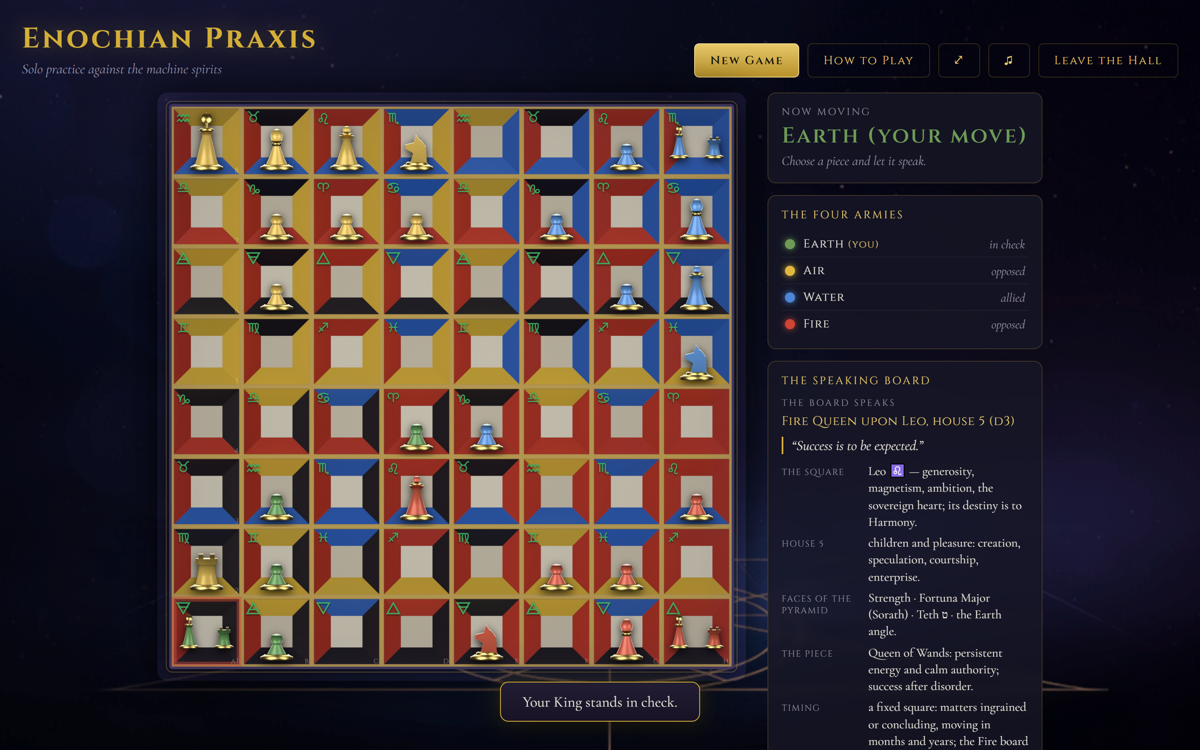
The Hermetic Order of the Golden Dawn appeared some three centuries after those workings, a late Victorian magical society that treated Dee and Kelley's records as a foundation to build on. Enochian material stood among its most advanced teachings, and one of the instruments the order built for those advanced members was a game. It constructed four elemental chessboards, one each for Fire, Water, Air, and Earth, and drew their symbolism directly from the Watchtower tablets. Every square carries attributions from the order's larger system: signs of the zodiac, tarot trumps, and other correspondences. You can see how each of the four boards is laid out, and trace the game's whole lineage on the history page.
The game the order set on those boards is real chess, but not the two-sided kind. Four armies stand at the four corners, one per element, and they fight in two fixed alliances: Air and Fire together as the active side, Water and Earth together as the receptive side. Your ally holds the corner diagonally opposite yours, so partners face each other across the whole board. And it was never meant as light entertainment. The published Golden Dawn papers treat it as a study and divination instrument, a way to watch elemental forces move against one another rather than sit still in a diagram. A finished game can be read as an oracle, a practice you can still try through the divination page.
What Dee left, and what he did not
Here is the honest accounting. Dee left an angelic language, the Watchtower tablets, and a body of records that magicians have studied ever since. He left no game. No chessboard appears in his papers, no chess piece, no rule of movement, no suggestion that the tablets were ever meant to be played on. Everything that makes Enochian chess a playable game came from the Golden Dawn: the four armies, the Queen who leaps exactly two squares, the King who begins doubled on his throne with a partner piece, the freezing of an army when its King falls to an enemy. All of it is Victorian.
The same goes for the game's other dressing. The Egyptian god-forms the papers assign to the pieces, Isis on Earth's Queen and Horus on its Knight among them, come from the order's own tables of correspondence, not from anything Elizabethan. So the fairest one-line description of Enochian chess is this: a Victorian creation reading a Renaissance system. The Golden Dawn approached Dee's tablets the way a composer approaches an old melody, as material for a new work in a new form. The game inherited the name because it inherited the symbolism, and for no deeper reason than that.
Most of what the public knows about the game arrived through the published Golden Dawn papers, which reached print through Israel Regardie. The game also carries a second name, Rosicrucian chess, after the Rosicrucian tradition the order drew on. Both names describe exactly the same rules.
Why the name still earns its keep
None of this makes the name dishonest. The four boards really are built from the tablet symbolism, and the elemental logic runs all the way down: which army you hold, which corner it defends, which alliance it belongs to, which attributions sit under each square. Calling the game Enochian tells you what it is made of, even if it cannot tell you who made it. Think of it the way you think of a Gothic revival church. The vocabulary is old, the building is not, and the building is no less real for that.
Does the history change how you play? Not the moves. The rules stand on their own, and you can learn the pieces and win games without opening a single Renaissance record. But knowing the lineage changes what you notice. When your Fire army presses toward the far edge of the board, you are watching a Victorian reading of an Elizabethan table of letters, still in motion more than four centuries after Dee recorded it. Start with what Enochian chess is, then walk through the full rules when you are ready to take a corner of the board for yourself.
Play the game Dee never saw
All four elemental boards are free to play in your browser, solo against the computer or live online with friends. No download, and solo play needs no account.
Play NowKeep reading
Curious about the other name? Read why the game is also called Rosicrucian chess, see the board explained square by square, or meet the four elements and the alliances they form.