An Enochian chess endgame does not look like a chess endgame. There is no lone King chased into a corner and mated. Kings here are captured outright, and the moment an enemy takes the first one, that whole army freezes and stops moving. So by the time a game is deciding itself, the board is rarely bare. It is cluttered with the stone of fallen armies, and the live pieces have to move around and through that clutter to finish the job. The win never changes: an alliance holds the field the instant it has taken both enemy Kings. The endgame is simply the work of getting that second King.
The last King is hunted, not mated
Because there is no checkmate, the endgame is always a hunt. Once you have taken one enemy King, his army is gone from active play and you are chasing a single survivor across the board. The check ladder from the published Golden Dawn papers still governs him: a King in check must flee to a safe square if he has one, may step into danger if he has no safe square, and can finally be captured when nothing can help him. Your task in the endgame is to reach that last rung, to run the enemy King out of safe squares and take him. The full account of how a game is decided lives in how you win at Enochian chess, and the endgame is where that condition actually gets met.
Two facts make the hunt cleaner than an ordinary chess mate. Frozen pieces give no check and allies give no check, so only the living enemy pieces threaten your King while you press theirs. And you do not need to trap the King with no escape. You only need one move where you can land on his square. That changes how you corner him: you are not building a mating net, you are closing the last exit and stepping in.
Frozen walls become the terrain of the endgame
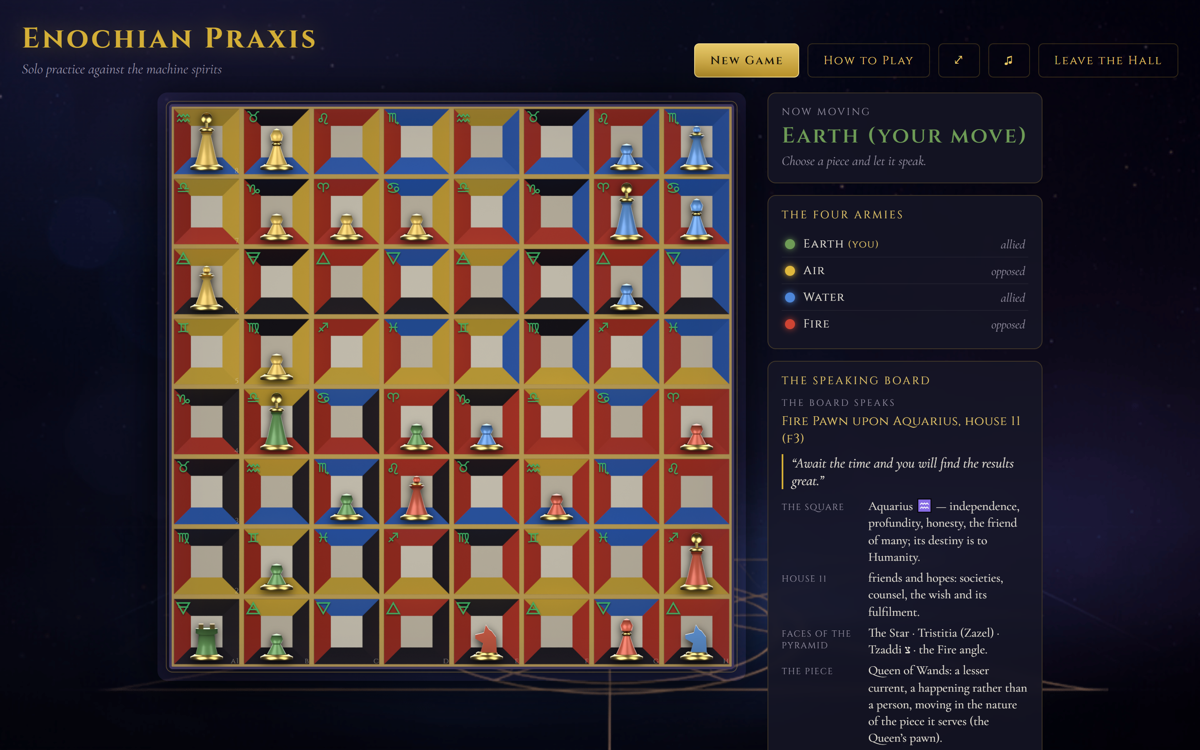
The first King taken leaves a wall behind. Every surviving piece of a frozen army stays fixed on its square, cannot be captured, blocks the lines it stands on, and threatens nothing. In the middlegame that is a nuisance. In the endgame it becomes the shape of the board. Files and diagonals dead-end at stone that will never move, safe squares vanish, and the open ground you need to run down a King is broken into pockets. Everything about how a freeze reshapes a position, and how a frozen army can be woken again, is covered in frozen armies.
The wall cuts both ways, and that is the heart of the endgame. If you took the first King, you built the wall, and now the last enemy King can shelter behind it. Your Rook and Bishop cannot slide through frozen pieces, and no one can land on a frozen square, so a survivor tucked among his fallen partner's stone can be genuinely hard to reach. The very army you froze can become the fortress protecting the King you still need. Good endgame play means using frozen walls to cut off flight squares when they help you, and finding the leaper or the knight that gets over them when they do not.
The Queen and Knight lead the hunt
Not every piece is equal once the board is full of walls. The Enochian Queen leaps exactly two squares in any direction and jumps whatever sits between, so she is never blocked by a frozen piece, and the Knight jumps in its usual L. These two go over stone the sliding pieces have to go around, which makes them the natural hunters in a cluttered endgame. A Rook or Bishop can be powerful along an open line, but a single frozen piece can shut that line for the rest of the game. When you plan the final approach on an enemy King, count which of your pieces can actually reach the squares near him, not just which of them look strong.
Promotion still matters at the end
Endgames turn on new material, and Enochian pawns promote by their own rules. A pawn promotes when it reaches its army's far edge, but promotion is delayed: it waits until the army has lost at least one pawn, and a pawn that arrives too early simply stands on the edge until a fellow pawn falls. A pawn normally becomes the piece it belongs to, so the Queen's pawn brings back a Queen and the Rook's pawn a Rook. A pawn that promotes on a corner square becomes the piece that shared that King's throne at the start. The full picture of how pawns advance and what they become is in pawns and promotion.
One rule is built for the endgame itself. An army worn down to its King and a single last pawn, alone or with only a Queen or only a Bishop left beside it, may choose what that pawn becomes rather than take the piece it belongs to. If the chosen piece would duplicate one already living, that living twin drops back to a pawn. So even an army stripped to almost nothing keeps one real chance to make the piece it needs and swing a losing endgame back toward a fight.
When the field stalemates: the four draws
Not every endgame produces a winner. When neither alliance can force both enemy Kings, the game ends in one of four drawn ways. The hundred-move rule stops a game after a hundred straight moves with no capture and no pawn advance, the sign that the hunt has stalled. The bare Kings draw ends it when only the four Kings are left, the elements resting in balance with nothing to decide. The bare alliance draw ends it when one side is reduced to its two Kings alone, too little to win with. And the locked board draw ends a field so jammed with pieces and stone that no army can make a legal move at all. A full survey of each of these sits in the guide to draws in Enochian chess.
These four endings do the same job together: they refuse to reward endless shuffling. If you cannot bring down both enemy Kings, you have not won, and a stalemated field says so cleanly instead of dragging on. Knowing which draw a position is drifting toward is itself an endgame skill, because sometimes the honest play is to force the draw rather than lose the hunt.
Play a game to its finish
The endgame is where all the strange rules meet at once: frozen walls, a King who can be taken, a last pawn that promotes late. Start a free game against the computer and play one all the way to the reading.
Play NowKeep reading
The endgame rewards a plan you laid three moves earlier. Sharpen the whole approach with a full look at Enochian chess strategy, then let the final position speak by reading the board as an oracle once the last King has fallen.