Scrying is the practice of looking into a reflective surface, a crystal, a bowl of water, a polished stone, and reading meaning out of the shapes and impressions that rise there. It is the visionary craft that stands at the root of the whole Enochian system, because the material the game is named for was scried into being before anyone thought to make a chessboard of it. Enochian chess is, in a real sense, scrying turned into a game. The board took the place of the crystal, but the essential act is the same: you fix your attention on a patterned surface and you let it tell you something you did not already know.
What scrying actually is
Strip away the mystique and scrying is a discipline of attention. The seer relaxes the ordinary, hunting way of looking and lets the eye rest on a surface with no fixed features: water, a mirror, a dark stone. Given nothing to grab onto, the mind starts to supply pattern, and the practitioner reads those patterns as answers. Different cultures have scried into different things across a very long span of time, but the method holds steady. You need a surface, a settled state of mind, and a question you carry into the looking. The surface does not create the meaning so much as give the mind a blank place to project it and a frame to hold it still.
That last part matters for what comes later. Scrying is not staring at chaos. It works because the surface is neutral enough to receive projection yet held enough to keep the vision from dissolving. A chessboard, oddly, satisfies both conditions. It is a fixed grid, orderly and repeatable, and yet a game fills it with a shifting arrangement that is never the same twice. The player who reads a finished game is doing something close to what the scryer does with a crystal: reading order out of a surface that has been stirred into a particular shape.
The scried source under the game
The Enochian material was not invented at a desk. It was reported by a scryer. In the 1580s a seer worked alongside John Dee, gazing into a stone and describing letters, names, and tables that seemed to form there, while Dee wrote everything down. Out of those sessions came an angelic language and four grids of letters, the elemental tablets or Watchtowers, one each for Fire, Water, Air, and Earth. Three centuries later the Golden Dawn took the symbolism of those tablets and built four chessboards on it. So the boards trace directly back to an act of scrying. If you want the person who did that looking, our piece on Edward Kelley and the scried tablets tells his side, and the fuller story of the grids themselves lives in the four Watchtowers behind the boards.
This is worth pausing on, because it explains why the game feels the way it does. A chess variant designed for pure competition would not carry a layer of divinatory meaning under every square. This one does, and the reason is its parentage. The whole apparatus descends from a visionary practice, and the people who shaped it into a game were students of that practice, not tournament players. They wanted an instrument that could be read, not just won. The history of the order makes plain that Enochian chess was kept for advanced members and used as a study and divination tool, which is exactly what you would expect from something born out of scrying.
The board as a surface to read
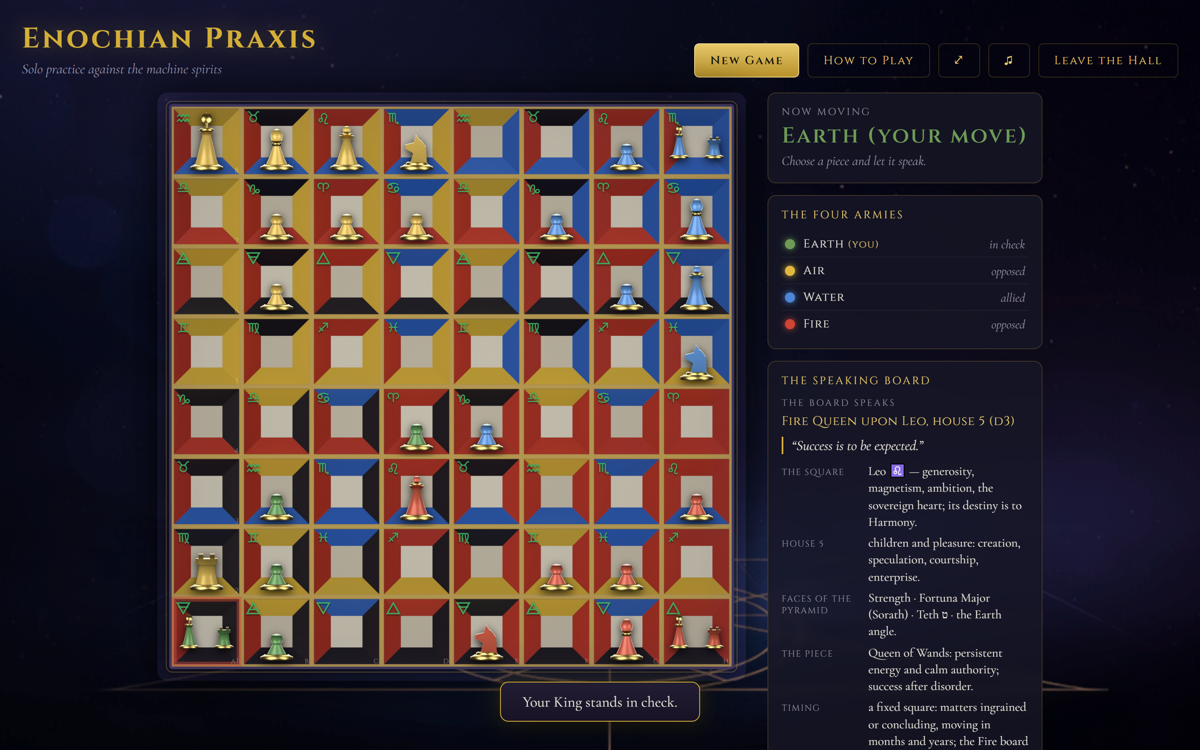
Here is the bridge from the crystal to the grid. Every square on an Enochian board carries a small stack of divinatory attributions, a sign of the zodiac, a tarot trump, a Hebrew letter, a geomantic figure, an astrological house. Each square is even drawn as a little pyramid seen from above, its four faces bearing symbols, so the surface you play across is dense with meaning before a single piece moves. When you play, the armies travel over that meaning and come to rest on particular squares. The finished position is a specific arrangement of pieces sitting on specific pools of symbol, and that arrangement can be read. You are not reading a random spill; you are reading a surface that the game has stirred into one shape, the way a scryer reads the shape the crystal happens to hold.
What makes the ending especially readable is that the game settles rather than scatters. There is no checkmate in Enochian chess. An army whose King is captured freezes in place, its pieces becoming inert terrain that still holds its squares but can no longer move. By the close, whole armies have gone still, and the board becomes a fixed landscape instead of a swirl of live pieces. That stillness is the scryer's calm surface returning at the end of the contest. The picture stops moving, and you read it. Our guide to reading the final position as an oracle works through how to gather the symbols the settled board leaves you.
Reading a game the way a seer reads a stone
The parallel is not just poetic; it shapes how you actually do a reading. A good scryer brings a clear question and holds it steady while looking, and does not force the surface to say what is wanted. The same discipline makes for a truer game reading. You set a question before the first move, choose an elemental board to key the mood, and then play honestly, as a real contest, without steering pieces toward the symbols you hope to see. If you nudge the game to flatter the question, you are no longer scrying; you are decorating. The reading is trustworthy only when the surface was allowed to form on its own. The full method sits in our guide to divining with Enochian chess, and the divination section walks a real reading start to finish.
There is one difference worth naming. A crystal gives the seer a private, wordless impression that has to be translated into speech. The board hands you a structured surface where the meanings are already spelled out square by square. That makes an Enochian reading steadier and easier to share than a lone gaze into a stone. Two people can look at the same final position, name the same symbols, and talk about what they mean, which is hard to do with a private vision. The game keeps the spirit of scrying while giving it a common language. The four boards each carry a slightly different set of tones, so choosing your surface is itself part of framing the question.
Try the board as your scrying surface
Bring a question, play a full game, and read the settled board the way a scryer reads a stone. Start free against the computer or claim a throne online.
Play NowKeep reading
To follow the visionary source all the way back, meet the scryer in Edward Kelley and the scried tablets, then see how the grids he reported became playing surfaces in the four Watchtowers behind the boards. When you are ready to read a game yourself, the divination section is the place to begin.