A finished Enochian chess game leaves a map. Because a captured King freezes his whole army in place, the ending is not a thin scatter of survivors: it is a fixed landscape where the losers stand as inert terrain and the winners rest wherever the last moves left them. That frozen board is what you read. This is not the single-move worked example you will find on the divination overview, which shows one landing decoded in full. This is the wider act: taking the whole final position, in one look, and drawing four separate signals out of it. Which alliance held the field. Where the captures fell. Which pieces did the taking. And the shape everything came to rest in.
Start with the alliance that held the field
The first and largest signal is who won, because winning in this game is a statement about elements. You do not win by checkmate. You win the moment both enemy Kings are taken, and only two outcomes are possible, since the four armies fight as two fixed teams. Air and Fire hold the field together as the active side, or Water and Earth hold it as the receptive side. Read the winner as the mood of the whole answer. An active victory leans toward things that move, kindle, and press outward: ambition, conflict, ideas taking light. A receptive victory leans toward things that hold and deepen: feeling, resources, patience, the slow forms that last. This is the headline over everything else, and the rest of the reading either colors it or complicates it. If you want to see how those elemental pairs are built and why they sit diagonally opposite one another, the piece on the four elements lays it out.
Find the squares where the captures fell
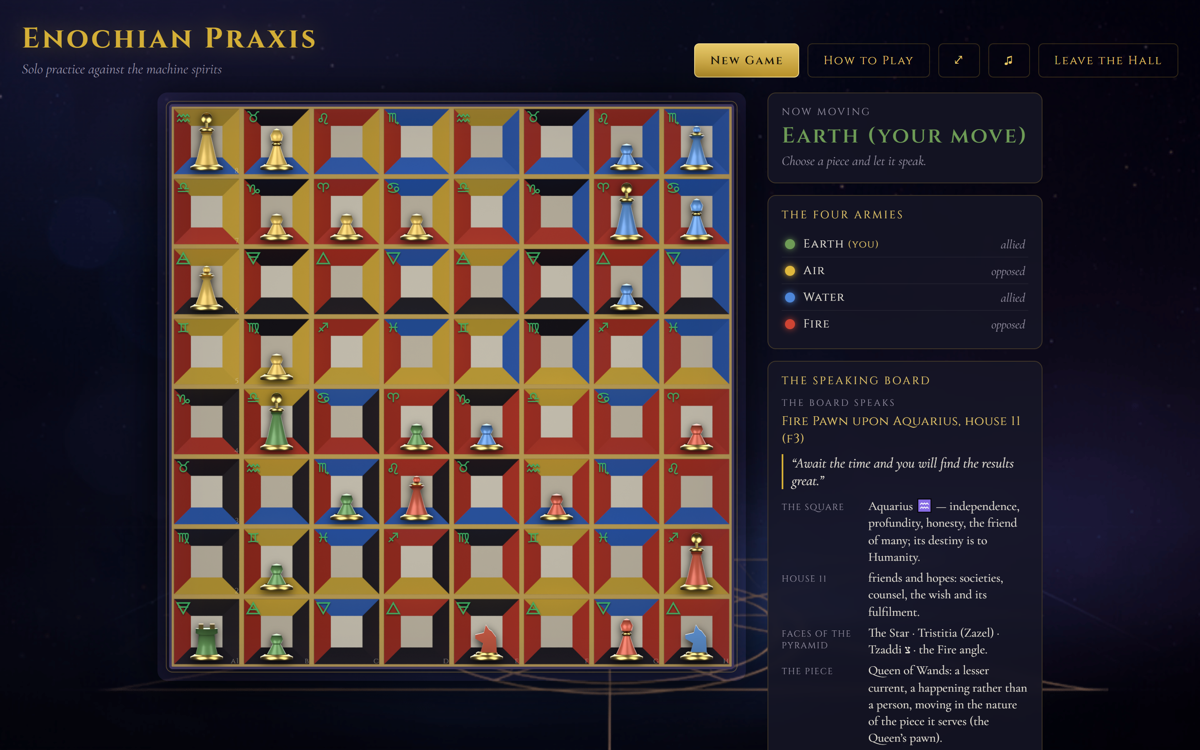
Once you have the mood, look for the places where force actually landed. Every square carries its own bundle of meaning, a sign of the zodiac, a tarot trump, a Hebrew letter, a geomantic figure, a house of the sky, drawn as a small pyramid whose faces bear those attributions. A capture marks its square more strongly than a quiet move, because something was taken there. So walk back through the game and note the squares where pieces were removed, above all the two squares where the enemy Kings fell. Those two are the loudest cells on the whole board. The symbols they carry speak most directly to the outcome, since they are the points where the game was decided. You do not need every capture. Three or four of the heaviest ones, with the King captures at the top, give you the specific vocabulary the elemental mood was speaking in. To turn any one of those squares into a full statement, work it the way the divination guide shows.
Ask which pieces did the taking
A capture has two halves: the square it happened on and the piece that made it. The second half is easy to skip and worth keeping. Each piece answers to a court role and a god-form, so the character that struck tells you in what manner the matter was decided. In the tarot mapping the site follows, the King is an Ace, the Queen a Queen, the Bishop a Prince, the Knight a Knight, and the Rook a Princess, each in the suit of its element. A game decided by leaping Queens reads differently from one decided by a patient Rook grinding down a file, or a Knight arriving from an angle no one guarded. The Queen is the piece to watch most closely here, since she leaps exactly two squares and cannot creep one, so wherever she strikes is a deliberate arrival rather than the end of a long glide. Note who took each King and who took the pieces around them. That is the agent of the reading, the hand behind the mood.
Read the final resting pattern
Now step back and take the board as one shape. The frozen armies are still present, holding their squares as terrain, and the survivors have come to rest somewhere specific. Where did the winning side's key pieces stop? A surviving King, a surviving Queen, a pawn stranded on a far edge: each rests on a square that carries meaning, and those resting squares are quieter than the capture squares but steadier, since they describe the state things settled into rather than the blow that got there. Look also at clustering. When several surviving pieces come to rest in one region of the board, or when the frozen and the living crowd one quarter, that concentration is itself a message about where the weight of the matter now sits. The reading you want is the pattern that repeats, a sign and a trump and a figure that all lean the same way across capture squares and resting squares alike, rather than the single most dramatic cell taken alone.
Gather the four signals into one answer
Read in order and let each layer narrow the last. The winning alliance gives you the mood. The capture squares, the King captures first, give you the specific symbols. The capturing pieces name the manner. The resting pattern shows where it all came to settle. When those four agree, you have a clean reading, and they usually do lean together, because the same game produced all of them. When they disagree, the tension is the answer: an active alliance that won only by a slow, receptive style of play is telling you something more careful than a plain victory would. Hold the four in view at once and let them speak as a single settled statement. That is what it means to read the final position as an oracle, rather than reading any one move.
Play a game to its ending
Bring a question, play a full game against the computer, and let it run all the way to the last King. The settled board that remains is your reading.
Play NowKeep reading
To understand why the ending freezes into a readable landscape at all, see how a fallen King freezes his army, and to sharpen the play that produces a good ending, look into Enochian chess endgames.