Edward Kelley was the scryer who sat with John Dee through the angelic sessions of the 1580s and reported what he claimed to see. Dee was the scholar and record keeper; Kelley was the one who looked into the shewstone and spoke. Between them they produced the material later called Enochian: an angelic language, a set of workings, and four tables of letters known as the elemental tablets or Watchtowers. Centuries later the Hermetic Order of the Golden Dawn took the symbolism of those tablets and built a four-cornered chess game on it. Kelley never touched a board, but without his part of that partnership the game would not carry the name it does.
The two men and one method
The Enochian work was a division of labor. Dee brought the learning, the Latin, and the discipline of writing everything down in order. Kelley brought the visions. In session after session Dee would put a question, Kelley would gaze into a polished stone or crystal, and he would describe letters, figures, and tables that appeared to him. Dee copied it all out. What survives is largely Dee's careful record of what Kelley reported, which is why the system reads as a collaboration even though the two roles were quite different. One man watched; the other wrote.
That method matters for the chess game, because the parts the Golden Dawn later leaned on came straight out of it. The elemental tablets are grids of letters. The Enochian language is a set of names and words drawn from the same sessions. Both of those are things Kelley reported and Dee recorded. When you hear the game called Enochian, the name points back to this exact process, not to any medieval chessboard. If you want the fuller picture of the scholar's side of the partnership, our piece on John Dee and the chessboard follows the same thread from Dee's end.
From scried tablets to four boards
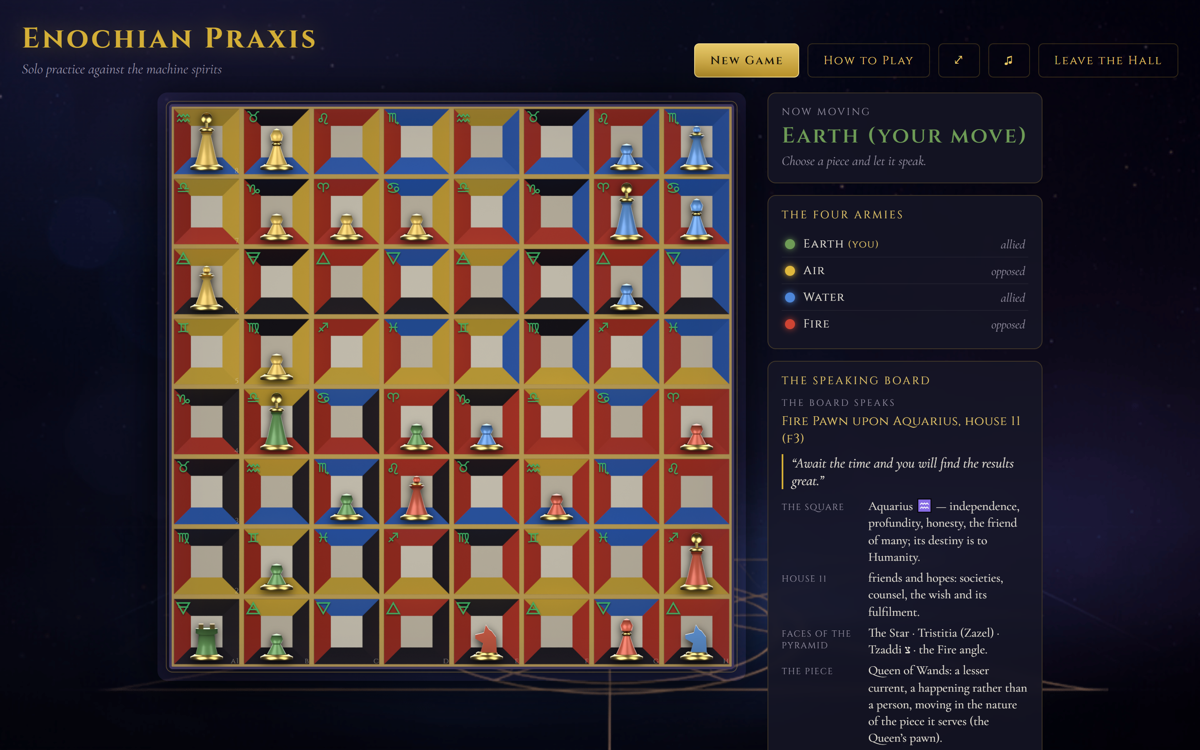
The elemental tablets are four grids, one for each of the classical elements: Fire, Water, Air, and Earth. That structure is the bridge between the 1580s sessions and the game. When the Golden Dawn designed its chess, it made four boards, one per element, and dressed each in the symbolism its tablet carried. The armies sit at the four corners, and the two elemental alliances that shape every game come from the same fourfold scheme. If you are new to how those elements pair off and drive play, the four elements of Enochian chess lays it out from the board's side rather than the history's.
None of that means Kelley designed a game. He did not. The line runs one way: the scried tablets gave the Golden Dawn a ready-made set of four elemental symbols, and the order poured its own chess system into that mold. The deeper story of the tablets themselves, and how each becomes a playing surface, sits in our look at the four Watchtowers behind the boards. Kelley's role ends at the source material. What happened to it three centuries later belonged to other hands.
Scrying then, scrying now
There is a neat symmetry worth noticing. Kelley's whole contribution was an act of scrying: looking into a reflective surface and reading meaning out of what appeared. The game his sessions helped seed keeps that spirit. Every finished Enochian game can be read as an oracle, because each square carries a layer of divinatory attributions and the final position becomes a picture to interpret. The scryer's habit of reading images did not vanish when the tablets turned into boards; it moved into how the game is used. Our guide on Enochian chess and the art of scrying draws that connection out in full, and the divination section walks a real reading step by step.
Keeping the claims honest
Kelley is a figure who attracts tall tales, so it is worth being plain about what is solid and what is not. The solid part is the working relationship: he served as Dee's scryer in the 1580s, and the sessions produced the Enochian language and the elemental tablets. Everything the game needs from him lives in that sentence. The rest, the alchemy stories, the reputation, the endless rumors, is not what the chessboard rests on and does not need to be settled here. The Golden Dawn read the recorded system with its own eyes and made a game of it. The material was scried; the game was designed. Both statements can be true without turning Kelley into something he was not.
It also helps to keep the credit chain straight. Most of what the public knows about the Golden Dawn's version of the game reached daylight through the published order papers, later brought out by Israel Regardie. The tablets and language trace to Dee and Kelley in the 1580s; the chess built on them traces to the order three centuries on. When those two eras get blurred, people start imagining an Elizabethan chess game that never existed. The clean version is simpler and more interesting: a scryer and a scholar recorded a system, and a Victorian society turned its four elements into four boards.
See the tablets become a board
The four elemental tablets Kelley helped record are the skeleton under the four boards. Start a free game and watch the symbolism come alive across a full match.
Play NowKeep reading
Trace the other half of the partnership in John Dee and the chessboard, meet the society that turned the tablets into a game in the Golden Dawn and its chess, or start from the beginning with what Enochian chess is.