The word "Enochian" in Enochian chess points back to a specific source: four elemental tablets, called the Watchtowers, recorded by John Dee and Edward Kelley in the 1580s. One tablet belongs to Fire, one to Water, one to Air, one to Earth. Three centuries later the Golden Dawn took the symbolism of those tablets and built four chessboards on it, one per element. That is the whole reason a game about corners and Queens carries an angelic name. The boards are the tablets, laid out as squares you can play across.
Who Dee and Kelley were
John Dee was a mathematician and an adviser to Elizabeth I, a serious scholar with a large library and a wide reputation. Edward Kelley worked with him as a scryer, the one who looked into a crystal and reported what he saw. Over a series of sessions in the 1580s, the two conducted what they described as angelic workings. Out of those sessions came a body of material that later occultists would call the system of Enochian magic: an angelic language, sets of names, and the four elemental tablets themselves. Dee kept careful records. Those records are the root of everything downstream, including the game.
None of that made a chess set on its own. The tablets sat in manuscripts for a long time before anyone thought to turn their symbolism into a board with pieces on it. That step belonged to a much later group.
From tablets to boards
The Hermetic Order of the Golden Dawn was a magical society of the late nineteenth century, and Enochian chess was one of its study and divination instruments, reserved for advanced members. The order inherited the Enochian tablets as part of its own teaching and treated them as a working map of the four elements. When it designed its chess, it did the natural thing: it made four boards, gave each the character of one tablet, and let the element of the board shape how a game on it opens. On the Fire board, Fire moves first. Each board is its own tablet in play.
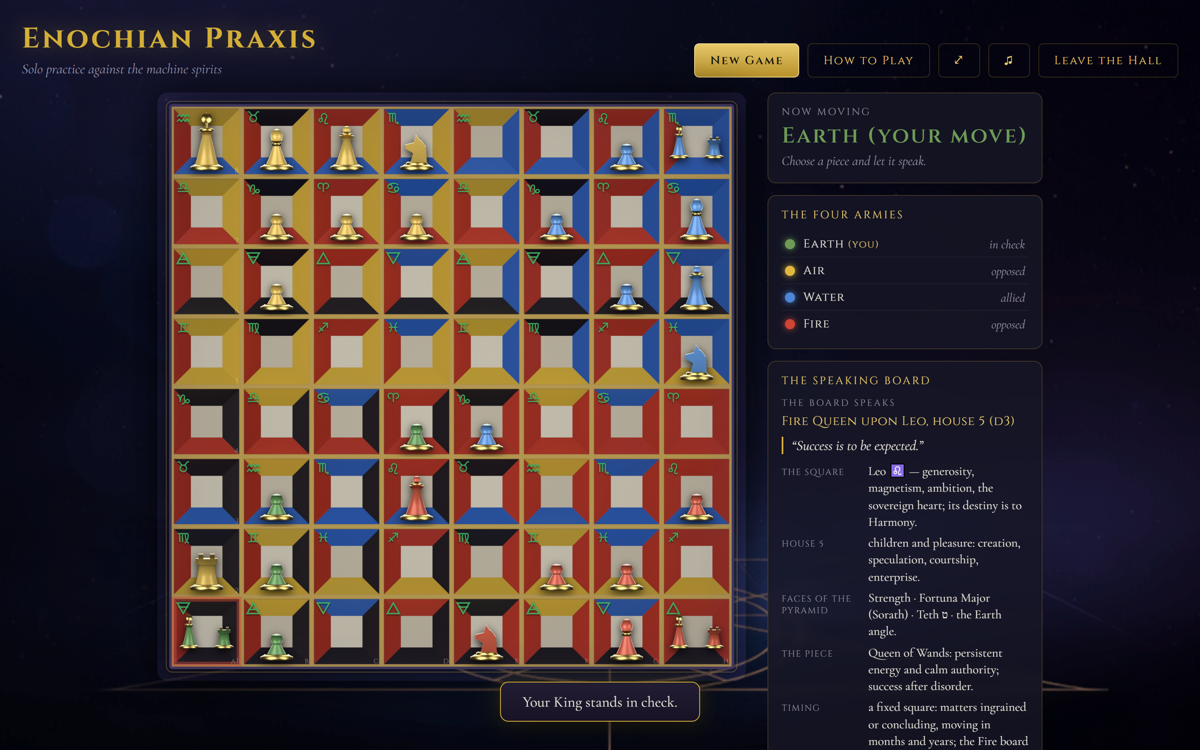
This is why Enochian chess is not one board painted four ways. The four designs are structurally the same eight-by-eight grid, but each is dressed in the attributions of its element, and every square on it is drawn as a small pyramid seen from above, its four faces bearing symbols. If you want the anatomy of a single square, the board explained walks through it, and the full set of four is laid out on the boards page.
One tablet, one element, one board
The pairing is clean. Fire, Water, Air, and Earth each own one tablet and one board. On the board, that element also owns a corner: Earth sits at a1, Air at a8, Water at h8, Fire at h1, with four armies facing off from the four corners. The elements are not loose decoration. They are bound into two fixed alliances, Earth with Water on the receptive side and Air with Fire on the active side, and an ally always sits at the corner diagonally opposite, never beside you. The tablet you are playing on sets the tone; the alliances set the sides. If the elemental scheme is new to you, the four elements of Enochian chess lays out how the pairs work.
The symbolism does not stop at the four corners. Every square carries its own attributions drawn from the tablets and the wider Golden Dawn system: a sign of the zodiac, a tarot trump, a Hebrew letter, a geomantic figure, an astrological house. Those layers are the reason a finished game can be read as an oracle rather than just scored as a win or a loss. The divination page shows a worked example of reading a final position, and the layers themselves grow out of the same tablets that gave the boards their names.
Why the name still matters at the table
You can play a full game without ever thinking about Dee, Kelley, or a single angel, and plenty of people do. But the name is not a costume. The tablets are why there are four boards instead of one, why each board leans toward a single element, and why the whole apparatus was built for study and divination rather than pure competition. The Golden Dawn wanted a way to move elemental forces around and watch what patterns formed. The Watchtowers gave it the elements; the chessboard gave it the motion.
Most of what the public knows about any of this reached print through Israel Regardie, who published the order's papers. The published Golden Dawn papers are the source for the game's rules and its symbolism alike, and they are consistent on the point that follows the tablets straight through: four elements, four boards, one system.
See a tablet become a board
The fastest way to understand the Watchtowers is to open one of the four boards and play. Start a free game against the computer, or claim a throne online.
Play NowKeep reading
Enochian chess is also known as Rosicrucian chess, after the order's inner framing, and it grew out of the same current of ideas as the tablets themselves. To follow the thread further, read about John Dee and the chessboard, or step back to the history of how the order shaped the game.