Enochian chess carries a full astrological system on its board. Every square holds a fixed set of divinatory attributions, and the signs of the zodiac are chief among them: a sign or an elemental force, a place among the astrological houses, a tarot trump, a Hebrew letter, a geomantic figure. None of it is decoration. The Golden Dawn built the game so that a move across the board is also a movement through the heavens, and so that a finished game can be read as an oracle from where the pieces stand.
Every square carries a piece of the sky
Start with the board itself. Enochian chess is played on an eight-by-eight board, one of four elemental versions, and every square holds the same fixed bundle of correspondences from game to game. The attributions are built into the squares the way files and ranks are built into an ordinary board. Nothing is shuffled or rolled fresh each session. The sky is simply there, folded flat beneath the pieces, waiting for something to land on it.
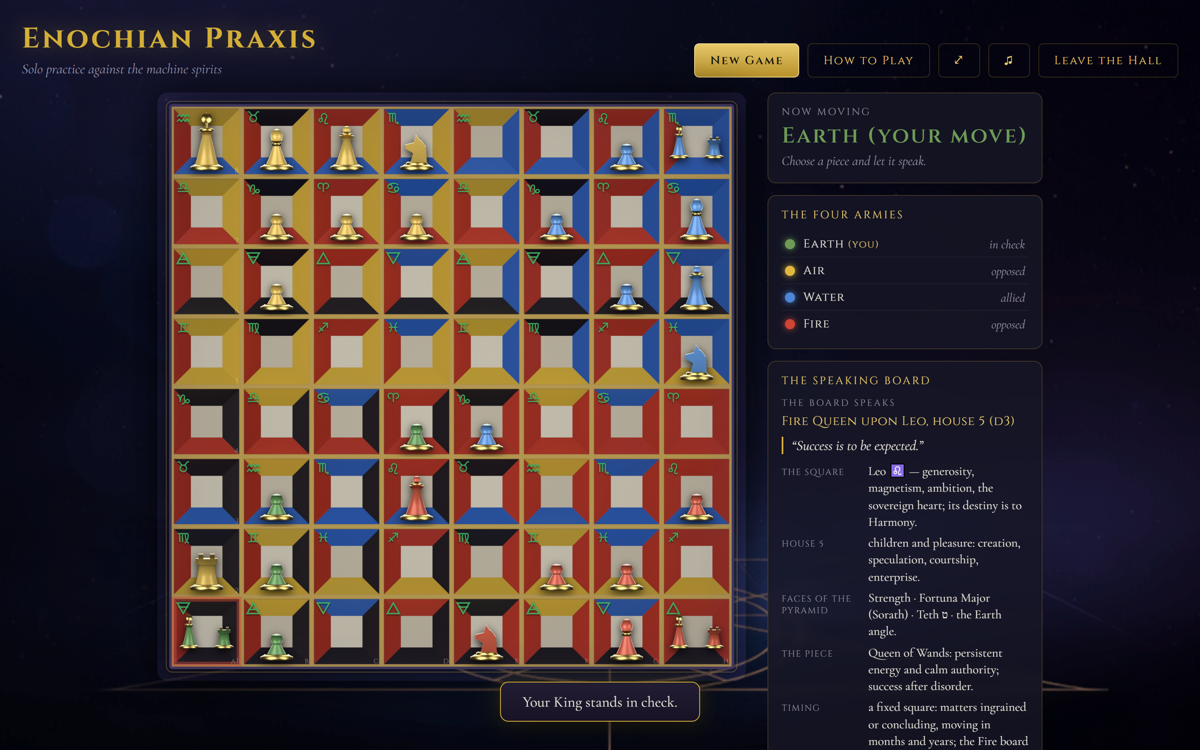
Study any single square and you will find it rendered as a small pyramid viewed from overhead, its four slopes converging on a point. Those slopes are where the attributions live: the element of the board on one, a letter for the square's column on another, a letter for its rank on a third, and on the last the quarter the square falls within. Combine the four and the square declares its sign and the geomantic figure that accompanies it. The boards page shows all four boards and explains that construction in detail, so this article can stay with the larger question: what does the astrology actually do while you play?
One move, two journeys
Every legal move happens twice. On the surface it is chess: a Knight jumps, a Rook slides, a pawn steps forward. Underneath, the same move is travel through signs and houses. The Knight leaves one sign behind and lands in another. The Queen, who leaps exactly two squares in any direction, passes clean over one square's sky and comes down in a different one. A pawn crossing the board walks the zodiac a single square at a time. You never have to think about any of this to play well, but it never stops happening, and once you know it is happening the game changes texture. A capture is no longer only a capture. It is a piece of one element striking on a square that belongs to a certain sign and a certain quarter of life, and that is exactly the kind of event a reading is built from.
The layer starts working before the first move. You choose one of four boards, Fire, Water, Air, or Earth, and that choice hands the opening move to the board's own army and sets the elemental world the whole reading will speak from. Four armies stand at the four corners, bound into two fixed alliances, each ally seated diagonally opposite its partner, and the turn rotates around the board through all four in order. A game in motion is a wheel: four elemental forces circling a field of signs, each turn shifting the pattern the final reading will be drawn from. The rules page covers the play side of all this, and the pieces carry a symbolic load of their own, mapped to the tarot court cards on the pieces page.
How a finished game becomes a reading
In the original Golden Dawn practice the game was a working, not just a pastime. The diviner framed a question, let dice decide the outcome, and played the contest through to its end, watching along the way how the four elements brought the matter to rest. The reading drew on which alliance came out ahead, on the squares where pieces were taken, and on the pieces that did the taking. The final position was the answer: where the pieces stand, and on what, is what the oracle says.
When you play at Enochian Praxis, the Speaking Board panel does that bookkeeping for you. Move a piece and it tells you what the square underneath holds. It marks the moments that carry weight as they arrive and, when the game ends, folds everything it has collected into a final reading. If you want to see exactly how one square speaks, the divination page walks through a worked example: a single capture read line by line through its sign, its house, its trump, its figure, and its closing line of counsel. That page is the natural next stop once the idea here has landed.
Where the layer comes from
The astrological board is a Golden Dawn creation with older roots. The Hermetic Order of the Golden Dawn, the magical society of the late nineteenth century, built the game as a study and divination instrument for its advanced members. The four elemental boards rest on the symbolism of the elemental tablets recorded by John Dee, mathematician and adviser to Elizabeth I, and Edward Kelley in the 1580s, which is where the Enochian name comes from. Most of what the public knows arrived when Israel Regardie published the order's papers. Everything on this site follows those published papers, described in our own words, and the history page tells the longer story.
Do you need to know astrology to play?
No. The game stands entirely on its own as strategy. You can learn the moves, hunt the enemy Kings, and never once ask which sign your Rook is parked on. The astrology waits underneath until you want it, and it asks for no belief when you do. Take the layer as a game mechanic, as a way to learn the Golden Dawn correspondences by watching pieces live and fall on them, or as a working oracle; the board gives the same reading in every case. Most players find that after a handful of games they know the signs and houses the way they know the files and ranks, not because they memorized a table, but because a Queen they cared about fell on one.
Watch your next game speak
Play free in your browser, solo against the computer or online with others. The Speaking Board reads every move as you make it, with no download and no account needed for solo play.
Play NowKeep reading
New to the game? Start with what Enochian chess is, learn the full rules, or look up any unfamiliar term in the glossary.