The astrological houses are one of the layers of meaning carried by the Enochian board. Alongside the zodiac signs, the tarot trumps, the Hebrew letters, and the geomantic figures, each square also answers to a house of the horoscope. A house is the astrologer's name for a department of life: your work, your home, your partners, your losses, your hidden matters. Because the houses are painted into the board, a game is never only a contest. When the pieces come to rest, their positions can be read as a chart of where the forces of a question have gathered.
What a house is, in one paragraph
In astrology the sky is cut two ways. The signs of the zodiac are the belt of constellations, the flavor of a force. The houses are the twelve slices of your local horizon, and they say where a force lands in a life. The first house is the self and the body, the seventh is partners and open enemies, the tenth is career and standing, the fourth is home and roots, and so on around the wheel. A planet in a sign tells you how it behaves; the same planet in a house tells you which room of your life it is standing in. On the Enochian board the pieces play the part of the planets, and the squares carry the rooms.
How the houses live on the board
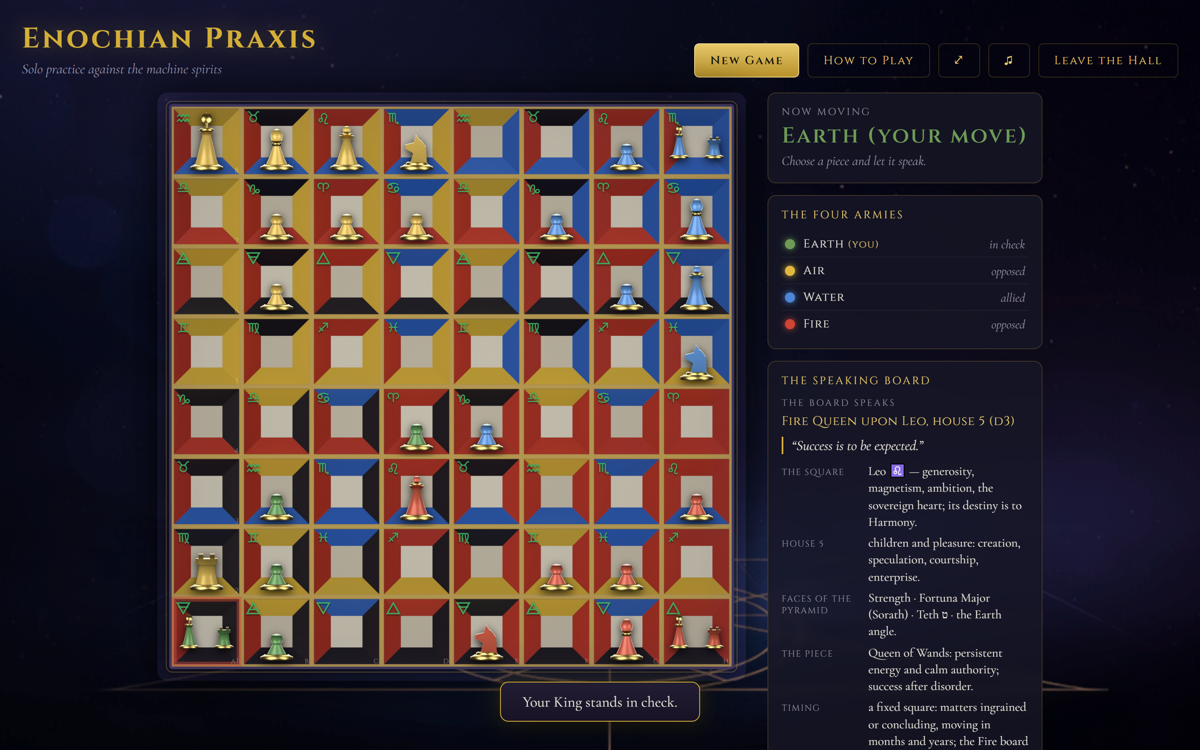
The Golden Dawn drew each square as a small pyramid seen from above, and the four faces of that pyramid carry the square's attributions. One face answers to a house. So the house layer is not an overlay you add on top of the game; it is built into the surface the pieces move across, in the same way the sign of the zodiac and the tarot trump are. You do not need to see the houses to play. They sit there whether or not you look, and they matter only when you decide to read.
This is a system-level layer, which is the honest way to describe it. There is no need to memorize which house sits on which coordinate, and this article does not hand you a per-square map. What matters is the principle: every square belongs to a house, the houses run their full circuit across the board, and a piece finishing on a given square has, by that fact alone, taken up residence in a department of life. The worked example on the divination page shows the whole layered picture in one place, and the boards section shows how the four elemental designs carry these markings.
Why standing somewhere means something
The reading rests on a simple idea. A game moves pieces from the corners into the field, they clash, and by the end some squares are held and others are empty. The pieces that survive have chosen, through the whole run of play, where to stand. Read the houses under those squares and you get a sentence about the question: this much energy came to rest in the house of partnership, that much in the house of loss, the King ended near the house of the self. It is the same instinct astrologers use when they see a stellium, a crowd of planets bunched in one house, and read it as the life pressing hard on one theme.
The pieces sharpen the sentence, because in Enochian chess each piece is already a symbol before it lands anywhere. A Queen carries her force differently than a Rook does; the four armies are the four elements, so a Fire piece resting in the house of home reads differently than a Water piece resting there. If you want the piece side of that equation, the pieces page lays out the god-forms and the tarot court each unit answers to, and the wider tarot correspondences show how those court cards color a reading.
The houses among the other layers
The houses are one voice in a chord. The same square that names a house also names a sign, a trump, a Hebrew letter, and a geomantic figure. In a full reading these are meant to be heard together: the sign gives the tone, the house gives the arena, the trump gives the archetype, and so on. The house is often the plainest of them to say out loud, because it answers a question everyone already asks. Not just what is happening, but where in my life is it happening. That is what a house is for.
It helps to keep the houses distinct from the signs, since the two are easy to blur. Both come from the sky, both circle the board, but they answer different questions. If you want the sign layer on its own, that is a separate subject from this one, and the divination guide keeps them apart on purpose. Here the point is narrow: the houses turn positions on the board into places in a life.
Reading a house layer without a chart
You can start reading the house layer the first time you play, and you do not need to know astrology to do it. Play a game to its end. Notice which parts of the board are crowded and which are bare. Look up the houses that sit under the busy squares, using the reference on the divination page rather than any memory of coordinates. Then say the plain thing: the pressure of this game gathered in these houses of life. Do that a few times and the board stops being a grid and starts being a horoscope that you happened to build one move at a time. The reading is only as heavy as you want it to be, and a game read lightly still tells you something true about where your attention went.
Build a chart by playing
Every finished game leaves a spread of pieces you can read as houses of life. Play one now, then look at where the forces came to rest.
Play NowKeep reading
The houses are one layer of a board that carries several. To see how they fit with the signs, the trumps, and the letters, read the full divination guide, then try the worked reading on the divination page.