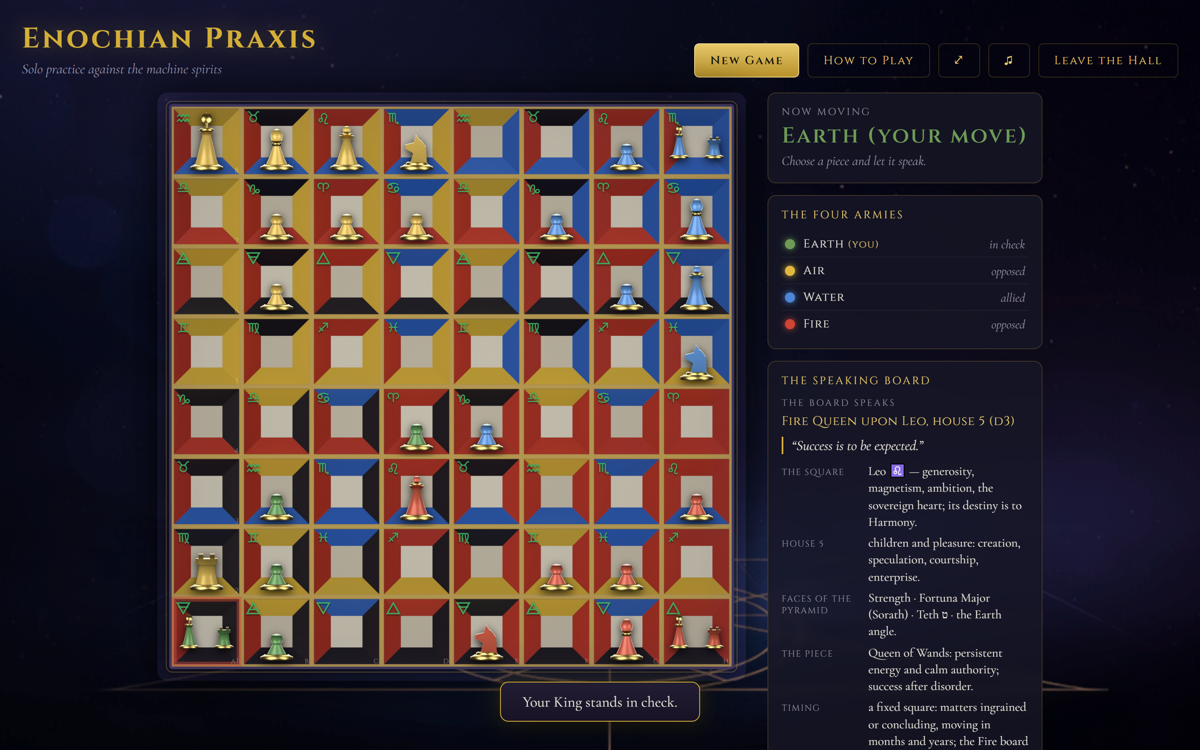
Every square on an Enochian chessboard carries a Hebrew letter, sitting alongside a sign of the zodiac, a tarot trump, a geomantic figure, and an astrological house. The letter is not decoration. In the Golden Dawn system that Enochian Praxis follows, the twenty-two letters of the Hebrew alphabet are the same set the order used to organize its tarot and its map of the heavens, so a letter on a square is a shorthand for a whole cluster of meaning. This article stays at the level of the system: how the letter layer is built, how it links to the trumps and the elements, and what it gives you when you read a finished game. It does not tell you which letter sits on which square, because the value is in understanding the layer, not memorizing a grid.
One letter among several attributions
Start with the square itself. In this game a square is not the flat, interchangeable space it is in ordinary chess. Each one is drawn as a small pyramid seen from above, and its four faces carry attributions: a zodiac sign, a tarot trump, a Hebrew letter, and a geomantic figure, with an astrological house folded in as well. The Hebrew letter is one face of that pyramid. It travels with the others, so wherever a piece lands it arrives at a letter and a sign and a figure all at once. You never read the letter in isolation. It is one voice in a small chord, and it earns its place because the letters are the connective tissue that holds the other attributions together.
Why the alphabet fits the board
The reason a Hebrew letter belongs on a chess square at all comes from how the Golden Dawn built its correspondences. The order took the twenty-two letters and sorted them into three groups: three "mother" letters that stand for the primal elements, seven "double" letters tied to the planets, and twelve "single" letters tied to the signs of the zodiac. Because the board's squares are keyed to signs and planets, and because those same signs and planets already have letters attached, the letters come along automatically. Nobody had to invent a separate letter scheme for the chessboard. The alphabet was already woven through the astrology and the tarot, so laying the board over that framework brought the letters with it.
The letters and the tarot trumps
The tightest link the letters make is to the Major Arcana. In the Golden Dawn scheme, each of the twenty-two trumps is paired with one of the twenty-two Hebrew letters, so the two sets run in parallel from end to end. A square that carries a given trump also carries that trump's letter, and the letter's own meaning colors how the trump reads. This is why the letter layer and the trump layer are not really two separate things on the board; they are the same idea stated twice. If you have read how the tarot maps onto the board, the letters are the hinge that made that mapping possible in the first place. The court cards live in the pieces, the trumps live in the squares, and the Hebrew letters are the thread the order used to sew the trumps to the signs and planets underneath them.
The letters and the elements
The letters also reach back to the elements, which is the layer every reading starts from. Three of the twenty-two, the mother letters, stand directly for primal elements, and the rest carry elemental flavor through the signs and planets they govern. So the alphabet is not neutral toward Fire, Water, Air, and Earth; it leans, letter by letter, the same way the armies do. When you already know that the four elements set the tone of a game, the letters simply add detail to that tone. A landing does not just say "this is fiery" or "this is watery"; the letter on the square narrows it, the way a single word narrows a sentence. The board you choose before play, whether the Fire, Water, Air, or Earth board, sets the key, and the letters fill in the smaller intervals inside it.
What the letters add to a reading
None of this changes how you play. You still move to capture Kings, and you still read the game at the level of elements and trumps first. The letters come in as the fine grain. When a game closes and its armies settle, you look at where the surviving pieces have come to rest and read the symbols on those squares. The Hebrew letter is one more corroborating detail in that cluster: if the sign, the trump, and the letter on a resting square all lean the same way, the reading is firmer than a sign alone would make it. If you want the worked method for gathering those symbols into a single statement, the divination guide walks through it move by move and at the close. The letters rarely lead a reading. They confirm it.
Reading the layer honestly
The discipline with the letters is the same as with every other attribution on the board: stay at the level of the system and resist the urge to over-read a single square. The letters are meaningful because they belong to one coherent table that runs through the tarot, the signs, and the elements, not because any lone letter carries a fixed private message you must decode. Read the chord, not the one note. Let the surviving position, the winning alliance, and the agreeing symbols do the work, and treat the Hebrew letter as the detail that tips a reading from likely to sure. Used that way, the letter layer is one of the quiet reasons a finished Enochian game can be read as an oracle at all.
See the letters land as you play
The fastest way to feel this layer is to make a move and watch which symbols the square is carrying. Start a free game and let the board name what each landing holds.
Play NowKeep reading
To see the whole oracle in one place, visit the divination overview, then choose the elemental board that fits your question among the four boards before you play.