Throne seizure is the rule that lets one King take charge of two armies. In Enochian chess a King who marches to his ally's throne, the corner square where the allied King began, takes command of that whole army. If the army was still moving, the two forces now answer to one hand. If the army had frozen after its own King fell, reaching the throne reawakens it, and a quarter of the board that had turned to inert stone stands up and fights again. No other move in the game can turn losing material back into a working army, which is why the throne is often the most contested square on the board late in a game.
Where the throne is and why it matters
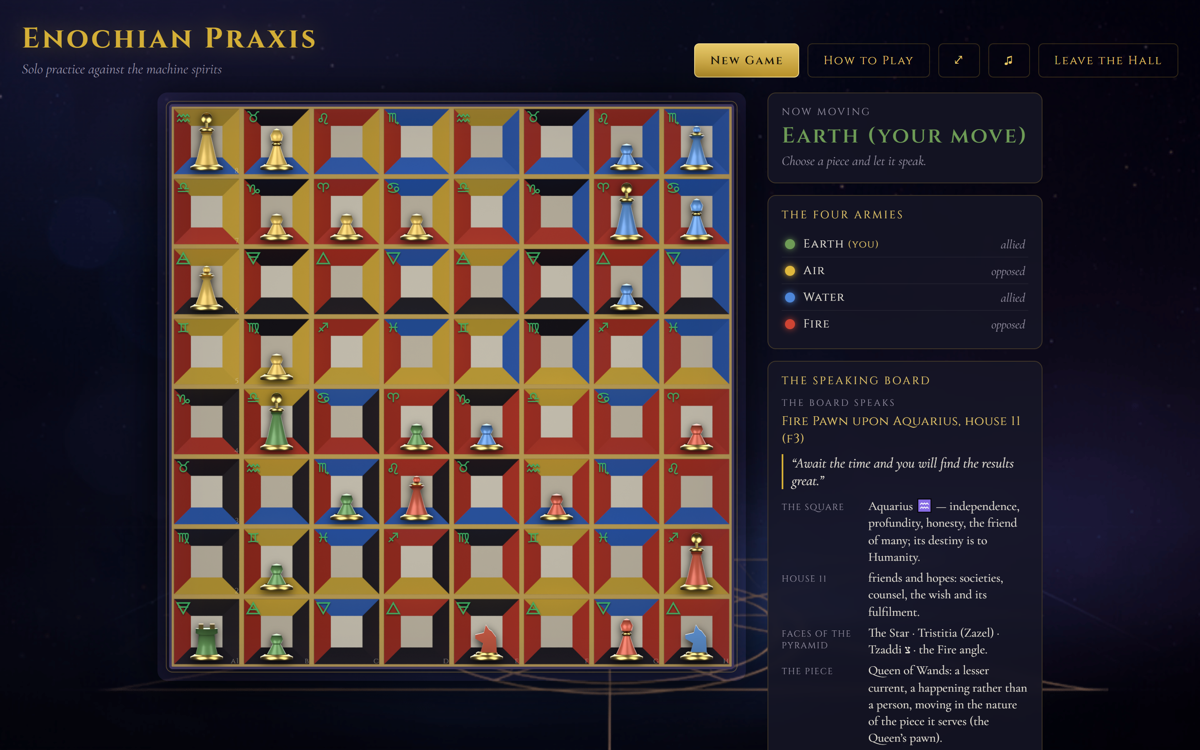
Every army starts in a corner, and that corner is its throne. Earth sits at a1, Air at a8, Water at h8, Fire at h1, and each King begins the game doubled on his throne with a single major piece beside him. Your ally is not next to you; the two armies of an alliance sit at corners that face across the diagonal, so Earth pairs with Water and Air pairs with Fire. The throne you are trying to reach is therefore always the far corner, on the opposite side of the board. That distance is the whole point. Command is not handed out cheaply. A King has to survive a long walk through contested ground to claim it.
How the seizure works
The move itself is simple. A King steps onto his ally's throne square, and from that instant he commands both armies. On his own turns he still moves as one King, but when the rotation reaches the army he has seized, he moves its pieces too. He is running two forces from opposite corners, and because allies never capture or check each other, the two never work against themselves. If the allied King is still alive when the seizure happens, that King stays on the board as an ordinary piece under the commander; command is about who directs the army, not about removing anyone. The King's page covers how he moves and why he can be taken outright, and the full rules place the throne inside the wider flow of a game.
Reawakening a frozen army
The seizure matters most when the allied army is frozen. When an enemy captures a King, that King's army freezes in place: its pieces become inert terrain that cannot move, cannot be captured, and blocks the lines it stands on while threatening nothing. You can read the full account of that state in what happens when a King falls. A frozen army looks finished, but it is only waiting. If the surviving allied King reaches the frozen army's throne, the freeze lifts. Every piece that had stood as stone wakes at once and moves again under the commanding King. A force that was scenery a moment ago is suddenly a second army back in the fight, on squares the enemy had learned to ignore.
This is why a march to the throne is one of the strongest long plans available to a side that has already lost a King. Losing a King in Enochian chess is not the same as losing the war. An alliance shares one fate, and as long as one allied King still walks, the frozen army has a way home. The commander does not have to fight through the frozen pieces or clear a path to them. He only has to place himself on one specific square, and the whole force answers.
Reversion: command that outlives no one
Command is borrowed, not owned. It lasts only as long as the King who holds it. When a commanding King is captured, every army he directed reverts. If the reverted army still has its own living King, it returns to that King's command and keeps moving. If its own King is dead, the army freezes again, dropping back to stone on whatever squares it then occupies. So an army woken at the throne is not safe forever. Take the commander who woke it, and it can turn back to terrain in the same move that removes him. This is the trapdoor under every throne seizure: the reawakened army is exactly as alive as the King now leading it.
How a game swings when a dead army returns
Picture the middle of a hard game. One alliance has taken an enemy King, frozen a quarter of the board, and now hunts the last enemy standing. That is close to winning, because a side wins the moment both enemy Kings are taken. But the hunted King has a plan that has nothing to do with defense. He turns and marches for his frozen partner's throne. If he arrives, the freeze breaks, and the material the attackers thought they had removed is back on the board and pointed at them. A position that read as nearly decided is even again. The attackers must now beat two working armies instead of chasing one lone King.
That single possibility changes how both sides play. The attacking alliance cannot simply corral the survivor; it has to watch the throne and often has to reach it first, sitting or blocking the corner so the frozen force can never wake. The defending King cannot trade freely, because he is the only route his stone army has back to life, and if he falls before he sits the throne, both are lost together. Many endgames come down to this exact race: a hunt against a march, one side trying to take the second King, the other trying to seat him on the throne before that happens. Because the same idea drives so many finishes, it belongs in any honest look at how the game is won and lost.
Wake an army for yourself
Reading about a frozen force standing back up is one thing; steering a King across the board to do it is another. Start a free game against the computer and race for the throne.
Play NowKeep reading
Throne seizure sits inside the freeze system, so the natural next step is how an army freezes in the first place. From there, see what Enochian chess is if you are new, and study the four elemental boards whose corners hold the thrones.