Enochian chess comes from the Hermetic Order of the Golden Dawn, a magical society founded in the late 19th century. The order taught a graded curriculum of ritual, symbolism, and correspondence, and it built this four-handed game for its more advanced members as both a study instrument and a divination tool. The board was a teaching device first. You learned the elements by moving them, and you could end a game by reading the finished position as an oracle. That double purpose, practice and prophecy in one object, is what makes the game unlike ordinary chess.
What the order was
The Golden Dawn was a structured society with degrees, and each degree carried its own material to master. A member climbed through a curriculum of Hebrew letters, tarot, astrology, the four classical elements, and the geometry that ties them together. The order framed its inner work in Rosicrucian terms, which is why the same game is sometimes called Rosicrucian chess. It is one game with two names. What matters for the chess is that the order was obsessed with correspondence: the idea that a letter, a planet, a tarot card, and an element could all point at the same underlying force. A student was expected to hold those links in mind until they became second nature.
Why a chess game
Rote memory is a poor way to learn a living system. The order needed something that would drill its correspondences under pressure, and a game does that better than a card index. Enochian chess seats four armies at the corners of a single board, one for each element: Earth, Air, Water, and Fire. The four armies are bound into two fixed alliances, Earth with Water on the receptive side and Air with Fire on the active side, and your ally sits at the corner diagonally opposite you, never beside you. To play at all you have to feel how the elements relate, which pairs cooperate and which oppose. The game teaches the same doctrine the order taught in its papers, except you absorb it by playing rather than by reciting. If you are meeting the elemental scheme for the first time, the four boards and their two alliances are the place to start.
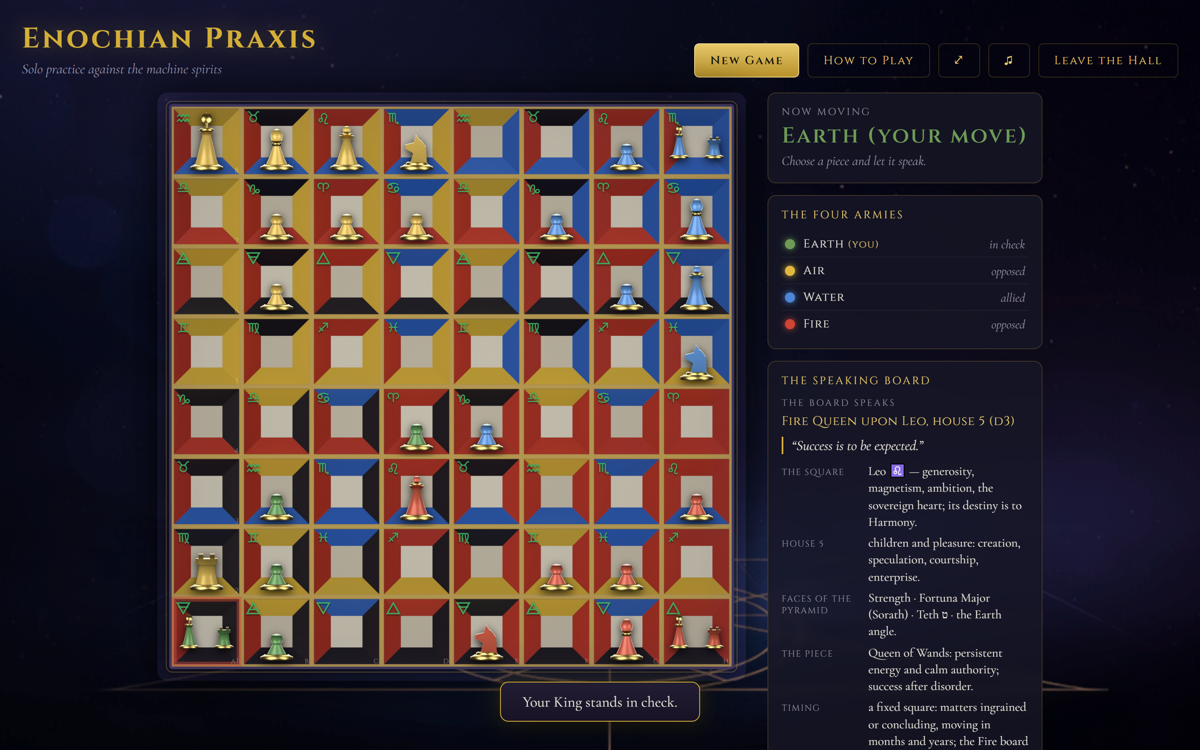
The board as a diagram
The chessboard did more than host a match. Every one of its sixty-four squares carries a layer of divinatory attribution: a sign of the zodiac, a tarot trump, a Hebrew letter, a geomantic figure, an astrological house. In the order's design each square is drawn as a small pyramid seen from above, its four faces bearing those attributions, so the board is a chart of correspondence you happen to be playing on. The four elemental board designs, Fire, Water, Air, and Earth, were built on the symbolism of the elemental tablets that the order inherited from an older source, which is where the name Enochian comes from. Sitting down to play meant sitting inside a map of the whole system the order was trying to teach.
Divination for advanced members
Because every square already carries meaning, a finished game can be read. When the last move is made, the pattern of where the pieces ended, whose armies stood and whose fell, is treated as an answer to a question posed before the first move. This is why the order reserved the game for advanced members rather than beginners. Reading a position as an oracle asks you to already know the correspondences cold, to see a Hebrew letter or a tarot trump the moment you look at a square. The game trained that fluency, and then it put the fluency to work. Our guide to divining with Enochian chess walks through how the reading is done, and the divination page gives a worked example.
How the game sat in the teaching
The order did not treat the chess as a diversion set apart from the real work. It was continuous with it. The pieces carry their own attributions: each element's army lines up with the court cards of a tarot suit, and the individual pieces were given Egyptian god-forms in the order's papers, so that moving a Queen was also handling a named power. The board carries the zodiac, the letters, the houses. Playing was one more way to rehearse the same correspondences a member met in ritual and in study, now under the small pressure of a contest with real stakes. A game you can lose focuses attention in a way a lecture cannot. That is the quiet genius of the design: it hides a curriculum inside something you actually want to win.
How it survived
The order was secretive, and its instructional papers circulated only among initiates. Most of what reached the public did so through Israel Regardie, who published the order's papers and so put the rules and the symbolism where anyone could find them. Without that publication the game would likely have stayed locked inside a handful of manuscripts. Because of it, the four-cornered board and its whole apparatus of correspondence came down to us intact enough to play. The account here rests on those published papers rather than on later reconstructions.
Play the order's game
The four-armed elemental board that trained the Golden Dawn's advanced members is free to play here, solo against the computer or online with others, and each game ends in a divination reading.
Play NowKeep reading
The history runs deeper than the game itself. You can trace where the name comes from through John Dee and the chessboard, or start from the ground up with a beginner's introduction to how the four armies move and win.