Shogi, the Japanese chess, and Enochian chess, the four-cornered board of the Golden Dawn, look nothing alike. One is a two-player war on a nine-by-nine grid; the other seats four elemental armies at the corners of a standard eight-by-eight board. But they share one striking idea that ordinary chess never touches. In both games, capturing a piece does not remove it from the story. What a captured force becomes is the most interesting thing these two games have in common, and it is where they part company most sharply.
What shogi does with a captured piece
In shogi, when you capture an enemy piece, it does not leave the game. It goes into your hand. On a later turn, instead of moving a piece already on the board, you may drop that captured piece back onto almost any empty square as one of your own. A pawn you took becomes a pawn you own. This single rule, usually called the drop, changes everything about how the game feels. Material is never really lost; it only changes color. Attacks build from reserves you have been collecting all along, and the board stays crowded and dangerous into the endgame rather than thinning out.
Shogi has a second twist worth naming because it rhymes with Enochian promotion. When many pieces reach the far third of the board, the promotion zone, they can flip to a stronger form. A promoted piece keeps that strength until it is captured, at which point it reverts to its base kind and enters the captor's hand as raw material. So shogi treats a piece as a resource that flows back and forth between two players, gaining and losing power as it crosses the board and changes owner.
What Enochian chess does instead
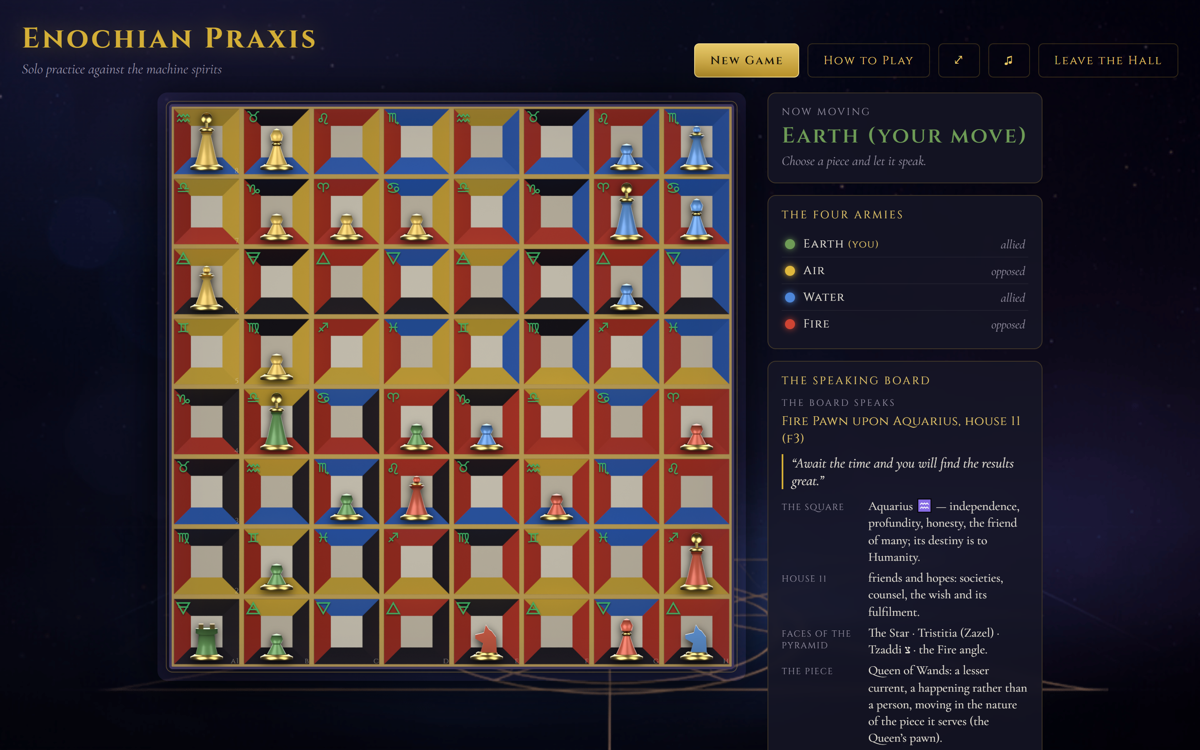
Enochian chess answers the same question in a way no other game does. There is no checkmate here. A King is captured outright, like any other piece. But the moment an enemy takes a King, that King's entire army freezes. Its pieces stay exactly where they stand and turn into inert terrain: they cannot move, they cannot be captured, they threaten nothing, and yet they still block the lines that sliding pieces travel. A whole force stops mid-battle and becomes part of the landscape. You can read the full mechanic in frozen armies, when a King falls.
This is the opposite of a drop. Shogi turns a captured piece into fresh strength for the person who took it. Enochian chess turns a captured King's whole army into a monument, present on the board but out of the fight. The captor gains no material at all. What the captor gains is position and pressure, because a frozen army can wall off a quarter of the board and reshape every path across it.
The part shogi has no answer for
Here is where Enochian chess goes somewhere shogi never does. A frozen army is not necessarily gone for good. It can be reawakened. Because the four armies fight in two fixed alliances, with your ally seated at the corner diagonally opposite you, a living King can march across the board and reach his ally's throne. When he seizes that throne he takes command of the ally's army, and if that army had been frozen, it stirs back to life and fights again under his hand. A force that had become terrain rises and moves once more. The mechanic is laid out in throne seizure and reawakening a frozen army.
There is also a gentler rescue built into the same alliance bond. When a King stands in danger, his own ally may capture him rather than let an enemy do it. A King taken by his ally is held in trust: his army does not freeze, and it keeps fighting under the ally's command. So Enochian chess offers two ways a doomed force can survive, both of them flowing from the fact that two of the four armies are always on the same side. Shogi, being a duel between two players, has no allies and therefore no such rescue.
Two philosophies of the captured force
Set the two systems side by side and the contrast is clean. Shogi says a captured piece is a resource that never dies; it simply switches hands and returns to the fight for whoever holds it. Enochian chess says a captured King freezes his army into stone, and only the loyalty of an ally, a rescue or a march to the throne, can turn that stone back into a living force. One game recycles the individual piece. The other suspends and possibly resurrects the whole army.
That difference reaches all the way to how each game ends. Shogi ends when one King is trapped with no escape, a true checkmate. Enochian chess has no checkmate at all: an alliance wins only when both enemy Kings have been taken and the field is held. Because a partner can be rescued or a frozen army reawakened, the game resists the clean single-blow finish that shogi drives toward. For the wider contrast with the game most Western players already know, see Enochian chess versus regular chess.
Feel the freeze for yourself
Reading about a frozen army is one thing; watching one lock a quarter of the board and then wake up is another. Start a free game against the computer and take a King to see what happens next.
Play NowKeep reading
If the drop-and-freeze contrast pulled you in, the next step is to see how Enochian chess is built. Start with what Enochian chess is, meet the four elemental armies in the four elements, or read how a game is decided in how you win.