Geomancy is one of the layers a square carries. An Enochian chess square is not just a place to stand a piece; it holds a small stack of attributions, and among them sits one of the sixteen geomantic figures. Geomancy itself is an old divination of the earth: you make a series of chance marks, count each row odd or even, and build figures out of single and paired dots. The Golden Dawn wove those figures into the board so that where your armies come to rest carries geomantic meaning, not only positional meaning. This article stays at the level of the system. It explains how the geomantic layer is built and how to think with it, without listing which figure belongs to any single square.
What geomancy is, in brief
Geomancy reads the earth the way astrology reads the sky. The diviner produces sixteen lines of marks without counting them, then reduces each line to a single or double dot depending on whether its count is odd or even. Four such rows stacked together make one figure, so there are sixteen possible figures in all. Each figure has a name, an elemental temperament, and a planetary and zodiacal flavor. Some are figures of motion, some of stillness; some are read as favorable, some as blocked. The whole art turns on reading those small towers of dots as a settled answer drawn up out of the ground rather than down from the stars. That earth-rooted quality is exactly why it belongs on a board whose four faces are the four elements.
What matters for the board is that the sixteen figures form a closed set. They are not a scale that runs from good to bad; they are sixteen distinct characters, each with its own weight, and any point you might mark can only ever land on one of them. That closed quality lets the figures serve as fixed labels. A designer can hand one figure to each region of the board and know the whole vocabulary is accounted for, the same way a designer can hand out the twelve signs or the tarot trumps. The figures become a way of naming ground.
How the figures sit on the board
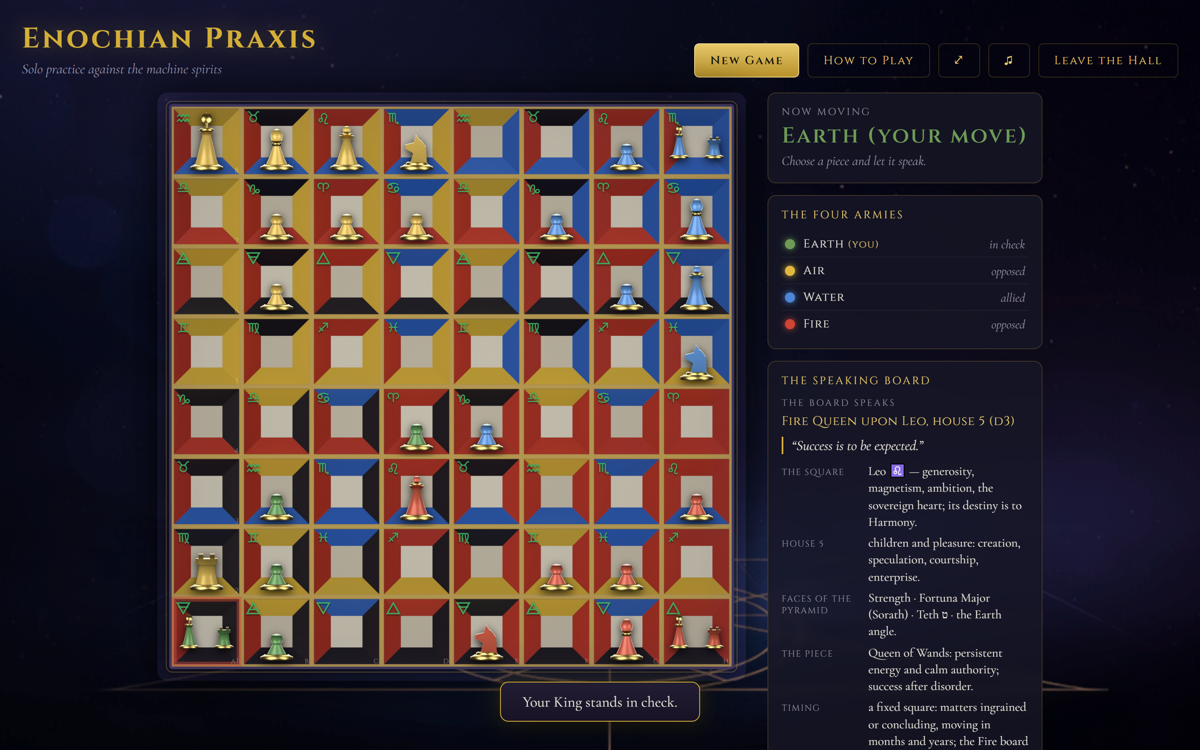
Each square is drawn as a small pyramid seen from above, and its four sloping faces carry attributions. One face can hold a sign of the zodiac, another a tarot trump, another a Hebrew letter, another an astrological house, and the geomantic figure takes its place among them. So the geomantic layer is not painted across the board as a separate diagram. It is folded into the squares themselves, one figure to a square, sharing the pyramid with the other correspondences. When you look at the finished board you are looking at many systems at once, and geomancy is the one that speaks in dots. If you want the fuller picture of how the boards are constructed, the guide to the four boards lays out the pyramidal squares in detail.
Why an elemental board suits an earth art
Enochian chess is elemental to its core. There are four boards, one for each element, and four armies bound into an active side and a receptive side. Geomancy is built from the same four elements: every figure is classed by which of fire, water, air, and earth rules it, and the balance of elements across a set of figures is half of what a reading turns on. Placing a figure on each square lets the two systems meet. A square already tinted by the board's own element now also carries a figure with its own elemental weight, and the agreement or tension between the two colors the meaning. If you are still sorting out how the elements pair and oppose across the board, the piece on the four elements of Enochian chess is the place to start.
Reading a game through the geomantic layer
The geomantic layer only fully comes alive when a game ends. A finished position is a settled arrangement of forces, and every occupied square hands you a figure. The kings, the surviving pieces, the squares that decided the game: each rests on ground with a geomantic name, and those names can be gathered into a small reading the way a geomancer gathers a set of figures from a fresh casting. You are not throwing marks in the dirt; the play itself has drawn the figures up for you. Which armies held their thrones, where the last capture fell, which pieces froze in place: all of it lands on figured ground. For the worked method of turning a finished board into an answer, the divination guide walks through it square by square.
None of this asks you to memorize a table before you play. The board carries its correspondences whether or not you consult them, and a beginner can enjoy a full game and never think about a single figure. The geomantic layer is there when you want it, a second reading resting under the first. That is the spirit of the whole design: a game you can play as a contest and, when it is over, turn over and read as an oracle.
Play a game, then read the ground
Start a free game against the computer or online, play it to its close, and let the final position hand you a spread of figures to read.
Play NowKeep reading
Geomancy is one layer of many. See how the same square also carries a Hebrew letter, and how a whole ended game gets read as an oracle once the last move is played.