On an Enochian board the twelve signs of the zodiac are not decoration. They are one layer of a full divinatory system printed onto the squares, so every square carries a sign, and a piece landing there lands on that sign. Move a Knight and it does not only cross the board; it moves from one zodiacal square to another. This is what people mean when they say the game speaks. The zodiac is one of the voices, sitting alongside the tarot trumps, the Hebrew letters, the geomantic figures, and the astrological houses that the same squares also carry. Understanding the zodiac layer is the cleanest way into how the board reads at all.
Every square carries a sign
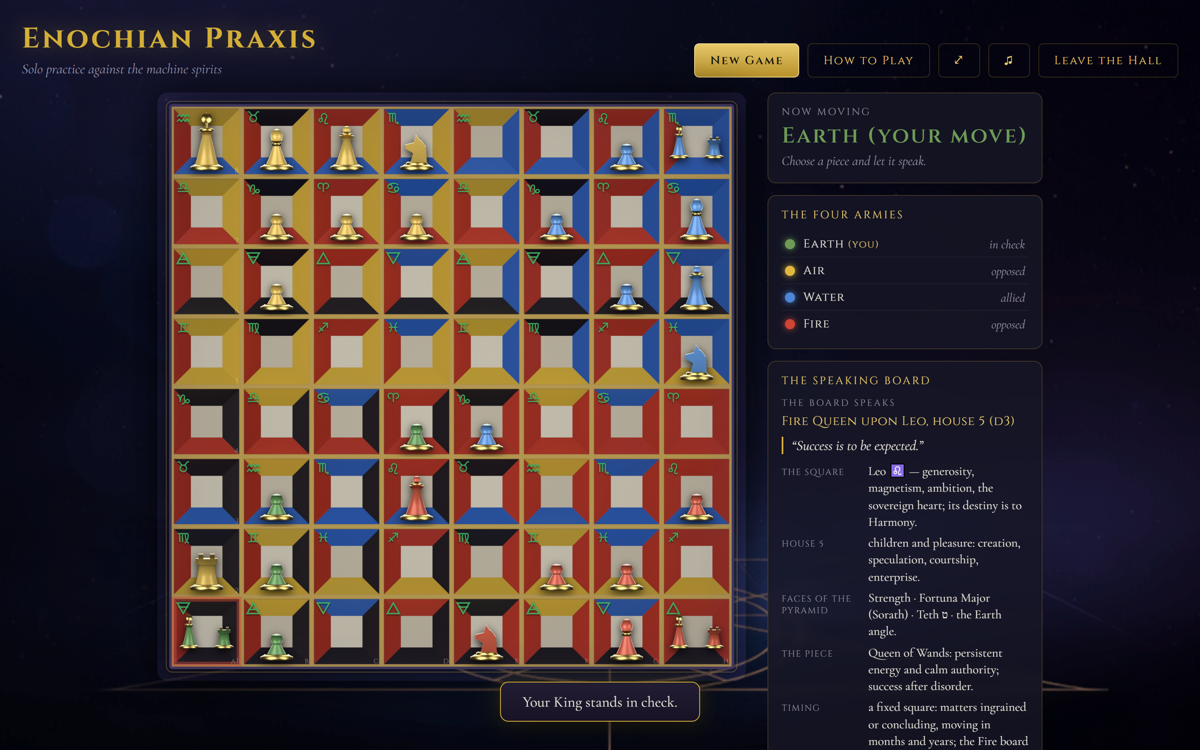
Look closely at a real Enochian square and it is not a flat color. It is drawn as a small four-sided pyramid seen from above, and each of the four faces bears an attribution. One of those attributions is a sign of the zodiac. The pyramid shape matters because it lets a single square hold several symbols at once without any of them crowding the others out. The zodiac is the layer most people notice first, because the twelve signs are familiar and their glyphs are easy to read on the board. If you have already looked at how the board is put together, you know that the color and the piece are only the surface. The signs are part of what lies underneath.
The point of a zodiac layer is not to teach astrology through chess. It is to give every position on the board a fixed astrological address. When a Queen sits on a given square, she sits on a particular sign, and that pairing of piece and sign is a statement the board is making. Read enough of those statements over a game and you have a reading. The zodiac is one of the surest ways the board turns a sequence of moves into something a diviner can interpret afterward.
A move is a step through the zodiac
Because the signs are fixed to the squares, motion across the board is also motion across the zodiac. A piece that advances is walking from sign to sign, and the path it takes is a small journey through the wheel. This is the part that feels strange to a chess player at first and then becomes the most interesting thing about the game. In ordinary chess a square is just a location. Here a square is a location and a sign and a face of a pyramid, all at once, so the same move that gains you tempo also carries a meaning you can read later.
None of this changes how the pieces move. A Queen still leaps her exact two squares, a Bishop still slides its diagonal, a pawn still steps forward. The zodiac layer rides on top of the mechanics; it does not bend them. What it adds is a second account of the game running in parallel with the tactical one. You can play the whole game paying attention only to captures and threats and never lose a thing, and a reader can come to the same game afterward and follow the signs instead. Both accounts are true at once.
One layer among several
The zodiac is not alone on the square. The same four faces of the same pyramid also carry a tarot trump, a Hebrew letter, a geomantic figure, and an astrological house. These layers are meant to work together. A sign says one thing, its house says where in life that thing lands, the trump colors it, and so on. When the board is read as an oracle, a skilled reader is not choosing between these layers but hearing them together, the way you might hear several instruments in a chord. The signs give the reading its zodiacal spine, and the other attributions fill in around them.
This is why the Golden Dawn built the board the way it did. The published Golden Dawn papers describe a study and divination instrument, not just a game, and the layered squares are how a game of moves becomes a spread of symbols. The four elemental boards, Fire, Water, Air, and Earth, each carry the full system, so the zodiac speaks on all of them; the element of the board tints how you weigh what the signs are saying. You can see the four designs and how they differ on the boards.
Reading the signs after the game
The zodiac layer earns its keep at the end. When a game finishes, the final position is a scatter of pieces across signs, and that scatter can be read. Which pieces ended on which signs, which signs were fought over, which sat empty and quiet all game: these become the raw material of a reading. The zodiac is rarely read in isolation, but it is often where a reading starts, because the signs are the layer most people can hold in their head. A worked example of a full reading, with the zodiac in its place among the other layers, is laid out on the divination guide.
We are keeping this at the system level on purpose. Which exact sign sits on which exact square is something you learn by looking at a board and by reading a full walkthrough, not from a list memorized in advance. What matters for understanding the game is the principle: the signs are fixed, they cover the whole board, and every move therefore moves through them. Once that clicks, the rest of the divinatory machinery makes sense, because it all works the same way.
Watch the board speak
Play a free game and watch each move land on its sign, then read what the position says when the game ends. The zodiac layer is easiest to understand when you see it move.
Play NowKeep reading
See the zodiac in its full context with the rest of the astrology inside the board, then walk through a complete reading in the divination guide or on the divination page.