If you can sit down and play Enochian chess today, you owe it to Israel Regardie. He published the papers of the Hermetic Order of the Golden Dawn, and those papers are where the rules, the piece moves, and the elemental correspondences of the game were written down. The order was small and secretive, its teaching passed by hand to sworn members, and the chess sat near the deep end of that teaching. Without a public edition of the papers, most of what you now know about the game would have stayed locked inside a handful of private notebooks, and it could easily have gone with them.
A game built for insiders
The Golden Dawn was a late nineteenth-century magical society, and Enochian chess was one of its advanced instruments, meant for members well along in their study rather than newcomers. It was not a parlor game. Each of the four boards is layered with correspondences, a whole system of signs, letters, and figures mapped across the squares, and a finished game could be read as a divination. That density is exactly what made the game precious and exactly what made it fragile. A game this intricate does not survive on memory. It survives on a written record precise enough that a stranger, decades later, can reconstruct the board and move the pieces correctly.
The correspondences are the clearest example. A player needs to know how the elements pair into their two alliances, how the pieces move, and how the whole ritual grid sits on the squares. None of that is obvious from a drawing of a board. It has to be spelled out, and in the order it was spelled out only for those inside.
What would have been lost
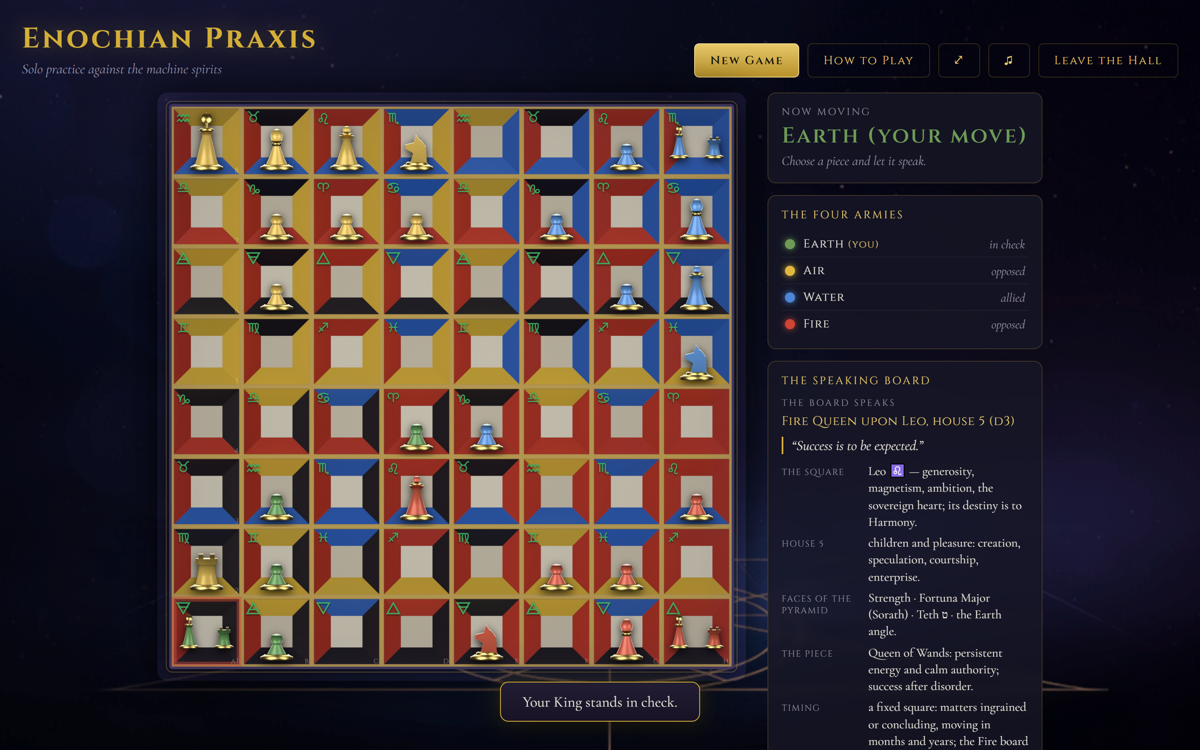
Picture the game with only the board surviving and none of the papers. You would see a familiar eight-by-eight grid with four armies at the corners and pieces you half recognize from ordinary chess. You would guess wrong on nearly everything that matters. You would not know that the Queen refuses to move a single square and instead leaps exactly two squares, jumping over anything between. You would not know that there is no checkmate, that Kings are captured outright, and that a captured King's army freezes into inert terrain. You would not know the delayed promotion, the throne seizures, or the concourse rule where four Queens meeting on one block trigger a mass capture. Every one of those is a written rule, not a thing you could deduce.
The correspondences would have fared worse. The idea that each square carries a sign of the zodiac, a tarot trump, a Hebrew letter, a geomantic figure, and an astrological house, and that these let a completed game be read as an oracle, is not something anyone recovers by studying a bare board. That layer lives entirely in the record. Lose the papers and you lose the reason the game exists. What is left would be a curious four-cornered variant, stripped of its meaning. The published papers are why we can talk about the game as a whole system rather than a rumor of one. They are the only source this site cites by name, alongside Regardie as the man who put them in reach.
Why the papers were fragile
Secret orders are built to keep knowledge in and often do their job too well. Material is copied by hand, held by a few officers, and scattered when a group fractures. The Golden Dawn did fracture, more than once, and its documents ended up spread across private hands with no guarantee any single copy would last. A tradition preserved only inside an initiatory chain is one accident, one house fire, one heir who does not care, away from silence. Regardie's decision to publish cut against the whole instinct of the order, and it is precisely that break with secrecy that turned a private teaching into something durable.
His publication did not invent anything about the game. It moved the existing record from a closed circle into the open, where it could be copied freely, checked, and studied by anyone who wanted to. That is the difference between a tradition that depends on a few living memories and one that can outlive everyone who first held it. A game that anyone can read the rules of is a game that anyone can keep alive.
Older roots, one rescue
The game reaches back further than the order that shaped it. The word Enochian comes from the angelic magic recorded by John Dee and Edward Kelley in the 1580s, the workings that produced the Enochian language and the four elemental tablets. The Golden Dawn built its four boards on the symbolism of those tablets and dressed the pieces in Egyptian god-forms. So the deep material is Elizabethan, the game design is Victorian, and the survival is twentieth-century. Regardie sits at that last hinge. The tablets could have been printed and the game still lost, because the game is a separate body of instruction that had to be published on its own terms. It was, and here it is.
Play the game the papers preserved
The rules Regardie printed are the rules you can play right now, free, against the computer or with friends online.
Play NowKeep reading
Regardie preserved the record; the fun is in playing it. Start with what Enochian chess is, walk through the full rules, or read more about the order that shaped the game and the wider history behind the board.