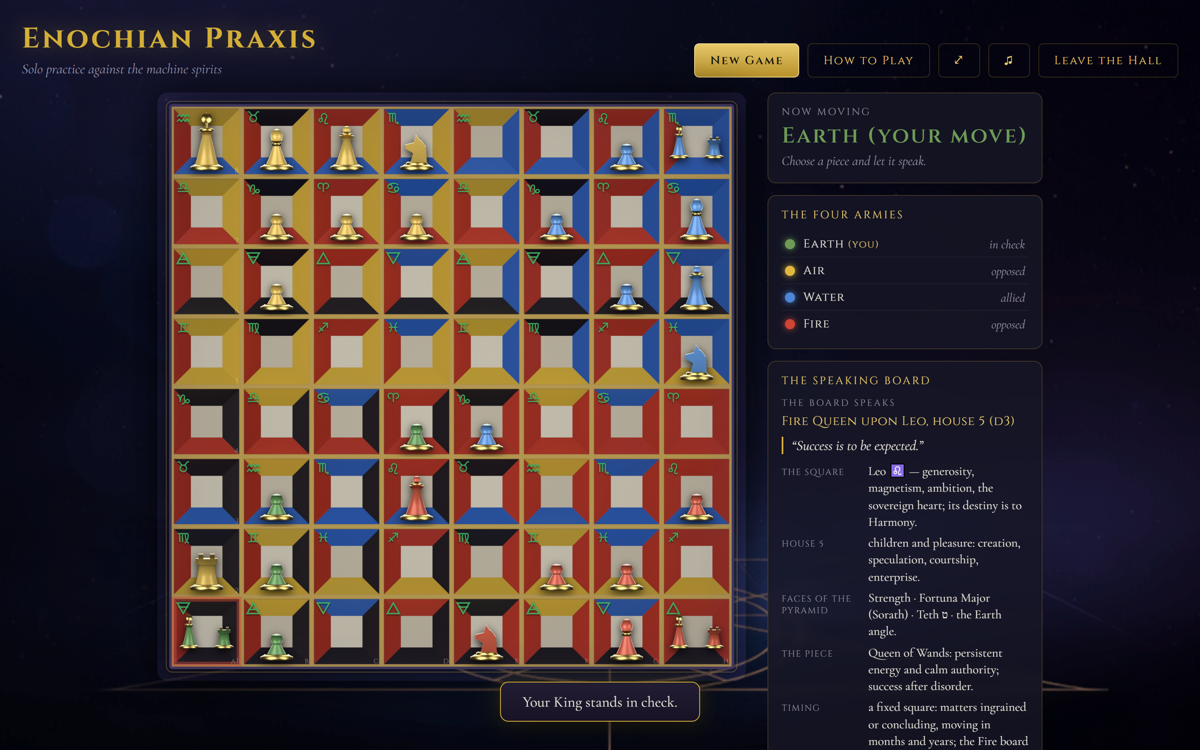
The Speaking Board is the panel that turns a game of Enochian chess into a reading you can follow as it happens. Every square on an Enochian board carries a fixed set of meanings, so the instant a piece settles onto one, that square has something to say. The Speaking Board says it. It names the piece, the sign and house of the square, the faces of the little pyramid drawn there, and a line of counsel from the old tables. Play and reading stop being two separate activities. They become one act.
Why the board can speak at all
An Enochian square is not blank. Each one is drawn as a small pyramid seen from above, and its four faces bear correspondences: the board's own element, the quarter it belongs to, and the letters that fix its column and rank. Read together, those faces resolve into a sign of the zodiac, a tarot trump, a Hebrew letter, a geomantic figure, and a place among the astrological houses. The meanings never change, which is what makes reading possible in the first place. A spread of tarot works because the cards mean the same thing every time; the Enochian board works the same way, only the meanings are painted onto fixed ground instead of shuffled. If you want the full picture of how a square is built, the divination page lays out the pyramid and its faces in detail.
Because the ground is fixed and the pieces move, a game writes a path across all that meaning. Where a capture falls, which sign a King flees onto, the house a promotion happens in: each of these is a landed square, and each landed square is a sentence. The Speaking Board reads the sentence as it is written rather than making you reconstruct it at the end.
What the panel names on each move
When a piece lands, the Speaking Board sets out a few things at once. First the piece itself, carrying its tarot court card: a Queen on the Fire board is the Queen of Wands, a Rook on the Water board is the Princess of Cups, and so on, following the court mapping described on the pieces page. Then the square: its zodiac sign, the astrological house it sits in, and the three faces of the pyramid that give a trump, a Hebrew letter, and a geomantic figure. Last comes a short oracle line, a plain verdict drawn from the old tables of meaning. You read the piece as the actor, the square as the field it acts in, and the oracle line as the tone of the result.
You do not have to move to hear it, either. You can rest on any square and study what it holds without touching a piece, which makes the panel a quiet way to learn the correspondences one square at a time. Beginners often use it exactly this way before they read a whole game, the same gentle on-ramp described in the beginner's guide.
Weighty moves gather as you go
Not every move deserves the same weight, and the Speaking Board knows it. An ordinary pawn step is noted lightly. Captures, promotions, a King fleeing check, and the rare formations like the concourse of four Queens are marked as heavier events and set aside. These are the moves where the elemental forces actually decide something, so they carry more of the eventual reading. By the time a game ends, the panel is holding a small collection of the moments that mattered, in the order they happened, ready to be drawn together.
This mirrors how the game was read in the original practice. A question was framed, the outcome was cast, and the play was watched to see how the elements settled it. The winning side, the squares where captures landed, and the pieces that took them all fed the answer. The Speaking Board keeps that method and simply does the bookkeeping for you, so nothing important slips past while you are busy thinking about the position.
From the last move to the whole game
An alliance wins the moment both enemy Kings are taken, and that is when the reading closes. At the end, the weighty moves the panel gathered are woven into a single verdict for the whole contest: which board you chose, which side held the field, the decisive square, and the counsel that square gives. One move already gives a coherent answer, as the worked example on the divination page shows. A full game stacks many of those answers and names which one carried the day. Draws read too. When only the four Kings remain, or an alliance is reduced to two bare Kings, the ending speaks of balance rather than victory.
None of this requires belief. You can treat the Speaking Board as a study aid for the Golden Dawn correspondences, as a game feature that adds atmosphere, or as a genuine oracle. It offers the same words either way, drawn from the published Golden Dawn papers and set down here in plain language. If you want the longer method for reading your own games, the divination guide walks through it step by step.
Hear the board speak
Start a free game and watch the Speaking Board name each square as you play, then read the verdict it builds by the end. No account, no download.
Play NowKeep reading
Want the deeper mechanics behind the panel? See how the board reads as an oracle, learn what the four elements lend each board, or begin with what Enochian chess is.