The Air board is the version of Enochian chess ruled by the element of air, and choosing it does three things at once. It gives the first move to Air, it hands the opening initiative to the active alliance of Air and Fire, and it sets the whole game in the world of thought and exchange for anyone who reads the final position as an oracle. All four elemental boards use the same standard eight-by-eight grid and the same four armies at the corners. What changes from board to board is which element rules, and on this one that element is air.
Air opens on the Air board
Turn order in Enochian chess rotates around the board, and the board's own element always moves first. On the Air board, Air takes the opening move. From there play passes around the corners in the usual rotation, so the second move belongs to Air's downstream neighbor and the sides trade turns from there. Because Air sits in the active alliance, that first move puts the active side ahead from the very start. If you want the receptive Water and Earth pair to lead instead, you pick a different board. The choice of board is made before a single piece moves, and it tilts the balance of the whole game. For a broader look at how the grid itself is built, see the Enochian chess board explained.
Air's army starts in the a8 corner. Its ally, Fire, sits at the opposite corner, diagonally across the board rather than beside it. That diagonal placement is deliberate and it matters for play: because allies face each other across the long diagonal, the rotation alternates the two alliances on every turn, keeping the active and receptive sides balanced as play circles the board. Air never captures Fire and never gives it check. The two armies win and lose together.
The character of air in play
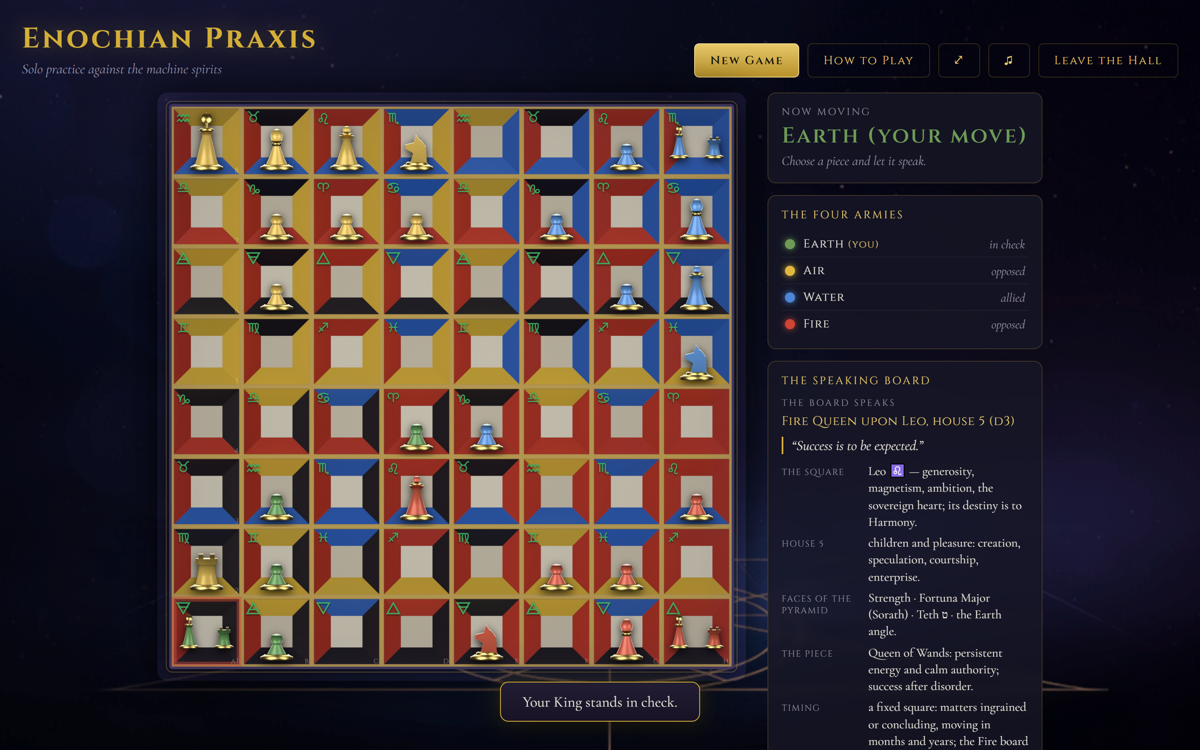
Air plays gold, and its temperament is quick and shifting. Where Fire drives straight at the enemy thrones, Air connects. It links positions together, keeps its options open, and carries the attack sideways when a frontal push runs into a wall. In the active alliance, Fire supplies raw pressure and Air supplies reach, so an Air board game tends to feel mobile and restless from the opening. The receptive side answers with patience: Water absorbs, Earth anchors, and both wait for the light elements to overextend.
Nothing about the piece moves changes on the Air board. The King steps one square, the Knight makes the ordinary L-jump, the Bishop and Rook slide until something blocks them, and the pawns creep one square forward with no double first step. The one piece that always surprises newcomers is the Queen, who leaps exactly two squares in any direction and jumps over whatever lies between, never moving just one square. If that leap is new to you, read the Enochian chess queen explained before you sit down at the Air board, because Air's mobility is easiest to feel when you already understand how the leaping Queen threads through a crowded field. The board's element sets the tempo and the mood; it does not rewrite the rules.
The Swords tablet behind the board
The four elemental boards were not designed as decoration. Each one rests on one of the four elemental tablets of Enochian magic, the Watchtowers recorded by John Dee and Edward Kelley in the 1580s and later carried into the Hermetic Order of the Golden Dawn. The Air board answers to the Watchtower of air, the tablet the Golden Dawn associated with the suit of Swords in the tarot. That is why the whole board reads as an air world: the symbolism painted onto its squares is drawn from the air tablet, and the pyramid squares beneath the pieces carry the air palette. To see how the four tablets map onto the four boards, read the Enochian tablets and the four Watchtowers.
This tablet grounding is the reason the board is called an Enochian board at all. The Golden Dawn treated the game as a study instrument as much as a contest, a way to move the elemental forces around and watch them interact. Most of what reached the public about it came through Israel Regardie, who published the order's papers. The Air board carries the air face of that whole system, from the color of the pieces to the correspondences on every square.
Reading an Air board game
Every square on the board holds a full set of divinatory attributions: a sign of the zodiac, a tarot trump, a Hebrew letter, a geomantic figure, and an astrological house. Each square is drawn as a small pyramid seen from above, its four faces bearing those symbols. When you gather a finished position into a reading, the board's element decides the world the symbols speak in. On the Air board that world is one of thought, communication, and exchange. A final position here reads in the language of the mind rather than the language of feeling or will. If you want to see how a finished game turns into an oracle, the worked example lives on the divination page, which walks through the reading step by step for any of the four boards.
Take the first move as Air
Choose the Air board in a free solo game and feel what it means to open the active alliance, or claim the gold throne online and let Fire push while you find the sideways line.
Play NowKeep reading
The Air board is one of four. To place it among the others and see why the board you pick decides the tempo, browse the four boards, then compare it with its ally on the Fire board and with the receptive side on the Water board.