The Fire board is one of the four elemental boards you can play Enochian chess on, and each game happens on exactly one of them. It is the board of the element Fire: quick, forward, and impatient. Two things mark it out from the other three. The Fire army moves first on it, and its whole design rests on the Golden Dawn Fire tablet rather than any of the others. All four boards use the same eight-by-eight grid and the same four corner armies, so the Fire board does not change the rules. What it changes is the color of the game, the tempo you feel from the first move, and the layer of meaning printed into every square.
One element gives the board its name
Every game of Enochian chess is set on a single board named for one of the four elements. Choosing the Fire board does not remove Water, Air, or Earth from play. All four armies still stand at the corners, Earth at a1, Air at a8, Water at h8, and Fire at h1. What the choice sets is the character of the ground under them. The board carries the temperament of its element, and Fire is the temperament of heat and motion. Play tends to run hot: pieces reach for the center early, threats build fast, and the game rewards a player who presses rather than one who waits. If you want the full comparison across all four, the guide to the four elements of Enochian chess lays them side by side.
Fire opens the game
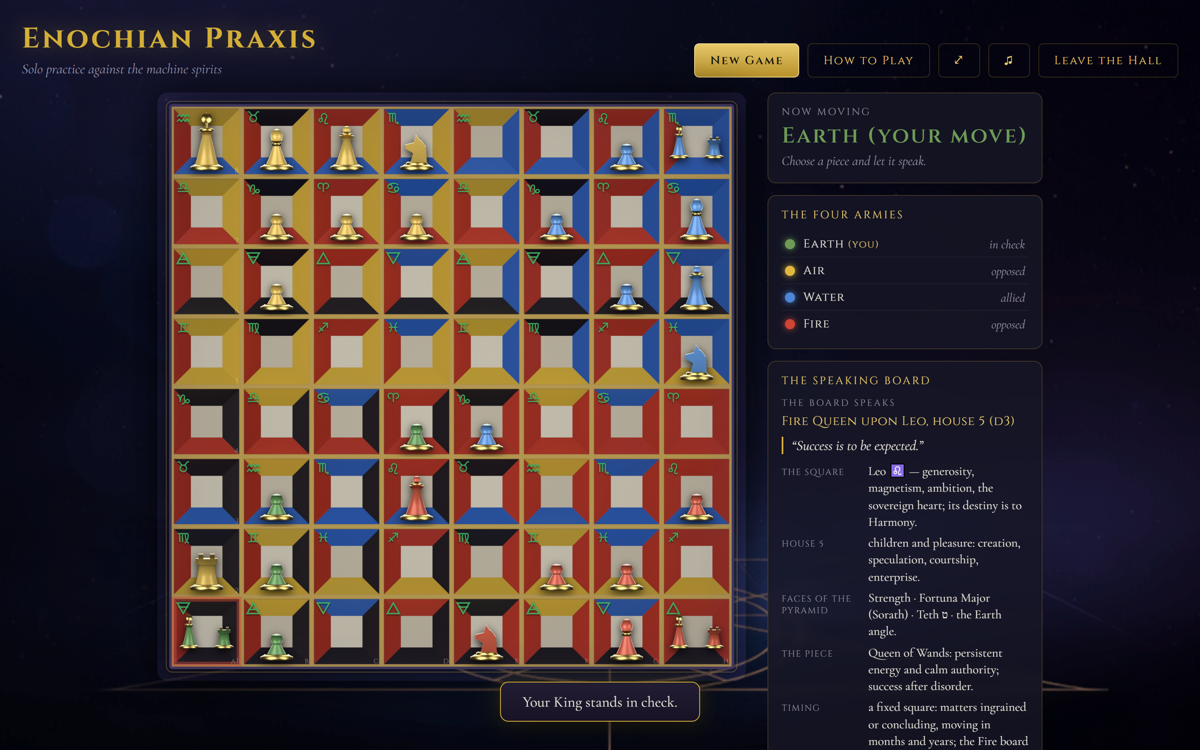
Here is the rule that makes the Fire board feel different the instant you sit down: on the Fire board, Fire moves first. Turn order rotates around the board in a fixed sequence, and the board's own element takes the first turn. So on this board the Fire army at h1 opens, and the rotation carries on from there. On the Earth board Earth would open, on Water it would be Water, on Air it would be Air. The effect is that the element whose board you are playing gets the first word. For Fire, an element already inclined to push, that opening move stacks the game's natural pace on top of its natural aggression. The player holding Fire starts with the initiative, and on the Fire board that head start is loudest.
Fire and Air, the active alliance
Fire never fights alone. The four armies are locked into two fixed alliances, and Fire is paired with Air on the active side, against the receptive alliance of Water and Earth. Your ally sits at the corner diagonally opposite you, never beside you, so on the Fire board the Fire army at h1 looks across the long diagonal to Air at a8. That diagonal placement matters. Because allies face each other corner to corner, the ordinary rotation alternates the two sides on every turn, and the active pair can build pressure from two opposite directions at once. Fire supplies the forward drive; Air supplies reach and mobility. Neither can capture the other, neither can give check to the other, and the two win or fall together. If you are learning how the pairings are set, the piece that most defines the alliance's aggression is worth study on its own, and the Enochian chess queen shows why the leaping attacker changes how you press a two-army attack.
Because Fire opens and Air answers soon after in the rotation, the active alliance often gets to state the shape of the game while the receptive side is still setting up. That is the Fire board's built-in bias. It does not decide the game, since the receptive pair answers with position and patience, but it tilts the opening toward the side that wants to move.
The Fire tablet behind the design
The four boards are not simply four color schemes. Each is built on one of the four elemental tablets that the Golden Dawn took from the Enochian system, the Watchtowers scried by John Dee and Edward Kelley in the 1580s. The Fire board follows the Fire tablet. Its arrangement of forces, its colors, and the attributions written across its squares all descend from that source, and the published Golden Dawn papers set out how the tablet maps onto the sixty-four squares. This is why the board reads as a study instrument as much as a game. You are playing on a diagram of the Fire Watchtower, laid flat and squared off, with each cell carrying its own weight of meaning. To see where the tablets themselves come from, John Dee and the chessboard traces the angelic workings that produced them.
What the squares carry
Every square on the Fire board holds a set of divinatory attributions: a sign of the zodiac, a tarot trump, a Hebrew letter, a geomantic figure, and an astrological house. Each square is drawn as a small pyramid seen from above, its four faces bearing those attributions, so the whole board is a grid of tiny four-sided figures. That is what lets a finished game be read afterward as an oracle. The point here is the system, not a table of which symbol sits on which cell. The attributions are set by the Fire tablet and worked out square by square in the papers, and the full layout belongs on the pages that show it. This attribution layer is the same in kind on every board and differs in content because each board answers to a different tablet. To see a game read out as a reading, the divination guide walks through a worked example.
Play a game on the Fire board
Feel the difference for yourself: Fire opens, the active alliance presses, and the board reads as an oracle when the last King falls. Choose the Fire board and start a free game against the computer or an online partner.
Play NowKeep reading
The Fire board is one of four, and the set only makes sense together. See the full collection on the boards, where each elemental design and the tablet behind it is laid out in one place, then read the sibling boards to compare their temperaments and turn orders.