The Water board is one of four board designs in Enochian chess, and it is the board that belongs to Water. Every game is played on a single eight-by-eight board, and the four designs (Fire, Water, Air, and Earth) are the same board dressed in different elemental symbolism. On the Water board, Water is the host element. It moves first, its imagery covers the squares, and the receptive alliance it shares with Earth takes the foreground. Choosing the Water board is choosing to let the game begin in the passive current rather than the active flame.
Water sits in the receptive alliance
The four armies are fixed to the corners: Earth at a1, Air at a8, Water at h8, Fire at h1. They lock into two permanent alliances. Water and Earth form the receptive, passive side. Air and Fire form the active side. Your ally sits at the corner diagonally opposite you, never beside you, so Water at h8 fights alongside Earth at a1 across the long diagonal. Allies never capture one another and never give check to one another, and an alliance wins and loses as a single body. Water is never alone on its own board; it is one half of a partnership that stretches corner to corner.
That pairing shapes how the Water board plays. Earth is the anchor, slow and holding ground, while Water moves around and between. The two are meant to work in concert: Earth occupies and defends, Water flows into the gaps and pressures from the far side. If you want the fuller picture of how these two elements answer each other, the piece on the four elements and their alliances lays out both sides in detail.
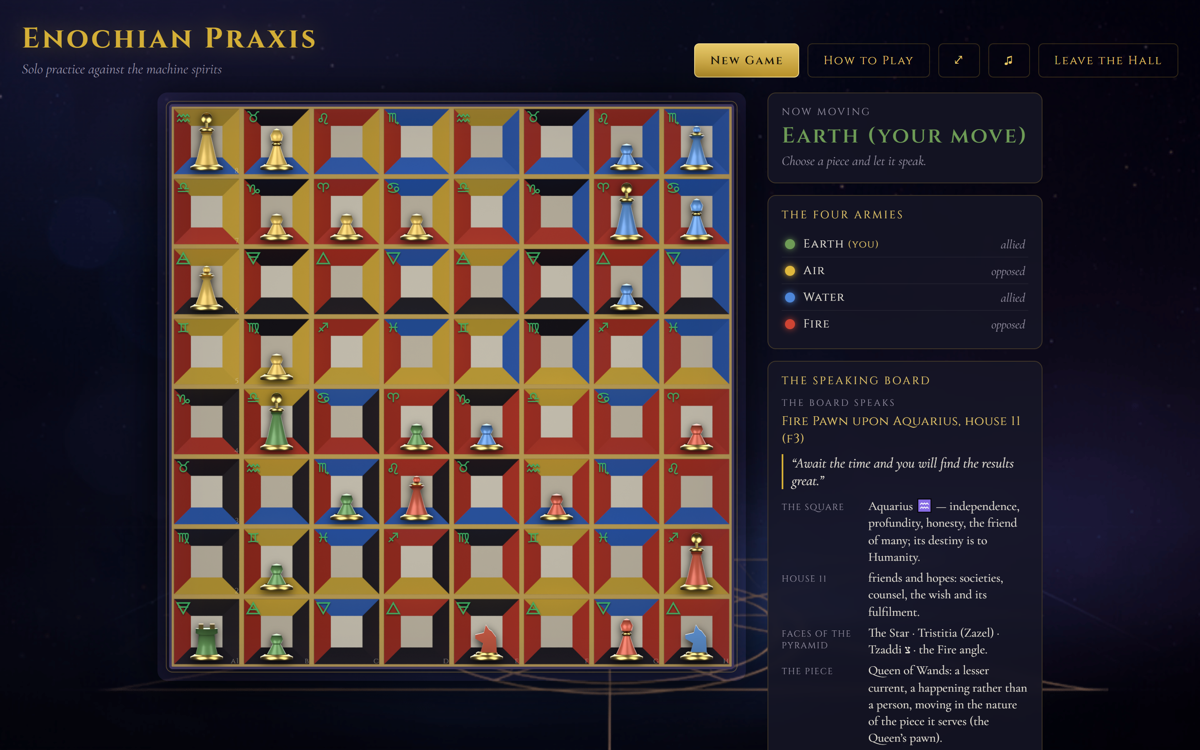
Water opens the game on its own board
A rule runs through all four designs: the board's own element moves first. On the Water board, Water opens. From there the turn rotates around the board in the fixed order, so after Water comes Fire, then Earth, then Air, and back to Water, each army taking a single move before the next. The receptive side leads the dance here, which is a quiet reversal of the more familiar image of Fire or Air striking first. If you are used to opening with an aggressive element, the Water board asks you to think in terms of positioning and response before assault. For a closer look at the sequence, see turn order and how the rotation runs.
The flowing character of Water play
Water is the element of flow, and the board rewards a playing style that matches it. The pieces themselves do not change from board to board; a Queen still leaps exactly two squares in any direction, a Bishop still slides on its bound color, a pawn still steps one square forward. What changes is the temper you bring. On the Water board the receptive alliance is meant to draw the enemy in and answer rather than to charge. You hold a line with Earth, let the active side commit, and then use Water's mobility to slip a piece across the board where it is least expected.
The leaping Queen suits this especially well. Because she jumps exactly two squares and passes over whatever stands between, she can appear on the far side of a wall the enemy thought was solid, which feels less like a march and more like water finding a crack. Coordinating her with your Earth ally is the heart of receptive strategy: Earth holds, Water leaps. There is no checkmate in this game, so the pressure builds differently than in ordinary chess. Kings are captured outright, and when a King is taken by an enemy the whole army freezes into inert terrain. The receptive side often wins by patience, letting the active side overreach and then taking a King while its guard is committed elsewhere. If you want the tactical detail on the two-square jump, the article on the Enochian chess Queen walks through her strange reach.
The Water tablet behind the design
The elemental imagery on the Water board is not decoration. Each of the four boards draws its symbolism from one of the four Enochian tablets, also called the Watchtowers, that came out of the angelic workings recorded by John Dee and Edward Kelley in the 1580s. The Golden Dawn built its four elemental boards on those tablets, assigning one Watchtower to each board. The Water board carries the symbolism of the Water tablet, and its squares are attributed accordingly through the layers the order laid over the field.
Those layers are dense. Every square carries a set of divinatory attributions, a sign of the zodiac, a tarot trump, a Hebrew letter, a geomantic figure, an astrological house, drawn as a small four-faced pyramid seen from above. On the Water board the whole field is tuned to the Water Watchtower, which is why a finished game here can be read as an oracle in a distinctly watery key. We do not lay out which attribution sits on which square (that belongs to a worked example rather than an article), but the way the layer works is covered in the divination guide, and the broader story of the tablets sits in the history of the game.
One board, four faces
It helps to remember that the Water board is not a different game, only a different dress. The rules are identical across Fire, Water, Air, and Earth. The armies, the alliances, the moves, the freezing and rescue of Kings, all of it holds the same on every board. What the choice of board does is decide which element hosts the game, which element moves first, and which Watchtower colors the divinatory reading at the end. Pick the Water board when you want the receptive side in the foreground and a game that begins in the current rather than the flame. The full set of designs, and how to move between them, lives on the boards page.
Play a game on the Water board
Take the receptive side for a spin: hold ground with Earth, flow with Water, and let the active side overcommit. Start a free game in your browser, solo against the computer or online with others.
Play NowKeep reading
The Water board is one of four. To see how the sibling design runs on the opposite side of the elemental split, read about the Fire board and the active alliance it belongs to.