The Earth army in Enochian chess wears five Egyptian god-forms. Its King is Osiris, its Knight is Horus, its Queen is Isis, its Bishop is Aroueris, and its Rook is Nephthys. These are attributions the published Golden Dawn papers set over the pieces, not extra rules: an Earth Queen leaps her two squares whether you name her Isis or not. What makes this corner stand out is the roster. Four of its five names belong to a single family of Egyptian gods that most readers already half know, which makes the Earth army the easiest of the four to picture the first time you meet it.
Where the Earth army sits
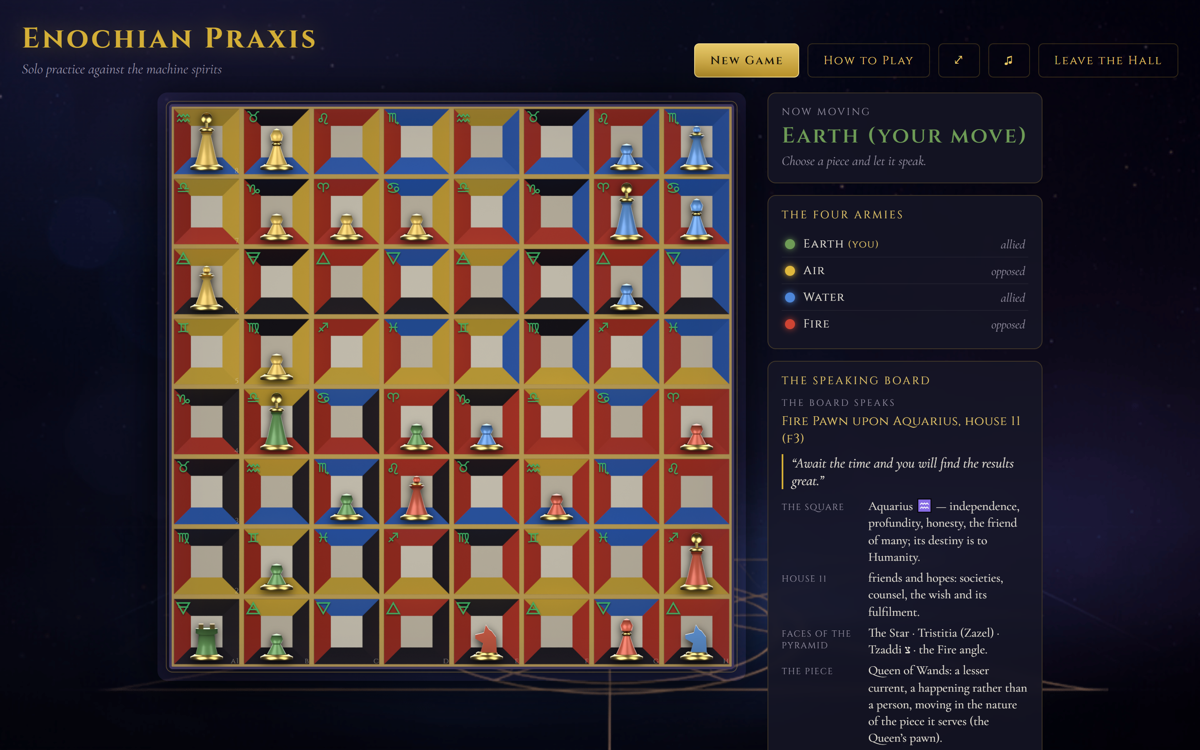
Earth takes the a1 corner and belongs to the receptive side of the board, allied with Water. Its ally sits at the opposite corner across the long diagonal, never beside it, so the two receptive armies work from far apart. Earth's pawns march toward file h, which is its promotion edge. That is the ground the five god-forms stand on. If you want the corner's full geography before the pantheon, the Earth board lays out its direction of play and what its squares carry, and the whole cast of names across the four armies lives on the Egyptian god-forms page. This article stays with Earth.
King Osiris, the throned form
The King of Earth is Osiris, and no name in the whole game needs less introduction. Osiris is the great god of the dead and of renewal in Egyptian religion, the ruler who was killed and restored, and setting him over the King of the earthy, receptive corner fits the papers' habit of crowning each army with a large foundational figure. As a piece he moves like any Enochian King, one square in any direction, and he begins the game doubled on his throne beside a major-piece partner chosen by the opening array. The mechanics of that shared first square are the same for every army, and the general King in Enochian chess page covers how the doubled throne works.
Queen Isis, the great mother
The Queen of Earth is Isis, the great mother goddess of the Egyptian pantheon and, in the old story, the wife of Osiris. Pairing the two at the head of the same army is the papers being tidy: the King and Queen of Earth are a matched pair drawn straight from the best-known myth in Egypt. On the board, though, this Queen is nothing like a chess queen. She leaps exactly two squares in any of the eight directions, jumping clean over whatever stands between, and she cannot move a single square at all. She is a short-range leaper, never blocked by a piece in her path, and she stays on one color for the entire game. The Enochian chess Queen page is worth reading before you trust Isis with anything, because the two-square leap catches everyone out at first.
Knight Horus, the son
The Knight of Earth is Horus, the falcon-headed god and, in the same family myth, the son of Osiris and Isis. So the Earth army already holds three of the story's central figures in three of its pieces: father, mother, and son sit as King, Queen, and Knight. The Knight is the leaping piece, the one that makes the ordinary chess knight's L-jump over whatever stands between, unstoppable by any blocker. Giving that reaching, agile piece to the young avenging god of the myth is a neat fit, though the papers offer it as a plain attribution and leave the rest to you. The Earth Knight moves like every Enochian knight, set beside its cousins in the Knight, Bishop, and Rook.
Bishop Aroueris, the elder form
The Bishop of Earth is Aroueris. This is the one name in the army that is not a household word, a Greek-tinged rendering the order carried over from the Egyptology of its day, and it does not line up neatly with a modern museum label. The honest course is to take it as the papers give it, a working image in a symbolic system rather than a dictionary entry, and not to build a myth around it that the sources do not support. As a piece the Earth Bishop is an ordinary diagonal slider, running any distance along the diagonals until something stops it, and like every Bishop it is bound to one color for the whole game. A frozen piece still blocks its line, which matters more here than in ordinary chess because whole armies can freeze at once.
Rook Nephthys, the guarding form
The Rook of Earth is Nephthys, the sister of Isis and the fourth figure this army draws from the one family, a goddess tied in the old story to mourning and protection. On the board she is the orthogonal slider, running along ranks and files until a piece or an edge halts her, blocked the same way the Bishop is, frozen pieces included. In the tarot court the order laid over the pieces, the Rook stands as the Princess of the suit, and Earth is the suit of Pentacles. Her pawn belongs to her and normally promotes back into a Rook when it reaches file h, though the game's delayed-promotion rule can hold a pawn waiting on the edge until the army has lost one of its own.
Reading the five as a family
Take the Earth army together and the pattern is plain: four of its five god-forms come from one story. Osiris, Isis, Horus, and Nephthys are all bound in the same cycle of Egyptian myth, and the papers set them over King, Queen, Knight, and Rook, with only Aroueris standing a little apart as the obscure name in the group. That is what makes this corner the friendliest of the four to a newcomer. You do not have to memorize a strange spelling to feel who is on the board. The point of the god-forms was never scholarly accuracy anyway; it was to keep the living image of Earth in front of the player, so moving the Queen felt like moving Isis and not just a token. The names also sit inside a larger stack, since every Earth piece reads as a tarot court card in Pentacles and every square beneath carries attributions of its own, which is what lets a finished game be read as an oracle. The pieces page walks through the tarot layer, and the divination page covers the reading.
Move the Earth gods yourself
Take the Earth corner in a free game against the computer, no account and no download, and let Osiris, Isis, and Horus stop being names on a page. The forms mean more once the pieces are in your hands.
Play NowKeep reading
The god-forms are one layer of a deep board. See the whole cast across the four armies, walk the geography of the Earth board, or start with the plain rules if the pieces are new to you.