Turn order in Enochian chess rotates around the board rather than bouncing back and forth between two sides. Play passes from corner to corner in a fixed circle. The default direction is deosil, meaning sunwise, and it visits the armies in the order Earth, Air, Water, Fire. A second direction, widdershins, reverses part of that loop into Earth, Fire, Water, Air. Whichever direction is used, the board's own element takes the first move, so a game on the Fire board opens with Fire. Everything else about who moves and when falls out of those two ideas.
Why the turn goes in a circle
Ordinary chess has two players, so a turn is a simple back and forth. Enochian chess seats four armies at the four corners of a single eight-by-eight board: Earth at a1, Air at a8, Water at h8, and Fire at h1. With four seats, there is no back and forth to fall into. The turn has to travel, and it travels along the edge of the board from one corner to the next. Each army moves once per lap, then the lap begins again. If you want to see how those four armies are arranged before you follow the turn between them, the board layout is the place to start.
Deosil: the sunwise default
Deosil is an old word for the sunwise direction, the way the sun appears to travel across the sky. It is the default rotation for the game. Starting from Earth, the turn moves to Air, then to Water, then to Fire, and back to Earth to begin the next lap. That gives the repeating sequence Earth, Air, Water, Fire. The order is not random. It carries the receptive and active elements in an alternating pattern that keeps the two teams from ever moving twice in a row, which is the whole reason the circle works the way it does.
You do not need to memorize the sequence to play. When you sit down, you take a seat, and the turn simply comes to you when it comes. But knowing the order helps you read the board, because it tells you exactly who moves after you and who moves before your next turn. If you are new to the game, the wider flow of a full game is laid out in the guide for beginners.
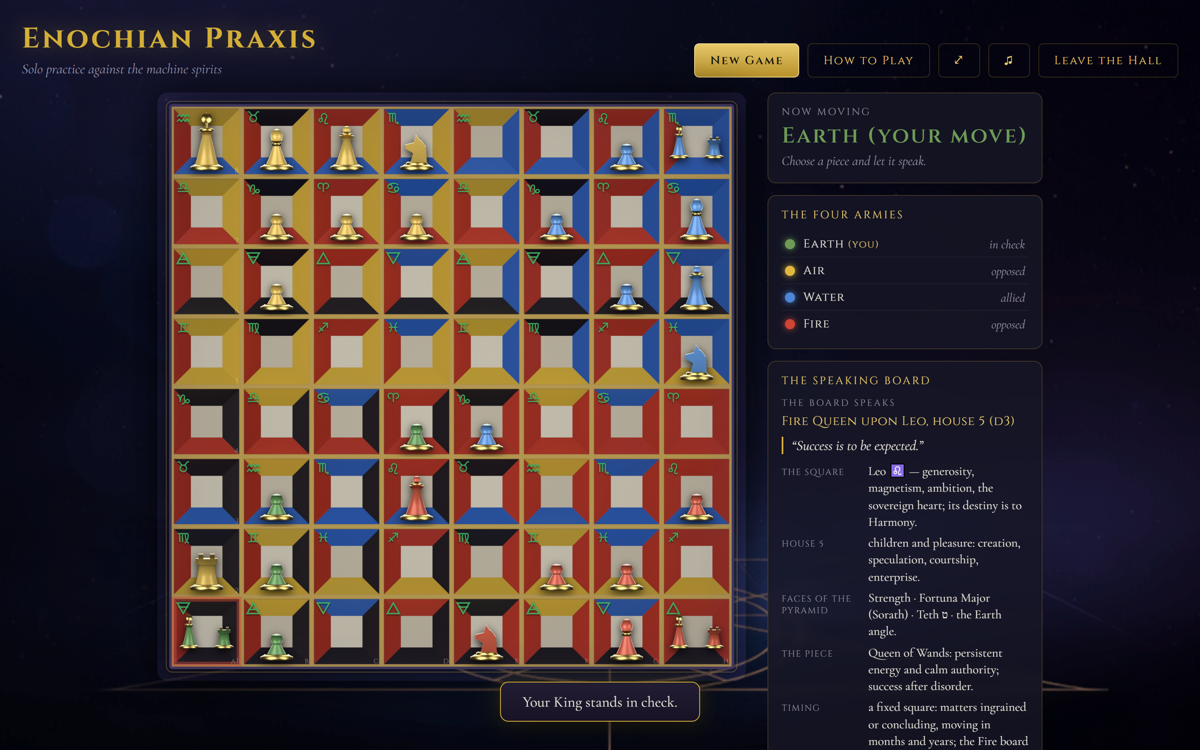
Widdershins: the other direction
Widdershins is the opposite word, the counter-sunwise direction, and it names the alternative rotation. Running the loop the other way gives the order Earth, Fire, Water, Air. Notice that Earth and Water keep their places at the start and middle of the sequence while Air and Fire swap ends. Both directions exist in the published Golden Dawn papers, and both preserve the same essential balance between the two alliances. The deosil order is the one to reach for unless a game agrees otherwise, and it is the order the online game uses by default.
Why the board's element moves first
A game of Enochian chess is played on one of four elemental boards: Fire, Water, Air, or Earth. The board is not just decoration. It sets the tone of the game, and it also decides who opens. The army whose element matches the board takes the first move. On the Fire board, Fire moves first; on the Water board, Water moves first, and so on for Air and Earth. From that opening move, the turn rotates in the chosen direction, so the starting point of the circle shifts to match the board while the direction of travel stays the same. If you want the meaning behind the four boards themselves, the piece on the four elements explains how each one carries its own character.
How the rotation keeps the alliances alternating
Here is the part that makes the whole system click. The four armies are not four independent sides. They are bound into two fixed alliances: Earth with Water on the receptive side, and Air with Fire on the active side. The crucial detail is where the allies sit. Your ally is never next to you. Your ally sits at the corner diagonally opposite yours, across the full length of the board.
Now walk the deosil order around the board and watch which side moves each turn. Earth moves, and Earth is receptive. Air moves next, and Air is active. Water moves, receptive again. Fire moves, active again. Because the two members of each alliance sit on opposite corners rather than adjacent ones, the circle can never land on the same team twice in a row. Every single turn switches sides. Receptive, active, receptive, active, all the way around the loop. The same thing happens under the widdershins order for the same reason. The diagonal seating and the circular turn work together to keep the two teams perfectly interleaved, so neither alliance ever gets two moves before the other replies.
This is why the seating rule matters so much and why it is worth stating plainly: allies are diagonally opposite, never side by side. It is not a cosmetic choice. It is the thing that makes turn order fair. If the allies sat next to each other, the rotation would give one team two moves running, then the other team two, and the balance would collapse. The Golden Dawn design avoids that by threading the alliances through the circle in an alternating pattern.
When two people share the board instead of four, this same rotation is what lets it work. Each person runs a whole alliance and moves one of their two armies each time the turn reaches that corner. Because the turn alternates sides, the two players still trade moves in strict turn, even though each is quietly steering two armies from opposite ends. There is more on that arrangement in the guide to playing with two players.
Feel the rotation for yourself
Reading about the circle is one thing; watching the turn walk around the board is another. Start a free game and let the rotation carry you from corner to corner.
Play NowKeep reading
Turn order is one thread in a larger weave. Once the circle makes sense, look at how the queen uses her strange two-square leap during those turns, or step back and see the game whole through its differences from ordinary chess.