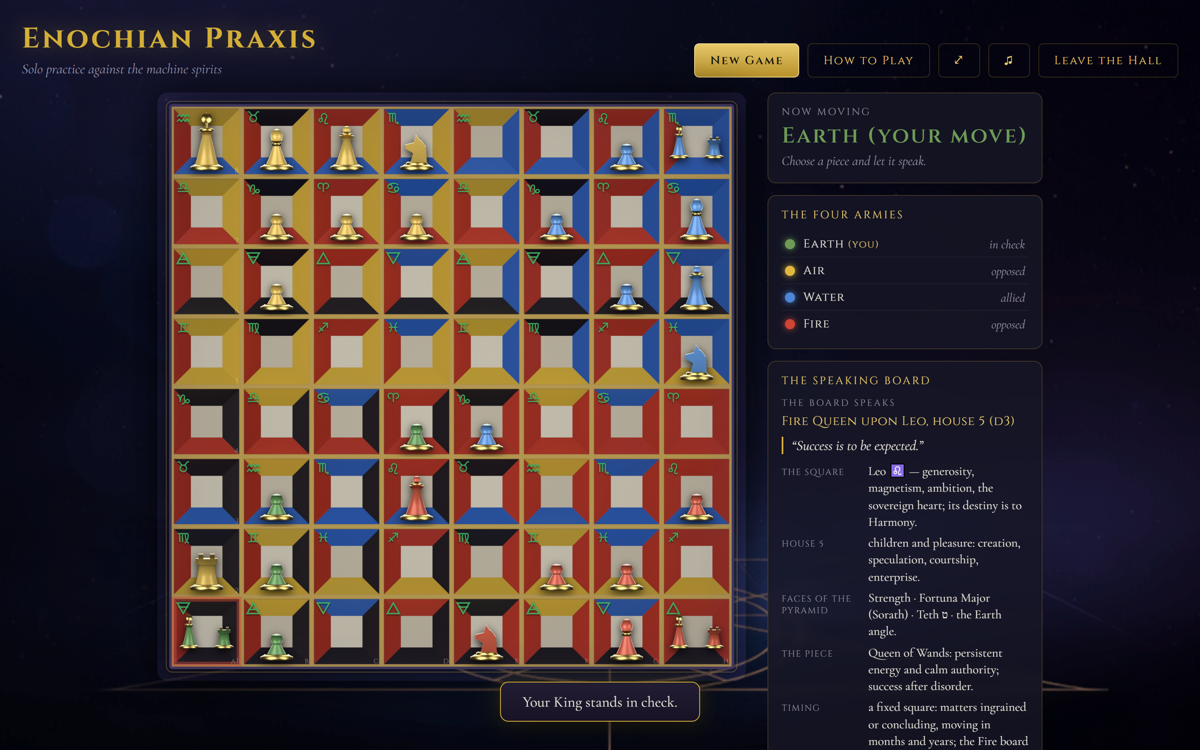
A setting is a fixed opening array. It tells each of the four armies exactly how to line up before play begins: which major piece sits doubled with the King on its throne, and in what order the remaining majors fill the corner. There are eight settings in all, each named for an element, split into two groups of four. One group is used on the Fire and Earth boards; the other is used on the Air and Water boards. Choose a setting and the whole board is arranged for you. Nothing about the setting is invented on the spot, and no army sets up differently from its allies within the same game.
What a setting actually decides
Every army fields the same pieces: one King, four majors (Rook, Bishop, Queen, and Knight), and four pawns. That never changes. What the setting changes is the arrangement of the four majors along the two edges that meet at the army's corner, and, crucially, which of those four shares the throne square with the King at the start. In Enochian chess the King begins doubled: he stands on his corner together with one major piece, the throne partner, so two units occupy that one square until the partner steps off. The setting names that partner and then dictates the sequence of the other three majors running out from the corner.
That single choice ripples outward. Because each pawn stands before one major and belongs to it, moving the majors around also moves which pawn guards which file. The throne pawn belongs to the throne partner rather than to the King, so the setting even decides which piece a promoting corner pawn will become. If you have read about pawns and promotion, you already know how much hangs on which piece owns which pawn. The setting is where that ownership is assigned.
Two groups of four
The eight settings are not interchangeable across every board. Four of them belong to the Fire and Earth boards, the two boards of the active and receptive extremes as the Golden Dawn arranged them. The other four belong to the Air and Water boards. Each of the eight carries an elemental name, so a game is described by naming the board and then the setting used on it. This pairing is why the same physical board can be laid out in more than one way: the Fire board does not have a single legal opening, it has a small set of them, and the players agree on which setting the game will use before the first piece moves.
The point of the split is not decoration. Each elemental board already carries its own symbolic layer, described on the boards page, and the settings that go with it are meant to sit in harmony with that layer. The published Golden Dawn papers, which reached the public mainly through Israel Regardie, laid the settings out this way rather than leaving the opening to taste. When you pick a board and a setting together, you are choosing a complete configuration that the tradition treated as a unit.
Why the same board opens several ways
Modern chess has one starting position. Enochian chess has many, and the reason is the setting. A game on the Fire board with one setting will not look like a game on the Fire board with another: the Queen may begin doubled with the King in one and out on the edge in the next, the Rook may hold a different file, and the pawn that stands ready to promote on the corner belongs to a different piece. Same board, same rules of movement, different opening geography. That variety is deliberate, and it is one of the features that sets the game apart from the chess most people know, as covered in Enochian chess versus regular chess.
Because the throne partner sits doubled with the King, the setting also shapes the earliest tactics. The partner is the piece that steps off the throne to free the King, so which major the setting places there decides who your first mover off the corner will be. Whoever chooses to unstack first, and which piece they free, is an opening decision made possible entirely by the setting. The Queen in particular plays very differently depending on whether she starts on the throne or out among the pawns, because she leaps exactly two squares and jumps over whatever lies between.
Reading a setting in play
You do not have to memorize all eight to enjoy a game. When you sit down, the setting is stated, the board fills in accordingly, and you read it the way you read any opening: note where the Queen and Knight sit, note which pawn guards the corner, and note who the King's throne partner is, because that partner is your first mover off the throne and your fallback for a corner promotion later. Everything else follows the ordinary rules of the pieces. The setting is simply the agreed starting shape, chosen before the clock of play begins.
See a setting come to life
The fastest way to understand the eight settings is to watch one arrange itself and then push the first pawns. Start a free game, pick a board, and let the opening array fall into place.
Play NowKeep reading
Once the pieces are set, the game begins. See what happens next in opening moves, learn how the four armies pair into two alliances, or start from the top with the full rules.