To set up Enochian chess, you pick one elemental board, seat the four armies at its four corners, double each King on its throne with a chosen major piece, line up the remaining majors in the order the setting fixes, and stand each pawn in front of the piece it belongs to. That is the whole job. The layout differs from ordinary chess in a few precise ways, and once you know them the position falls into place. This guide walks through each step so nothing lands on the wrong square.
Step one: choose one board
Enochian chess is played on a single eight-by-eight board, the same grid as ordinary chess. What is different is that four board designs exist, one for each element: Fire, Water, Air, and Earth. A game happens on exactly one of them. You are not stacking or combining boards. You choose the element you want to play, set that board out, and everything else follows on that one surface. If you are new to the boards themselves, the differences between them are covered in the Enochian chess board, explained, but for setup all four boards seat the armies the same way.
Step two: seat the four armies at their corners
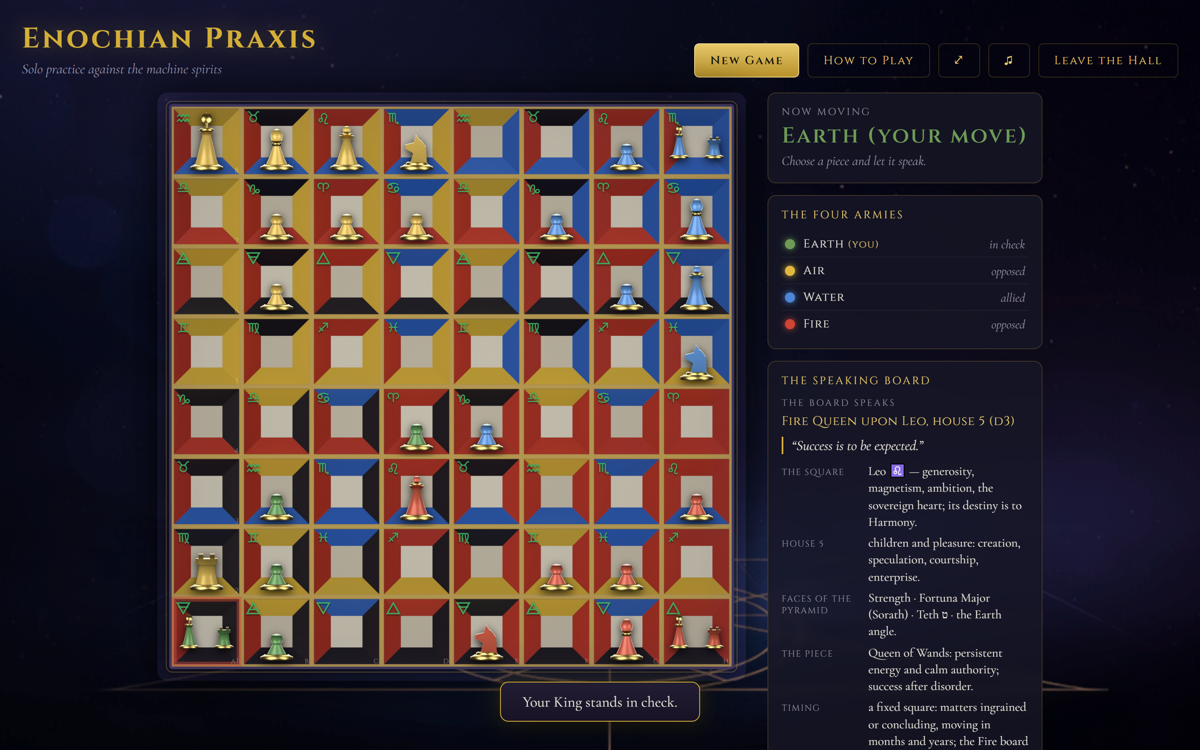
Each corner holds one army. Earth takes a1, Air takes a8, Water takes h8, and Fire takes h1. Keeping the corners straight matters, because the alliances are built into the geometry. Earth and Water are partners, and Air and Fire are partners, which means each ally sits at the corner diagonally opposite its own, never in the corner next to it. If you find yourself placing two allied armies side by side, you have the corners wrong. The reason the pairs face across the diagonal is bound up with how the elements relate, which the four elements of Enochian chess lays out in full.
Each army is nine units: one King, four major pieces (a Rook, a Bishop, a Queen, and a Knight), and four pawns. Four armies of nine put thirty-six units on the board at the opening, so a full setup is crowded near the corners and completely empty through the center.
Step three: double the King on its throne
Here is the step that surprises everyone. The King does not sit alone. At the start each King is doubled on its throne, the corner square, sharing that single square with one major piece called the throne partner. Two units occupy the corner at the opening. Which major joins the King is not fixed once and for all; it is decided by the setting you are using, which we come to next. The King is the one piece you never place a pawn in front of directly: the pawn on the throne file belongs to the throne partner, not to the King. If you want the King's role spelled out beyond setup, see the King in Enochian chess.
Step four: order the majors by the setting
The four major pieces do not have one fixed home the way chess pieces do. Their order along the army's back edge is set by the opening array you choose, called a setting. There are eight settings, each named for an element and grouped into two families: four are used on the Fire and Earth boards, and four are used on the Air and Water boards. The setting you pick does two things at once. It names which major shares the throne with the King, and it fixes the order of the other three majors as they stand out from the corner. Pick your setting before you place the majors, place the throne partner on the corner with the King, then set the remaining three in the order that setting gives. The full family of arrays is laid out in the eight settings if you want to see each one.
Step five: place the pawns before their owners
Every pawn belongs to one particular piece and stands directly in front of it. There is a Rook's pawn, a Bishop's pawn, a Queen's pawn, and a Knight's pawn, each on the square ahead of its own major. The throne pawn belongs to the throne partner sharing the corner, never to the King. This ownership is not just bookkeeping. When a pawn reaches the far edge it normally promotes to the very piece it belongs to, so a Queen's pawn becomes a Queen and a Knight's pawn becomes a Knight. Getting the pawns lined up in front of the right pieces now is what makes promotion make sense later. The details of that system are in pawns and promotion in Enochian chess.
Point the pawns the right way as you place them. Each army marches toward the far edge of the board: Earth toward file h, Water toward file a, Fire toward rank 8, and Air toward rank 1. That far edge is the army's promotion edge. Because the four armies march in four different directions, the pawns do not all face the same way as they would in ordinary chess. Think of each corner army as pushing straight across the board toward the side opposite its own.
A quick check before you start
Once everything is down, run through the position. Four corners filled, thirty-six units total, each King doubled with a major on its throne, the three remaining majors in the order your setting names, a pawn in front of every major including the throne partner, and every army facing its own far edge. If all of that is true, the board is set. From there the board's own element opens play and the turn rotates around the corners. The beginner's guide gives a gentle plan for that first game.
Common setup questions
How do you set up an Enochian chess board?
Choose one of the four elemental boards and play on it alone. Seat the four armies at the corners: Earth at a1, Air at a8, Water at h8, Fire at h1. On each throne place the King doubled with its throne partner, then set the other three major pieces in the order the chosen setting dictates, and stand each pawn on the square in front of the piece it belongs to.
Which corner is which element in Enochian chess?
Earth takes a1, Air takes a8, Water takes h8, and Fire takes h1. Earth and Water are allies and Air and Fire are allies, so each pair sits at diagonally opposite corners rather than side by side.
Why are two pieces on the King's square at the start?
The King begins doubled on its throne with one major piece, called the throne partner. Two units share the corner square at the opening, and which major joins the King is decided by the setting you are using. The pawn in front of the throne belongs to the throne partner, never to the King.
See a board set for you
The free online game lays out the corners, the doubled Kings, and the setting for you, so you can study a correct starting position without placing a single piece by hand.
Play NowKeep reading
With the board set, the next thing to learn is how the pieces travel, since several of them do not move the way their chess names suggest. Start with the full rules, then look at how the pieces move to see why the Queen leaps and the pawns never take a double step.