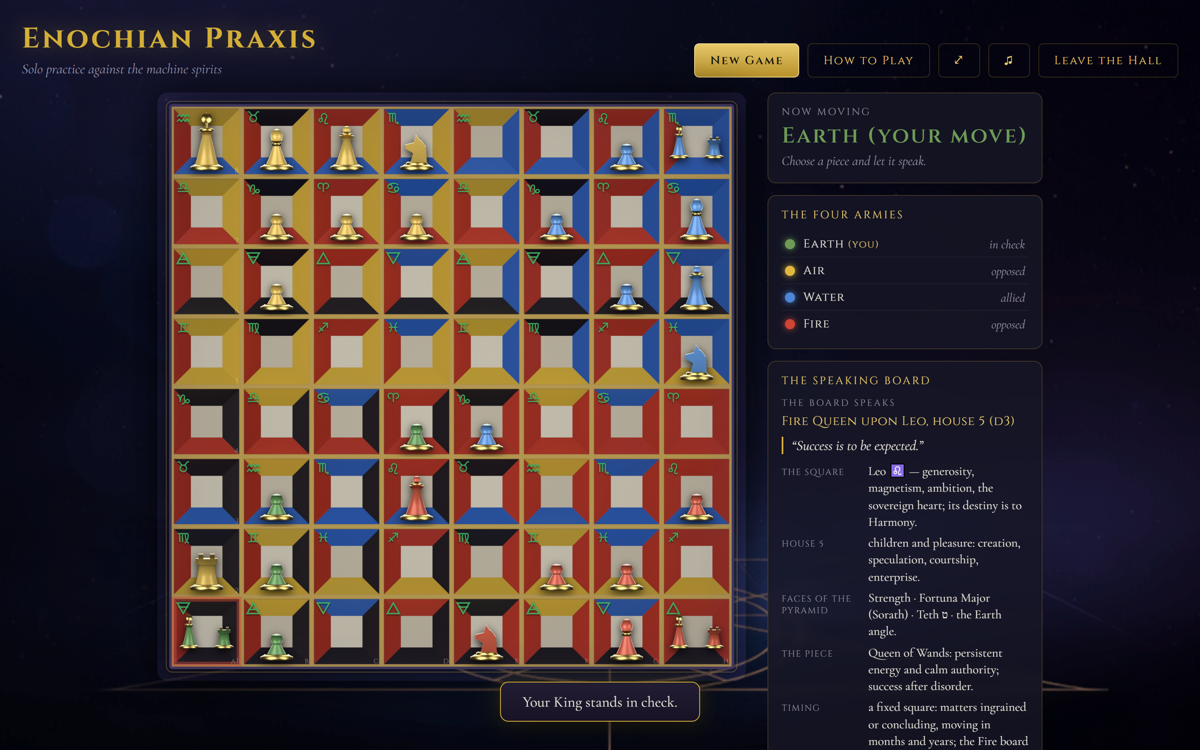
The tarot enters an Enochian game on two separate channels, and confusing them is the most common mistake. The court cards belong to the pieces, one court rank for each kind of man. The tarot trumps, the twenty-two Major Arcana, belong to the squares. They are a fixed attribution painted onto the board itself, the same on every game, and they never move. Understanding the trumps as a layer of the terrain, rather than a property of the pieces, is the key to reading a finished position well.
Two channels, one board
Start with the split. The Golden Dawn hung a whole table of correspondences on this game: every piece answers to a card, and every square answers to a set of symbols. On the piece side, the ranks map to the tarot court, and that mapping is published on the pieces page: the King is an Ace, the Queen a Queen, the Bishop a Prince, the Knight a Knight, the Rook a Princess, each in the suit of its element. That is the moving half of the tarot. It walks around with the army. The trumps are the still half. They stay fixed to their squares no matter who steps on them, so the same trump greets whichever piece arrives.
You can see why the distinction matters. If you treat a trump as something a piece carries, you will double-count meanings and lose track of what belongs to whom. Keep the two channels apart and each move reads cleanly: the piece brings its court card, the square offers its trump, and the two meet. For the fuller picture of how the court cards and suits sit inside the armies, the companion piece on Enochian chess and the tarot lays out that side in detail. This article stays with the squares.
Where the trumps come from
The trumps are not sprinkled onto the board at random. The Golden Dawn tied each Major Arcana card to a sign of the zodiac, a planet, or an element, and the squares of the board carry those same astrological attributions. So the trump on a square arrives with its sign or planet: a square governed by a given sign holds the trump the order assigned to that sign, and the same holds for the planetary and elemental trumps. The zodiacal side of this is its own subject, covered in the article on the zodiac on the board, but the short version is that the trumps ride in on the zodiac. Where the sign goes, its card goes.
This is why the trump layer is stable and learnable. It is not a fresh deal each game the way a spread is. It is a permanent map. The published Golden Dawn papers set the attributions once, and every board built to that pattern carries them in the same places. Each square is drawn as a small pyramid seen from above, and its four faces bear its attributions, so the trump is there in the paint, waiting to be read.
How a trump colors a reading
A finished game can be read as an oracle, and the trumps are what give the reading its weather. When a piece settles on a square, you have a court card standing on a trump. The court figure names an actor or a force: a person, a temperament, a way of acting. The trump underneath names the larger situation that actor has stepped into. The Major Arcana are the big movements of a tarot deck, the archetypes and turning points, so a trump under a piece raises the stakes of that square. A quiet court card on a heavy trump reads very differently from the same card on a gentler one.
Read this way, the board is a spread you build by playing rather than by shuffling. The pieces are drawn cards that keep moving until the game ends, and the squares are a fixed field of trumps they pass across. Because there is no checkmate in this game and a captured King's army freezes in place, the pieces that end the game locked in position stay as fixed pairings, each court card pinned to the trump beneath it. The closing spread is the sum of those pairings, some still active and some frozen, and the trumps tell you what kind of story the pieces have been moving through.
Reading the trumps well
A few habits keep the trump layer honest. First, resist the urge to invent per-square meanings from memory. The attributions are fixed, and the reliable move is to read the trump the board actually assigns to a square rather than the one you wish were there. The worked walkthrough on the divination page shows the layer in action on real squares. Second, weigh the trumps against the other attributions each square carries. The Major Arcana share the board with the zodiac and with other symbol sets, and a strong reading balances them instead of leaning on the trump alone.
Third, hold the trump layer next to the game itself. The trumps do not change how a piece moves or which squares matter tactically; the leaping Queen and the sliding Bishop obey the rules whatever card sits under them. But once a game is over, the trumps turn a record of moves into a field of meaning. That double life, a strict game on top of a fixed oracle, is the whole point of the design. If you are still getting comfortable with the game half, the primer on Enochian chess for beginners is the place to start, and the trump layer will make more sense once the moves feel natural.
See the trumps under your pieces
The fastest way to understand the trump layer is to make a move and watch a court card land on a Major Arcana square. Start a free solo game and let the board show you the pairing.
Play NowKeep reading
Once the trumps feel familiar, follow the other symbol layers into the same squares and see how a full game closes into a single oracle. The pieces, the zodiac, and the divination walkthrough each open a different door onto the same board.