Capricorn belongs to Earth, and on an Enochian board that tie is the first thing to hold in mind. Every square carries a sign of the zodiac as one face of its meaning, and each sign answers to an element. Capricorn is Earth, so it speaks in the same register as the Earth army seated at corner a1, the receptive, holding force paired with Water. The sign does not sit on any one square you need to memorize. It runs through the whole board as part of the divinatory layer, and what it adds is a particular flavor: patience, structure, and the long climb toward a result that will not be rushed.
Cardinal Earth, the sign that builds
The zodiac sorts its twelve signs by element and by mode, and Capricorn is cardinal Earth. Cardinal signs begin things; Earth signs make things solid. Put those together and you get the builder of the wheel, the sign that starts a project and means to finish it, stone by stone. That is a different temper from the other two Earth signs. Where one is careful and one is fixed, Capricorn is the one that sets a goal at the top of the hill and climbs. The old glyph is a goat, and often a sea-goat, an animal at home on both the mountain and the deep water. That double footing is worth noticing, because on the board Capricorn's element ties it to Earth while its ambition reaches upward.
On an Enochian board this matters because the signs are not decoration. They are one layer of a full system printed onto the squares, alongside the tarot trumps, the Hebrew letters, the geomantic figures, and the astrological houses. If you have read how the zodiac sits on the board, you already know the principle: a piece landing on a square lands on that square's sign, so a game is also a walk through the wheel. Capricorn is one of the twelve voices in that walk, and it is an Earth voice, steady and slow to speak but hard to argue with once it does.
Kin to the Earth army
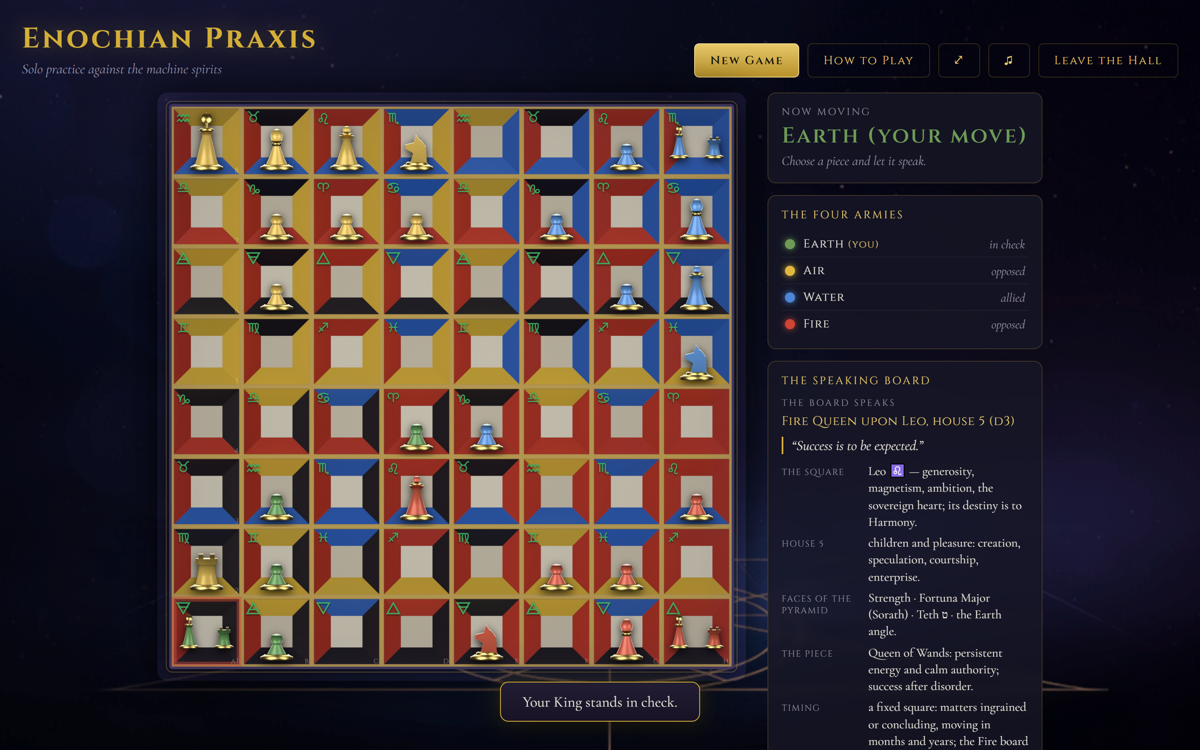
The four armies each carry an element: Earth at a1, Air at a8, Water at h8, Fire at h1. Because Capricorn is Earth, it resonates with the Earth army in the same way the element itself does. This is a resonance, not a placement. Capricorn does not command Earth's pieces or live in Earth's corner. It shares Earth's nature, and the nature of that army is receptive. Earth plays with Water against the active pair of Air and Fire, and the two allies sit diagonally opposite, Earth at a1 and Water across the full diagonal at h8, never side by side. The receptive side wins by holding and outlasting rather than by striking first, and Capricorn's discipline is a good description of how that game feels from the inside.
Think of what Capricorn asks for: structure, patience, a plan carried out over time. That is the receptive temperament almost exactly. An Earth player builds a position, keeps it sound, and waits for the pressing armies to overreach. Capricorn adds ambition to that patience. It is not content to merely survive; it climbs. So when the sign colors a reading, it tends to point at goals that are reached the slow, honest way, through work that stacks up rather than luck that arrives. If you want the fuller portrait of the army it echoes, the Earth board lays out that grounded, holding character in full.
How Capricorn colors a reading
A finished Enochian game can be read as an oracle, because the final position is a scatter of pieces across signs, houses, and the other attributions the squares carry. When Capricorn turns up in that scatter, it flavors whatever it touches with its own qualities. A piece resting on a Capricorn square carries a note of commitment and long effort, the sense of a thing being built to last. Fought-over Capricorn ground reads as a contest over structure or standing, over who holds the high, hard-won position. This never overrides the mechanics of the game. It runs in parallel with them, one more thread the reader picks up after the last move.
Because Capricorn is cardinal, it also carries the note of a beginning that means to endure. A cardinal sign starting something is a project laid down with intent, not a passing impulse. In a reading that can mark the point where a plan takes root, especially a plan on the receptive, Earth-flavored side of the question. And because Capricorn is often drawn as the sea-goat, it can hold a quiet second meaning: the ambition that climbs is fed by depths below, the private resources a person draws on to keep going. A reader weighs these against the other layers rather than in isolation, letting the sign temper the trump and the house it shares its square with instead of shouting over them.
Where the sign fits the whole board
Capricorn is one voice among the twelve, and one layer among several. We keep this at the level of the system on purpose: which exact square shows Capricorn is something you learn by looking at a real board, not from a memorized list, and it changes nothing about how the pieces move. What is worth carrying away is the tie. Capricorn is cardinal Earth, so it belongs to the same element as the Earth army, and it lends the board its own steady, upward-reaching weight. Read enough games and you start to feel where the Earth signs cluster and what they are saying about the slow, structural side of the question in front of you. To see the sign in its full setting, alongside the houses and the other Earth signs, walk through a complete reading and note how one Earth voice among many gives a position its ground.
Feel the Earth game for yourself
Play a free game, take the receptive side, and watch how a patient, building position reads at the end. Capricorn's temper is easiest to recognize once you have held that kind of ground.
Play NowKeep reading
Capricorn is one Earth voice on a board that also carries the other three elements. Step back to the four elements and their alliances to see how Earth pairs with Water against the active side, then follow the zodiac overview to see the rest of the wheel in its place.