Enochian chess raises the same questions for nearly everyone who meets it, and most of them deserve a straight answer rather than a chapter. Four armies share one board, the Queen jumps, whole armies freeze when their King falls, and the finished game can be read as an oracle: it is different enough from modern chess that guessing gets you nowhere. Below are the questions we hear most often, answered directly. Where a fuller page exists, the answer links to it.
What is Enochian chess?
Enochian chess is a four-handed chess variant created within the Hermetic Order of the Golden Dawn, the late 19th-century magical society. Four elemental armies, Fire, Water, Air, and Earth, begin at the corners of a standard eight-by-eight board, bound into two fixed alliances. The order taught it to advanced members as a game, a study instrument, and a tool of divination. Our Learn page gives the full plain-language introduction.
Who invented Enochian chess?
It grew up inside the Hermetic Order of the Golden Dawn and was taught to the order's advanced members. Most of what the public knows arrived through the published Golden Dawn papers, which Israel Regardie brought into print. The history page follows the story from Elizabethan angel magic to the game you can play today.
Why is it called Enochian?
The name honors the system of Enochian magic recorded in the 1580s by John Dee, mathematician and adviser to Elizabeth I, and his partner Edward Kelley. Their angelic workings produced the Enochian language and the four elemental tablets called the Watchtowers. The Golden Dawn built the symbolism of its four chessboards on those tablets, and the game took the name with them.
Is Enochian chess the same as Rosicrucian chess?
Yes, the two names describe one game. The Golden Dawn drew on Rosicrucian tradition, and its inner order was Rosicrucian in framing, so the same four-handed elemental chess circulates under both labels. Whichever name you meet, the armies, the alliances, and the rules are identical.
How many players does Enochian chess need?
Anywhere from one to four. Earth and Water form one fixed alliance and Air and Fire the other, with each ally seated at the corner diagonally opposite its partner, so the seats divide cleanly: one player can run all four armies, two can each hold an alliance, three can split so one person holds an allied pair, and four can each command a single element. Allies never capture each other and never give check to each other; an alliance stands or falls as one.
Can two people play Enochian chess?
Yes, and it is one of the most common ways to play. Each player takes one full alliance and moves both of its armies as the turn rotates around the board, so you are timing two forces from diagonally opposite corners. We cover the rhythm of it in our guide to playing with two players.
Is there checkmate in Enochian chess?
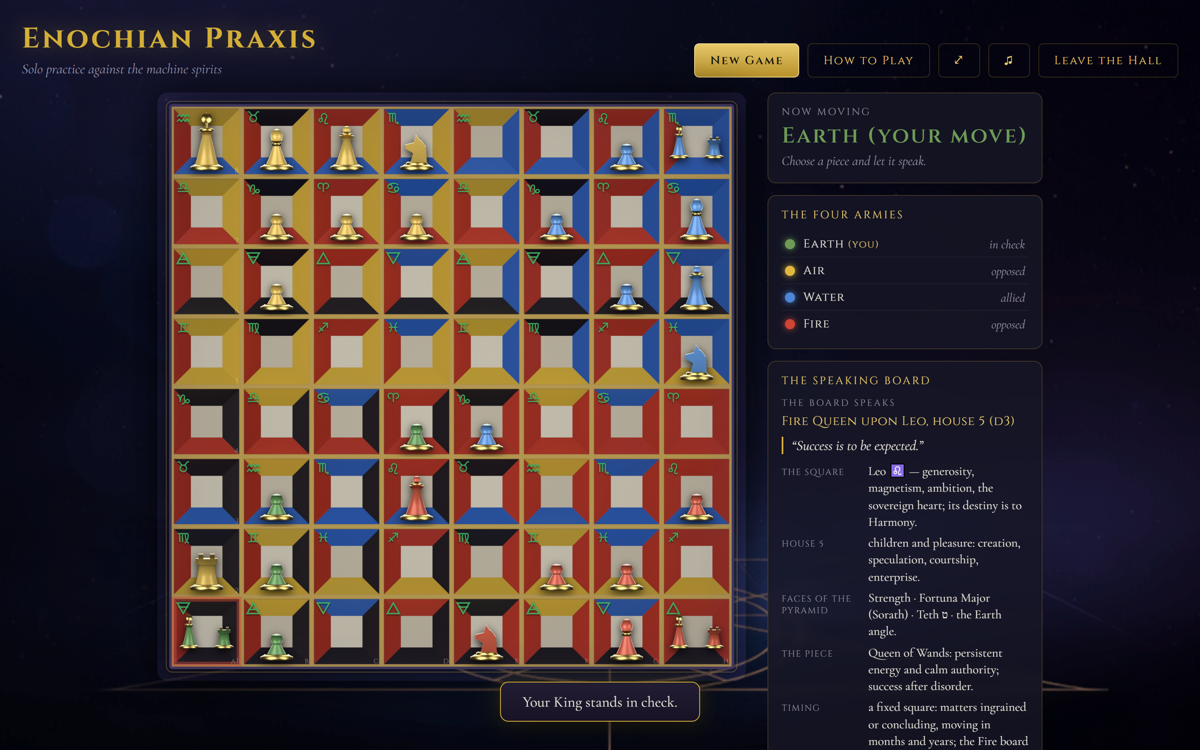
No. Kings in Enochian chess are captured outright, like any other piece. Check still matters: the published Golden Dawn papers set a strict ladder for answering it, beginning with the rule that a checked King who has a safe square must move to it. The full sequence, down to the point where nothing can help and the King may simply fall, is on our How to Play page.
How do you win at Enochian chess?
An alliance wins the moment both enemy Kings have been taken. Allies win and lose together, so it makes no difference which partner lands either capture. Draws exist too: a hundred straight moves with no capture and no pawn advance, only the four Kings left on the board, one alliance reduced to two bare Kings, or a board where no army can move all end the game in balance. What the win condition does to your priorities is the subject of How Do You Win at Enochian Chess?
What happens when a King is captured?
When an enemy captures a King, that King's entire army freezes where it stands. Frozen pieces become inert terrain: they cannot move, cannot be captured, they block sliding pieces, and they threaten nothing. Two doors lead back into the game: an ally may capture a checked King first, a rescue that keeps his army alive under the ally's command, and a King who reaches his ally's throne takes command of that army and wakes it if it was frozen.
How does the Queen move in Enochian chess?
She leaps exactly two squares in any of the eight directions, jumping over whatever stands between. She can never move a single square, and nothing can block her, which makes her a short-range leaper rather than the long-range queen of modern chess. Every piece's movement is laid out on the pieces page.
Do pawns promote in Enochian chess?
Yes, with two distinctive twists. A pawn promotes on reaching the far edge in its marching direction, but only after its army has lost at least one pawn; a pawn arriving early waits on the edge, still a pawn, and promotes automatically the moment its army loses one. Each pawn also belongs to the major piece it starts in front of and normally becomes that piece, so the Queen's pawn makes a Queen and the Rook's pawn a Rook. An army cut down to its last pawn earns an exception: that privileged pawn may choose its promotion piece.
What are the four boards?
Fire, Water, Air, and Earth: four elemental versions of the same eight-by-eight battlefield. A game is played on one of them, and the board's own element moves first, so Fire opens on the Fire board. Each board carries the symbolism of its element, drawn from the Enochian tablets. Meet all four on the boards page.
Is Enochian chess hard to learn?
Less hard than it looks. Most pieces move exactly as they do in modern chess, and the genuinely new rules, the leaping Queen, the frozen armies, the delayed promotion, are each simple on their own. The real learning curve is coordination: thinking together with a partner army seated at the diagonally opposite corner. We wrote a full answer in Is Enochian Chess Hard to Learn?
Is Enochian chess really used for divination?
Yes, divination was part of its design from the start. Every square carries attributions, among them zodiac signs and tarot trumps, so a finished game can be read as an oracle. On this site, every game ends with a divination reading of the final position. The divination page goes deeper.
Is Enochian chess connected to tarot?
Yes, through the court cards. Each piece corresponds to a tarot court rank: the King to the Ace, the Queen to the Queen, the Bishop to the Prince, the Knight to the Knight, and the Rook to the Princess. The four armies match the four suits, Fire with Wands, Water with Cups, Air with Swords, and Earth with Pentacles. The full table lives on the pieces page.
Where can you play Enochian chess?
Right here, in your browser. enochianpraxis.com runs the complete game on desktop and mobile with no download, and a fullscreen board option keeps play comfortable on small screens. You can play solo against the computer or live online with two, three, or four players, and empty seats can be run by the computer so a game is never short a side. Play Enochian Chess Online gives the full tour.
Is Enochian chess free to play?
Yes, completely. Solo play against the computer is free at all three strengths (Novice, Adept, Magus), with autosave, and online multiplayer is free as well. So are all the learning pages, from the rules to the glossary.
Do you need an account to play?
Not for solo play. You can open the site and start a game against the computer immediately, and autosave holds your position without a sign-in. Online multiplayer requires a sign-in so the server can seat players, validate every move, and show the same live board to everyone.
Is there a physical Enochian chess set?
Not one you can order off a shelf. Ready-made sets are rare, so players who want a physical game usually build or print their own boards and pieces. You do not need one to play: the browser game is free and carries all four elemental boards.
The fastest answer is a game
Ten minutes at the board settles more questions than any FAQ. Start a free solo game against the computer, no account needed, and see the four armies move for yourself.
Play NowKeep reading
Start with what Enochian chess is, walk through the full rules, or follow our beginner's guide into your first game.